Free Consultation

LD Articles, Resources and Success Stories

The Lifelong Impact of Reading: Strong Skills at 7 Shape Success at 70

Research shows that reading ability at age seven predicts more than school success — it shapes income, career, and wellbeing decades later. A landmark study of 17,000 people found that stronger early literacy skills led to higher earnings and better life outcomes. Reading is not just an academic milestone; it is the foundation for lifelong opportunity.

Read more...

Reading Skills: 8 Types, 4 Stages, 10 Strategies

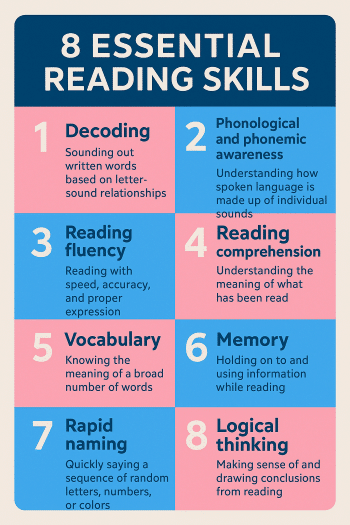
Reading looks simple — but it’s one of the brain’s most complex tasks. This guide breaks down the skills children need to read, what can go wrong, and how to help. Includes a checklist, 8 core skills, 4 stages of development, and 10 proven strategies.

Read more...

40 Reasons Why Reading Isn’t Just Important – It’s Essential

Reading may look like a quiet, passive act — a person, a book, and a cozy chair. However, beneath that stillness is a cognitive fireworks show. Reading lights up multiple brain systems, builds our inner world, and directly shapes our academic, social, and professional success. Here are 40 evidence-based reasons why reading isn’t just important — it’s essential.

Read more...

The Adaptable Mind

John Zerilli’s book, The Adaptable Mind: What Neuroplasticity and Neural Reuse Tell Us about Language and Cognition, asks a big question: How does the brain really work? Especially: Does it have special parts for things like language, or does it reuse the same parts for many different things?

Read more...

Why Computer-Based Reading Often Falls Short for Struggling Readers

While educational technology can offer exciting tools, it’s essential to recognize its limitations when used inappropriately — especially for children with reading disabilities. Here’s why computer-based reading often doesn’t work unless carefully designed and supported.

Read more...

Surface Dyslexia in Chinese

Weekes and Chen (1999) report the case of LJG, a Chinese-speaking patient with anomia and semantic impairment following a left hemisphere cerebrovascular accident.

Read more...

Correlation Between Vocabulary and Reading Comprehension

Vocabulary and reading comprehension are tightly interwoven elements of literacy development. Research across multiple disciplines consistently demonstrates a strong, positive correlation between students’ vocabulary knowledge and their ability to comprehend written text.

Read more...

Correlation Between Vocabulary and Phonological and Phonemic Awareness

Vocabulary, phonological awareness, and phonemic awareness are foundational components of early language and literacy development. While each is a distinct skill, research increasingly supports a dynamic, reciprocal relationship among them, particularly during the early years of reading acquisition.

Read more...

Interactions Between Short-Term and Long-Term Memory in the Verbal Domain

The book "Interactions Between Short-Term and Long-Term Memory in the Verbal Domain" by Annabel Thorn and Mike Page explores how short-term memory (STM) and long-term memory (LTM) work together in verbal tasks such as speaking, listening, and remembering language.

Read more...

Developmental Dyscalculia: Fresh Perspectives

The 2013 editorial Developmental Dyscalculia: Fresh Perspectives by Szűcs and Goswami offers a comprehensive review of theoretical and practical issues in understanding and diagnosing developmental dyscalculia (DD).

Read more...

Ten Myths in Special Education

In an insightful article, "Ten Faulty Notions About Teaching and Learning That Hinder the Effectiveness of Special Education,” William L. Heward critiques ten commonly held beliefs about teaching and learning that hinder effective instruction in special education.

Read more...

Teaching Reading: 8 Facts You Should Know

Reading is a fundamental skill, and getting it right early can make all the difference to a child’s future success. Here are eight facts about teaching reading that you should know.

Read more...
Contact Us