
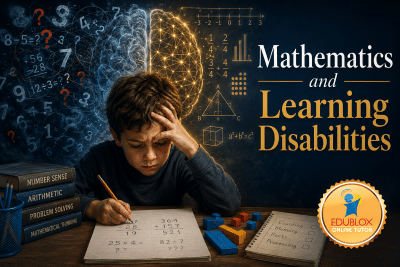
David C. Geary’s 2004 article, “Mathematics and Learning Disabilities,” remains one of the landmark papers in dyscalculia research because it helped organize many scattered findings into a coherent understanding of mathematical learning disabilities.
Key findings from the study
Geary argued that dyscalculia is not simply “being bad at math,” but involves underlying memory and cognitive deficits that interfere with learning mathematical concepts and procedures. He estimated that between 5% and 8% of school-age children experience some form of mathematics learning disability.
One of the paper’s major contributions was distinguishing between children who struggle due to poor instruction and those with genuine cognitive deficits that affect mathematical learning. Geary emphasized that persistent difficulties across several years are more likely to indicate a true learning disability.
The article identified several common characteristics of learners with dyscalculia. These include difficulties with counting principles, frequent counting errors, immature problem-solving strategies, heavy reliance on finger counting, and poor retrieval of basic arithmetic facts from long-term memory. Many children continue using developmentally immature strategies long after their peers have shifted to faster mental methods.
Cognitive deficits behind dyscalculia
Geary highlighted the importance of working memory in mathematics. Children with dyscalculia often struggle to hold and manipulate information while solving problems, leading to mistakes such as losing track during counting, misaligning numbers, or making errors in carrying and borrowing.
A particularly influential aspect of the paper was Geary’s proposal of three subtypes of mathematics learning disabilities:
- a procedural subtype involving immature strategies and sequencing difficulties,
- a semantic memory subtype involving difficulty retrieving math facts, and
- a visuospatial subtype involving problems representing and organizing mathematical information spatially.
The paper also explored possible neurological contributions to dyscalculia, suggesting that difficulties may involve disrupted functioning in brain systems responsible for attention, working memory, language processing, inhibition, and visuospatial processing.
Importantly, Geary concluded that dyscalculia is complex and multifaceted. Different learners may exhibit distinct patterns of strengths and weaknesses, underscoring the need for individualized assessment and intervention rather than a one-size-fits-all approach.