
For as long as there have been schools, there have been children who struggled to learn.
In the past, children who failed at school were often labeled lazy, uninterested, or unintelligent. Today, we know that a variety of learning disabilities, developmental disorders, and processing difficulties can make learning more challenging than expected.
Understanding these conditions is the first step toward getting the right help. While each condition affects learning differently, early identification and appropriate intervention can make a significant difference.
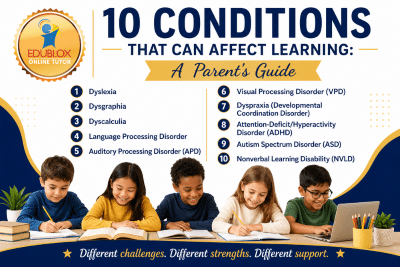
Below are ten common conditions that can affect learning and academic performance.
1. Dyslexia
Dyslexia is the most common learning disability and affects the development of reading, spelling, and written language skills.
Children with dyslexia often struggle to decode unfamiliar words, develop reading fluency, spell correctly, and build the automatic word recognition needed for effortless reading. As a result, reading comprehension may also suffer.
Researchers now understand that dyslexia is closely linked to difficulties in phonological processing, rapid automatized naming (RAN), and orthographic processing. These weaknesses can make it harder to develop orthographic mapping—the process through which written words become permanently stored for fast, automatic recognition.
Common signs include:
- Slow or inaccurate reading
- Difficulty sounding out unfamiliar words
- Poor spelling
- Avoidance of reading
- Difficulty remembering sight words
- Difficulty reading aloud
- Reading that remains effortful despite practice
With appropriate intervention, many children with dyslexia make significant progress and become confident, successful readers.
2. Dysgraphia
Dysgraphia is a learning disability that affects writing. It can interfere with handwriting, spelling, sentence structure, and the ability to express thoughts clearly in writing.
Writing is a complex skill that requires integrating language, memory, attention, fine-motor coordination, and visual processing. When one or more of these underlying skills are weak, writing can become slow, frustrating, and laborious.
Children with dysgraphia may struggle to form letters correctly, organize their ideas on paper, remember spelling patterns, or keep up with classroom writing demands. As a result, written work often does not reflect their true knowledge or understanding.
Common signs include:
- Poor or illegible handwriting
- Slow writing speed
- Difficulty spacing letters and words
- Frequent spelling errors
- Difficulty organizing thoughts in writing
- Incomplete written assignments
- Avoidance of writing tasks
Because writing occupies a substantial portion of the school day, dysgraphia can significantly impact academic performance. With appropriate intervention and support, however, children can improve their writing skills and gain confidence in expressing themselves in writing.
3. Dyscalculia
Dyscalculia is a learning disability that affects the understanding and use of numbers and mathematical concepts.
Children with dyscalculia often struggle to develop number sense—the intuitive understanding of numbers, quantities, and numerical relationships that forms the foundation of mathematics. As a result, learning basic math skills can be much more difficult than expected for their age and intelligence.
Difficulties may begin with counting and recognizing numbers and later extend to learning math facts, understanding place value, performing calculations, telling time, handling money, and solving mathematical problems. Many children with dyscalculia require considerably more repetition and explicit instruction than their peers to achieve mathematical competence.
Common signs include:
- Difficulty learning to count
- Poor number sense
- Difficulty learning and recalling basic math facts
- Weak mental math skills
- Confusion about place value
- Frequent calculation errors
- Difficulty telling time or handling money
- Anxiety or avoidance of mathematics
Because mathematics builds upon previously learned concepts, early difficulties often compound over time. However, with appropriate intervention, explicit instruction, and targeted support, children with dyscalculia can make substantial progress and develop greater confidence in their mathematical abilities.
4. Language Processing Disorder
Language Processing Disorder (LPD) affects a person’s ability to understand, interpret, and use spoken language effectively. It is not a hearing problem; rather, it involves difficulties processing language once it has been heard.
Some children struggle to understand what others are saying (receptive language difficulties), while others have trouble expressing their thoughts clearly in words (expressive language difficulties). Many experience challenges in both areas.
Because language plays a central role in classroom learning, language processing difficulties can affect reading, writing, following instructions, participating in discussions, and understanding new concepts.
Common signs include:
- Difficulty following verbal instructions
- Limited vocabulary compared to peers
- Problems finding the right words when speaking
- Difficulty understanding complex sentences
- Frequent misunderstandings during conversations
- Trouble retelling stories or explaining ideas
- Difficulty participating in classroom discussions
Language processing difficulties can significantly impact academic performance and social interactions. However, with appropriate intervention and support, children can improve their language skills and become more effective communicators.
5. Auditory Processing Disorder
Auditory Processing Disorder (APD) affects the brain’s ability to interpret and make sense of sounds. Children with APD usually have normal hearing, but they struggle to process, organize, and understand what they hear.
Listening involves more than simply hearing sounds. The brain must distinguish between similar sounds, recognize patterns, remember auditory information, and attach meaning to spoken language. When these processes are inefficient, learning can become significantly more challenging.
Because spoken language is central to classroom instruction, APD can affect reading, spelling, language development, and academic performance.
Common signs include:
- Difficulty following spoken instructions
- Frequently asking for repetition
- Trouble understanding speech in noisy environments
- Difficulty distinguishing similar sounds
- Problems remembering verbal information
- Appearing not to listen or pay attention
- Difficulty learning phonics and spelling
- Delayed responses to verbal questions
Children with APD often perform better when information is presented visually as well as verbally. With appropriate intervention and support, they can develop more effective listening, language, and learning skills.
6. Visual Processing Disorder
Visual Processing Disorder (VPD) affects the brain’s ability to interpret and make sense of visual information. It is not caused by poor eyesight. Children with VPD may see clearly, yet struggle to process what they see accurately and efficiently.
Visual processing plays an important role in reading, writing, spelling, mathematics, and many everyday classroom activities. Difficulties can occur in areas such as visual discrimination, visual memory, spatial awareness, and recognizing patterns and relationships.
As a result, tasks that seem simple to others may require considerable effort and concentration.
Common signs include:
- Difficulty distinguishing similar letters, numbers, or shapes
- Confusion between letters such as b, d, p, and q
- Problems copying from the board
- Poor visual memory
- Difficulty locating information on a page
- Problems with spatial awareness and directionality
- Losing place while reading
- Difficulty with puzzles, maps, charts, and diagrams
Visual processing difficulties can affect reading fluency, spelling, handwriting, and mathematics, as well as overall academic performance. With appropriate intervention and support, children can develop more efficient visual processing skills and become more confident learners.
7. Dyspraxia (Developmental Coordination Disorder)
Dyspraxia, formally known as Developmental Coordination Disorder (DCD), is a neurodevelopmental condition that affects motor planning, coordination, and the ability to carry out skilled movements. It is not related to intelligence, but it can make everyday tasks more difficult.
Children with dyspraxia often struggle to plan, organize, and execute movements smoothly and efficiently. Difficulties may affect both fine-motor skills, such as handwriting and using scissors, and gross-motor skills, such as running, jumping, catching a ball, or participating in sports.
Because many school activities require coordination and organization, dyspraxia can significantly impact academic performance and self-confidence.
Common signs include:
- Clumsiness and frequent accidents
- Poor balance and coordination
- Difficulty learning new motor skills
- Poor handwriting
- Difficulty using scissors, buttons, or shoelaces
- Problems with sports and playground activities
- Difficulty organizing tasks and materials
- Delayed achievement of developmental milestones
Children with dyspraxia often need more time and practice to master motor tasks than their peers. With appropriate support, occupational therapy, and targeted intervention, they can improve their coordination, independence, and confidence.
8. Attention-Deficit/Hyperactivity Disorder (ADHD)
Attention-Deficit/Hyperactivity Disorder (ADHD) is a neurodevelopmental condition that affects attention, self-regulation, and executive functioning. Although ADHD is not a learning disability, it can have a significant impact on learning and academic performance.
Children with ADHD often struggle to maintain focus, control impulses, stay organized, and manage their time effectively. As a result, they may know the material but have difficulty consistently demonstrating what they know.
ADHD is typically classified into three presentations: predominantly inattentive, predominantly hyperactive-impulsive, and combined presentation.
Common signs include:
- Difficulty sustaining attention
- Easily distracted by external stimuli
- Forgetfulness and poor organization
- Frequently losing items
- Difficulty following through on tasks
- Impulsive behavior
- Excessive talking or fidgeting
- Difficulty sitting still when expected
Many children with ADHD also have co-occurring learning disabilities, such as dyslexia, dysgraphia, or dyscalculia.
While ADHD presents challenges, it is important to recognize that many individuals with ADHD are creative, energetic, and capable of thinking outside the box. With appropriate support, accommodations, behavioral strategies, and, when appropriate, medical treatment, children with ADHD can thrive both academically and socially.
9. Autism Spectrum Disorder (ASD)
Autism Spectrum Disorder (ASD) is a neurodevelopmental condition that affects social communication, behavior, and the way a person experiences and responds to the world around them. Autism is not a learning disability, but it can influence learning in a variety of ways.
Autistic individuals have diverse strengths and challenges. Some require substantial support in daily life, while others are highly independent and excel academically. The term spectrum reflects this wide range of abilities and characteristics.
Many autistic children process information differently, which can affect communication, social interaction, flexibility of thinking, and sensory experiences. These differences can influence classroom learning and participation.
Common characteristics include:
- Difficulty understanding social cues and nonverbal communication
- Challenges with social interaction and conversation
- Preference for routines and predictability
- Repetitive behaviors or highly focused interests
- Sensory sensitivities to sounds, lights, textures, or smells
- Difficulty coping with unexpected changes
- Strong attention to detail
- Intense interest in specific topics
Autism is not caused by poor parenting, and it is not a disease that needs to be cured. Rather, it represents a different way of experiencing and interacting with the world.
With understanding, appropriate support, and accommodations that build on their strengths, autistic children can thrive academically, socially, and emotionally. Many develop unique talents and abilities that contribute meaningfully to their communities and professions.
10. Nonverbal Learning Disability (NVLD)
Nonverbal Learning Disability (NVLD) is a condition characterized by difficulties with visual-spatial processing, nonverbal communication, motor coordination, and higher-order reasoning. Children with NVLD often have strong verbal abilities but struggle with interpreting visual information, recognizing patterns, and understanding social cues.
As a result, their strengths and weaknesses can be puzzling to parents and teachers. A child may have an advanced vocabulary and strong reading skills yet struggle with mathematics, organization, social situations, or tasks involving visual-spatial reasoning.
Although NVLD is not currently recognized as an official diagnosis in major diagnostic manuals such as the DSM-5, many professionals recognize the distinct pattern of difficulties associated with it.
Common signs include:
- Strong verbal skills but weak visual-spatial skills
- Difficulty understanding maps, diagrams, charts, and graphs
- Problems with organization and planning
- Difficulty interpreting facial expressions and body language
- Challenges with social interactions and friendships
- Poor motor coordination
- Difficulty understanding abstract concepts and patterns
- Struggles with higher-level mathematics and problem-solving
Because many of these difficulties are not immediately obvious, children with NVLD are sometimes misunderstood or viewed as careless, socially awkward, or unmotivated. With appropriate support and intervention, however, they can learn strategies to compensate for their weaknesses while building on their considerable strengths.
How to Help Children Who Struggle to Learn
Every child is unique, and every learning difficulty is different. A child with dyslexia requires a different intervention from a child with dyscalculia, ADHD, autism, or dyspraxia. There is no one-size-fits-all solution.
The most important step is to identify the underlying cause of the difficulty. Once a child’s specific strengths and challenges are understood, parents, teachers, and specialists can develop an appropriate intervention plan.
Early intervention is often the key to success. The sooner difficulties are identified and addressed, the better the outcomes tend to be. Support may include specialized instruction, educational therapy, occupational therapy, speech-language therapy, accommodations at school, or other targeted interventions.
Final Thoughts
A learning disability or developmental condition does not define a child’s future.
With understanding, appropriate support, and effective intervention, children can make significant progress and achieve success at school and beyond. The key is recognizing that struggling learners are not lazy or unintelligent—they simply learn differently and may need a different approach to reach their full potential.
Edublox provides support for students with dyslexia, dyscalculia, and other learning difficulties. We help students worldwide overcome academic challenges and reach their full potential. Book a free consultation today to discuss your child’s needs and explore how we can help them succeed.
10 Conditions That Can Affect Learning was authored by Sue du Plessis (B.A. Hons Psychology; B.D.), an educational specialist with 30+ years’ experience in the learning disabilities field.