
In 1907, a schoolmaster in Glasgow, Scotland, told a county Medical Officer of Health that he was “greatly puzzled” by four of his pupils. The boys were the youngest in a family of eleven children and, unlike their seven siblings, had “experienced the greatest difficulties in learning to read.”
The medical officer, a former pupil of James Hinshelwood, immediately recognised the true nature of the problem. He referred the boys to his old mentor for confirmation and expert guidance (Hinshelwood, 1907, p. 1230).
Diagnosed with congenital word-blindness
Hinshelwood confirmed the medical officer’s suspicions: the boys suffered from congenital word-blindness — what we now call developmental dyslexia. He noted that the condition “frequently assumes a family type,” was likely hereditary, and stemmed from a “faulty development” of a specific cerebral area.
Because the difficulties were clustered in one family, while the boys had normal intelligence, sound vision, good auditory and visual memory (except for words and letters), and an otherwise supportive home and school environment, Hinshelwood concluded that “their cerebral defect was a purely local one,… strictly confined to the cerebral area for the visual memory of words and letters, the left angular gyrus, and did not extend at all beyond that” (p. 1231).
A brain-based condition
Four years later, in 1911, Hinshelwood revisited the same family when he examined two children of the eldest daughter. Although she herself had no reading difficulties, two of her six children displayed the same word-blindness as their uncles.
Hinshelwood’s conclusion was clear: congenital word-blindness was rooted in the brain. His reasoning stemmed from parallels he observed between adults with acquired reading impairments resulting from brain injury and children with otherwise unexplained reading difficulties. If adults with brain lesions lost the ability to recognise and remember words and letters (acquired word-blindness), and if certain children showed identical symptoms despite normal intelligence, intact senses, and proper instruction, then the condition must likewise be due to localised, likely hereditary, brain dysfunction.
Acquired vs. congenital
In his seminal book Congenital Word-Blindness (1917), Hinshelwood distinguished between acquired and congenital forms. In acquired word-blindness, the visual memories of words and letters, built up through years of practice, were destroyed by brain damage. In the congenital form, children with normal brains and intelligence could not establish those visual memories in the first place — at least not through the usual methods of schooling.
Crucially, Hinshelwood believed that congenital word-blindness was treatable. With “personal and systematic instruction,” begun as early as possible, when the brain is most plastic, children could be taught to read despite their difficulties (p. 97).
Hope for both forms
Hinshelwood also had hope for those with acquired word-blindness. He argued that with re-education, the corresponding centre in the opposite hemisphere could take over the lost function. He described several case studies in which this process had succeeded.
Importantly, he stressed that treatment was a matter of justice, not privilege (p. 99):
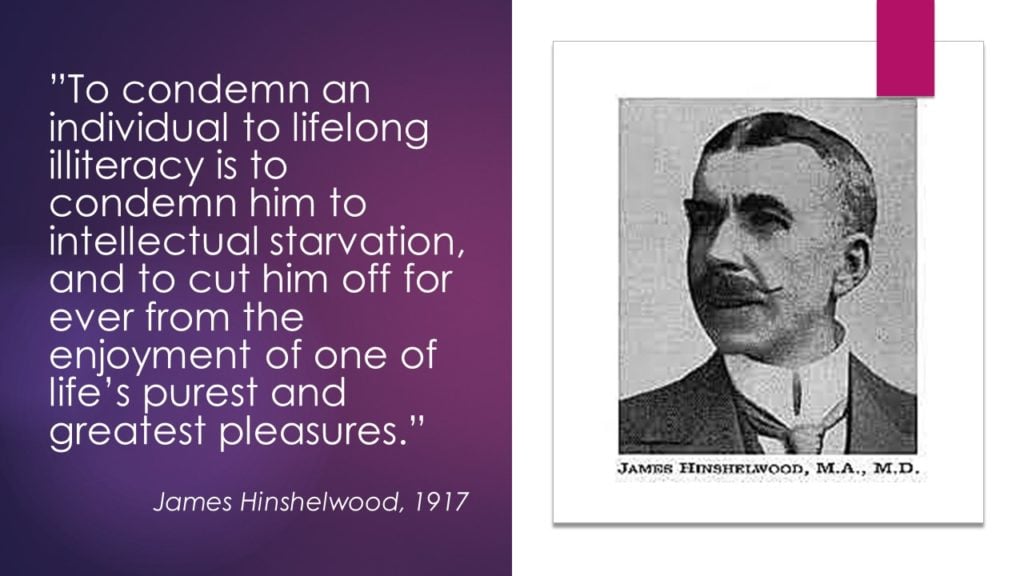
“The child of the rich man in most cases is spared the struggle for existence, and is provided for by his parents, but the child of the poor man has to earn his bread and push his own way in the world. To ask him to begin his career in life as an illiterate without being able to read is surely to handicap him very heavily throughout his whole existence, no matter what career he may choose. There is more to be considered than simply ‘getting on well in the world.’ Every man, rich and poor, has an intellectual side to his existence, and life would be to many a very poor thing without this. To condemn an individual to lifelong illiteracy is to condemn him to intellectual starvation, and to cut him off for ever from the enjoyment of one of life’s purest and greatest pleasures. I regard it, therefore, as a gross injustice to any child, no matter what his position in life may be, not to be taught to read, if it is possible to do so even at the cost of great trouble to all concerned.”
Three stages of treatment
Hinshelwood understood that both auditory and visual memory are essential in learning to read, and that together they form the foundation for phonics and sight reading. He rejected the “look and say” approach and instead outlined an “old method” that unfolded in three stages:
- Acquiring visual memories of letters — children must first learn to recognise each letter of the alphabet by sight.
- Spelling aloud — words are sounded out letter by letter, engaging auditory memory and reinforcing the connection between sounds and symbols.
- Building visual memory of whole words — once letters and phonics are mastered, words can be recognised instantly by sight, much like a familiar face or picture.
This final stage, he explained, transforms reading from a laborious decoding process into fluent recognition, where each word is seen as a meaningful unit. For children with congenital word-blindness, reaching this point requires determination, patience, and consistent repetition — yet Hinshelwood was convinced it was possible (p. 108):
As instruction advances it will be found as a rule that the rate of progress gradually becomes accelerated, and obstacles, which at first seemed insuperable, are gradually overcome.
Ahead of his time
Although his localisation of the brain defect was not accurate by modern standards, Hinshelwood was astonishingly ahead of his time. More than a century ago, he not only described dyslexia as a neurological and hereditary condition but also wrote explicitly about brain plasticity — decades before the concept gained widespread scientific acceptance. His conviction that the brain could adapt and that children could be taught to read through systematic training placed him well over 100 years ahead of his time.
More than fifty years later, the Japanese violinist and educator Shinichi Suzuki echoed the same truth from a different field. Suzuki believed that ability is not an inborn gift but something that develops through love, repetition, and guided practice. He illustrated this principle through an experiment described in Nurtured by Love (1993, pp. 92–93):
“Since 1949, our Mrs. Yano has been working with new educational methods for developing ability, and every day she trains the infants of the school to memorize and recite Issa’s well-known haiku. Children who at first could not memorize one haiku after hearing it ten times were able to do so in the second term after three to four hearings, and in the third term only one hearing.”
Hinshelwood and Suzuki, working decades and continents apart, both recognized the same universal law of learning: that as instruction advances, progress accelerates. Whether through teaching a child to read or to play the violin, both men understood that consistent practice and encouragement enable the brain to strengthen its pathways until what once seemed impossible becomes possible.
Edublox offers explicit, systematic reading instruction integrated with cognitive training to help students overcome the symptoms of dyslexia. We work with families worldwide. Book a free consultation to explore how we can support your child’s learning journey.
References for Dyslexia: Biography of James Hinshelwood:
- Hinshelwood, J. (1907). Four cases of congenital word-blindness occurring in the same family. The British Medical Journal, 2(2444): 1229-32.
- Hinshelwood, J. (1917). Congenital word-blindness. London: Lewis.
- Suzuki, S. (1993). Nurtured by love (2nd ed.). USA: Summy-Birchard, Inc.
Dyslexia: Biography of James Hinshelwood was authored by Sue du Plessis (B.A. Hons Psychology; B.D.), a dyslexia specialist with 30+ years of experience in learning disabilities.
Edublox is proud to be a member of the International Dyslexia Association (IDA), a leading organization dedicated to evidence-based research and advocacy for individuals with dyslexia and related learning difficulties.