
Feral children — those raised with little or no human contact — have long fascinated scientists and the public. While some tales are myths or exaggerations, others are tragically real. Among the most famous cases is that of Genie, a girl discovered in California in 1970 who had been subjected to years of abuse, neglect, and isolation. Her story shocked the world, raised urgent ethical questions, and became a landmark case in psychology and linguistics.
Early life and discovery
Genie was born in 1957 in Arcadia, California. At around twenty months old, her life took a devastating turn. Her father, who was reportedly psychotic and violently intolerant of noise, confined her to a small room in the family’s home. There, she was kept almost naked and strapped to a homemade potty chair for most of each day. She could move only her hands and feet. At night, she was sometimes placed in a crib with a cover that restricted her movement.

Genie’s father forbade her near-blind mother and older brother from speaking to her. If anyone made noise, he would punish them severely. Genie’s diet consisted of milk, baby food, and cereal fed rapidly by spoon. If she choked, food would be rubbed into her face.
By 1970, Genie was 13 years old but weighed only 59 pounds. She could not straighten her arms or legs, chew food, or control her bladder and bowels. She had no recognizable words.
In October of that year, after a violent argument with her husband, Genie’s mother fled with her to her parents’ home. Weeks later, while applying for disability benefits, she mistakenly entered a social services office with Genie. A shocked social worker realized something was terribly wrong. Authorities were contacted, Genie’s parents were arrested, and she became a ward of the court. Soon afterward, her father took his own life.
First impressions at the hospital
Genie was admitted to the Children’s Hospital Los Angeles. Doctors found physical evidence of her years of restraint: calluses and bruises on her buttocks, hip deformities, an undersized ribcage, and bone growth consistent with an 11-year-old. Although her eyesight was normal, she could not focus beyond the dimensions of her small room.
Her case drew the attention of psychologists, linguists, and physicians. David Rigler, a University of Southern California professor, and his colleagues took charge of her care. For researchers, Genie represented a rare and controversial opportunity to study the effects of extreme isolation on human development, especially language development.
Learning to speak and draw
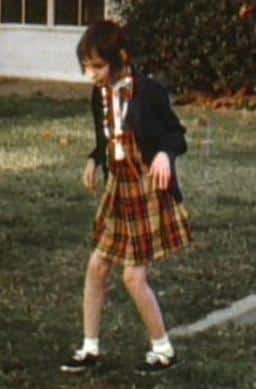
To the surprise of many, Genie showed intelligence and curiosity. She quickly learned to use tools, draw, and navigate her surroundings. She could construct mental maps, such as finding her way through a supermarket to the candy counter.
Language proved more difficult. While she gained some comprehension and acquired a vocabulary of more than 100 words, her speech remained at the level of a toddler: phrases like “want milk” or “two hand.” She often made grammatical errors not found even in young children.
Her progress seemed to support the critical period hypothesis — the idea that humans must acquire language during a limited window of early childhood, or risk never fully mastering it. Genie’s case became central to debates about nature, nurture, and the boundaries of human learning.
Custody battles and research controversy
Unfortunately, Genie’s care was entangled with competing interests. In 1971, she briefly lived with her teacher Jean Butler, then moved in with David Rigler and his family, where she stayed for almost four years. Rigler’s wife, Marilyn, provided daily teaching and support.
The National Institute of Mental Health initially funded research into Genie’s case. But in 1974, amid disputes over record-keeping, blurred boundaries between foster care and research, and allegations of excessive testing, the funding was revoked. Genie’s mother sued the hospital and research team, claiming they had harmed rather than helped her daughter.
When Genie turned 18, she briefly returned to live with her mother, who soon admitted she could not care for her.
Decline and later life
Afterward, Genie was placed in a series of foster homes and institutions for disabled adults. Tragically, she was again subjected to neglect and abuse. Cut off from those she had known, she regressed rapidly. Her language and social skills deteriorated, and her physical and emotional health worsened.
By the late 1970s, she scored 74 on nonverbal IQ tests, in the low-normal range, but her language abilities remained extremely limited. In 1978, her mother abruptly barred all scientific observation and testing.
Since then, little has been publicly known about Genie’s life. As of 2016, she was believed to be living in state care in California, but her exact circumstances remain private.
The bigger picture: feral children
Genie’s case is not unique. Stories of feral or isolated children appear throughout history. A boy in Syria reportedly ate grass and leaped like an antelope. A girl in Indonesia lived in the forest for six years after falling into a river; she walked like an ape and developed razor-sharp teeth. These accounts, whether fully verified or not, highlight the resilience — and vulnerability — of children deprived of regular human contact.
Conclusion
Genie’s story remains one of the most haunting in the history of psychology. She was both a victim of unimaginable cruelty and the subject of intense scientific interest. While her case deepened our understanding of child development and language acquisition, it also raised enduring ethical questions about how vulnerable people should be studied and cared for.
More than anything, Genie’s life is a reminder of the devastating consequences of abuse and isolation — and of society’s responsibility to protect its most vulnerable members.
Edublox provides support for students with dyslexia, dyscalculia, and other learning difficulties. We help students worldwide overcome academic challenges and reach their full potential. Book a free consultation to discuss your child’s learning needs and discover how we can help.