The Orton-Gillingham (OG) approach is a direct, explicit, multisensory, highly structured, sequential, and diagnostic method designed to teach reading, spelling, and writing to struggling readers, including those with dyslexia.
According to the Orton-Gillingham Academy, OG is best understood as an approach rather than a fixed program or system. In the hands of a well-trained teacher or tutor, it becomes a highly flexible tool, adaptable to the unique needs of each learner.
A brief history
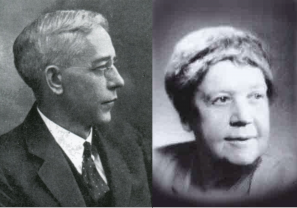
The Orton-Gillingham approach was developed by psychologist Anna Gillingham, building on the theoretical work of American neurologist Samuel Torrey Orton.
Orton studied over 1,000 struggling readers and noticed that children with dyslexia often experienced left-right confusion and letter reversals (e.g., b for d, was for saw). He theorized that dyslexia was linked to incomplete cerebral dominance, which interfered with the development of a clear left–right orientation.
Gillingham translated Orton’s theories into a highly structured approach that repeatedly links phonemes (sounds) with their written forms, names, and cursive formations—laying a solid foundation for literacy.
The essence of the Orton-Gillingham approach
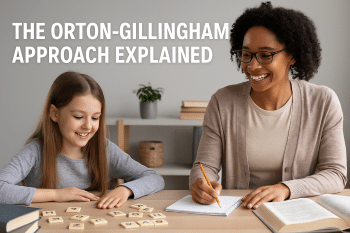
At its core, OG is systematic, sequential, synthetic, and phonics-based—but those words only scratch the surface. This is not just teaching letters and sounds; it’s building the entire English language system in a logical, cumulative way that meets each learner exactly where they are.
Instruction is explicit—nothing is left to chance. Teachers model and explain concepts such as:
- How sounds map to letters (sound–symbol correspondence)
- How those letters combine into syllables and words
- How word structure changes through prefixes, suffixes, and roots (morphology)
- How words function in sentences (syntax)
- How meaning is built and expanded (semantics)
A defining feature is its multisensory approach:
- Visual – seeing letters and words
- Auditory – hearing and saying sounds aloud
- Kinesthetic/tactile – tracing or writing letters, forming words in sand, or using manipulatives
Engaging multiple pathways reinforces memory, strengthens neural connections, and supports students who may have weaknesses in one sensory channel.
OG instruction is also incremental and cumulative—each new concept builds on mastered skills, and review is constant to ensure long-term retention. The approach is diagnostic and prescriptive, meaning lessons are continually adapted based on the student’s performance.
In practice, a session may start with phonemic awareness activities, move into structured phonics work, practice spelling patterns, review syllable division, and end with connected reading and writing tasks. Over time, students progress from simple CVC words (map, hit, Tim) to multisyllabic words, advanced spelling rules, and fluent reading.
In short, OG explicitly teaches the structure of English, connects it to all sensory pathways, and moves forward only when mastery is achieved.
How OG works in practice
OG starts with the most common and accessible sounds—often single consonants and short vowels (a, b, h, i, j, k, m, p, t). Once mastered, these are blended into simple words (map, hit, Tim).
Lessons follow a see–say–write–read cycle:
- Hear the sound from the instructor
- Say the sound aloud while viewing the letter
- Write the letter or trace it while repeating the sound
- Read words containing the letter
- Spell the words, naming each letter as it is written
From there, students learn:
- Additional letters in a planned order
- Consonant blends (st, cl, tr)
- Common phonograms (sh, ea, tion)
- Syllable patterns (closed, open, vowel-consonant-e, r-controlled, vowel team, consonant-le)
- Spelling generalizations (e.g., ck vs. k)
.
Writing is integrated throughout—through dictation, short-sentence writing, and creative story-building—reinforcing reading skills. Later lessons add fluency work, comprehension strategies, and dictionary use.
Because OG is individualized, pacing varies: one student may need extra time on short vowels, another on blends or multisyllabic decoding. This flexibility is a hallmark of the approach.
OG key features in a nutshell
While the details can vary from one Orton-Gillingham-based program to another, all true OG instruction is built around the same essential principles:
1. Explicit
Nothing is left for the student to guess or “discover” by chance. Skills are taught directly, step-by-step, with the teacher explaining and modeling exactly what to do and why. For example, rather than simply giving a list of words to read, the teacher first teaches the sound–symbol relationship and then demonstrates how to blend the sounds into words.
2. Multisensory
OG lessons engage visual, auditory, and kinesthetic/tactile learning pathways simultaneously. A student might see the letter m, say /m/, and trace it while repeating the sound. This integration strengthens neural connections and reinforces memory through multiple channels.
3. Systematic
The teaching sequence is carefully planned. Easier or more common sounds and patterns are introduced first, followed by more complex ones. This prevents learning gaps and ensures a logical progression from simple to advanced skills.
4. Incremental
Each new concept builds on previously mastered material. Nothing is introduced in isolation—new skills connect back to what the student already knows, forming a sturdy, layered understanding of language.
5. Cumulative
Review is constant and deliberate. Previously taught skills are woven into future lessons to keep them fresh in memory. This ongoing reinforcement is especially important for students with dyslexia, who often need more repetition to store information in long-term memory.
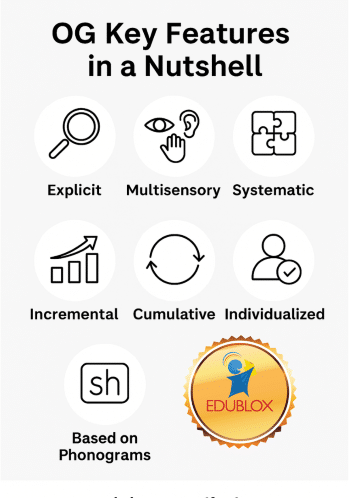
6. Based on phonograms
Instruction focuses on phonograms—the written symbols that represent sounds. These can be single letters (b, t, a) or letter combinations (sh, ea, tion). Understanding phonograms and how they combine is the foundation for accurate reading and spelling.
7. Individualized
No two learners progress at exactly the same pace. OG instruction is diagnostic, meaning the teacher continually assesses performance and adjusts the lesson plan accordingly. Struggling with a particular sound or rule? The teacher slows down, re-teaches, and practices until the material is secure before moving forward.
Together, these features make Orton-Gillingham a highly structured yet flexible approach—structured in its sequence and techniques, flexible in how it’s applied to meet the unique needs of each learner.
How effective is Orton-Gillingham?
The Orton-Gillingham approach has a long history of use and a loyal following among educators who work with students with reading difficulties and dyslexia. But what does the research actually say about its effectiveness? The short answer: results are mixed.
Review by Ritchey & Goeke (2006)
Ritchey and Goeke examined 12 studies involving students from elementary school through college. Their findings were varied:
- 5 studies found that OG instruction was more effective than comparison or control interventions for all measured outcomes.
- 4 studies found that OG was more effective for at least one outcome, but not all.
- 2 studies found that the alternative instruction was more effective than OG.
- 1 study found no significant differences between OG and the comparison once other variables were considered.
Where OG stood out most was in:
- Word attack/nonword reading skills – average effect size of 0.82 (a large effect)
- Reading comprehension – average effect size of 0.76 (also a large effect)
Other reading-related skills showed smaller to moderate effects.
Meta-analysis by Stevens et al. (2021)
To get a broader view, Stevens and colleagues conducted a meta-analysis—a method that combines data from multiple studies to identify overall trends. They focused on OG interventions for students with or at risk for word-level reading disabilities (WLRD).
Their results were more cautious:
- Foundational skills (phonological awareness, phonics, fluency, spelling):
- Effect size = 0.22, p = .40 → positive but not statistically significant.
- Vocabulary and comprehension:
- Effect size = 0.14, p = .59 → again, positive but not significant.
In other words, while OG tended to show some advantage, the differences weren’t strong enough to rule out chance in the studies analyzed.
What Works Clearinghouse findings
These results echo the What Works Clearinghouse (WWC), a U.S. Department of Education initiative that reviews education research. Their conclusion: the evidence in favor of OG programs is limited—sometimes because results are mixed, but more often because existing studies don’t meet their strict quality standards.
Why use OG anyway?
Despite the mixed data, OG remains one of the most respected forms of structured literacy for students with reading difficulties and dyslexia. Its explicit, multisensory, individualized nature is exactly what many struggling readers need.
However, at Edublox, we’ve learned that OG alone often isn’t enough. While it teaches the how of reading, it doesn’t directly strengthen the cognitive skills that make reading fluent, automatic, and lasting.
That’s why we combine Orton-Gillingham-based reading instruction with cognitive skills training—addressing both the symptom (reading difficulty) and the cause (weak cognitive foundations).
Our cognitive training targets:
- Working memory – to retain phonics patterns and spelling rules
- Processing speed – to make decoding quick and effortless
- Attention control – to sustain focus during reading and study
- Visual and auditory memory – to prevent forgetting of rules and words
This integration makes OG more powerful. Students don’t just improve their reading—they retain, apply, and transfer their skills to all subjects.
For many families, the transformation is life-changing: children go from frustrated, reluctant readers to confident, independent learners.
Below are four videos of students whose lives were changed with this approach:
📅 Take the first step today. Book your free consultation to discuss your child’s reading needs and explore how Edublox can help.
References:
- Ritchey, K. D., & Goeke, J. L. (2006). Orton-Gillingham and Orton-Gillingham-based reading instruction: A review of the literature. The Journal of Special Education, 40(3), 171–183.
- Stevens, E. A., Austin, C., Moore, C., Scammacca, N., Boucher, A. N., & Vaughn, S. (2021). Current state of the evidence: Examining the effects of Orton-Gillingham reading interventions for students with or at risk for word-level reading disabilities. Exceptional Children, 87(4), 397–417.
- Solari, E., Petscher, Y., & Hall, C. (2021). What does science say about Orton-Gillingham interventions? An explanation and commentary on the Stevens et al. (2021) meta-analysis. The Reading League Journal, 46–51.
Authored by Sue du Plessis (B.A. Hons Psychology; B.D.), a reading and dyslexia specialist with 30+ years of experience in learning disabilities.
Edublox is proud to be a member of the International Dyslexia Association (IDA), a leading organization dedicated to evidence-based research and advocacy for individuals with dyslexia and related learning difficulties.