
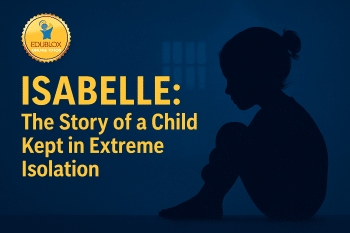
A feral child is a human who has lived away from human contact from a very young age and has little or no experience of human care, loving or social behavior, and, crucially, human language. Feral children are confined by humans (often parents), brought up by animals, or isolated in the wild. This is the story of Isabelle.
An illegitimate child
Isabelle was born in 1932. She was an illegitimate child, and because of the social stigma at the time, her mother’s family chose to keep her hidden. Isabelle’s mother had developed normally up to the age of two, but after an accident, she became deaf and mute and received no further education.
From the day Isabelle was born until she was a little over six years old, she and her mother lived together in seclusion in a dark room with the blinds drawn. They were separated from the rest of the family, and the grandparents did not allow the mother to leave the house alone.
This arrangement deprived Isabelle of the most basic elements of childhood: sunlight, fresh air, play, stimulation, and interaction with others. Her mother loved her and did what she could, but communication was limited to gestures and crude sounds. Isabelle grew up without hearing normal speech, without social contact, and without the opportunity to explore the world outside four walls.
Escaping from home

Eventually, Isabelle’s mother gathered the courage to escape, carrying her daughter with her. In this way, the little girl’s plight came to the attention of the authorities.
By then, the effects of confinement were severe. Years without sunlight, fresh air, and proper nutrition had left Isabelle with a rachitic condition — essentially rickets — that made it almost impossible for her to move around. When doctors examined her, she could not walk normally. With proper medical care, surgery, and good nutrition, however, her body responded, and she gradually learned to walk and move like other children.
At six and a half years old, Isabelle was first tested for intelligence. Her mental age appeared to be around nineteen months. Instead of speech, she made a croaking sound. She was essentially starting life anew, with the physical body of a child but the language and mental development of a toddler.
Rapid improvement
The remarkable part of Isabelle’s story is how quickly she improved once she was placed in a stimulating environment with intensive training. Supported by teachers and psychologists, she began catching up at an extraordinary pace.
Within months, she was learning words. By the time she was eight years old, she was considered a child of average intelligence. Her language had progressed so quickly that she could use between 1,500 and 2,000 words. She delighted in nursery rhymes, could retell stories she heard, and even made up her own. Most importantly, she moved beyond the immediate and concrete, able to imagine, describe, and share ideas about a world larger than herself.
This was a striking finding for psychologists because it showed that, despite six years of almost total isolation, a child could still acquire language at a late stage if given proper support. Isabelle’s rapid development suggested that the “critical period” for language learning was wider
and more flexible than many believed at the time.
Her case stood in contrast to others, such as Genie, a girl discovered decades later in California, who never fully acquired language after extreme isolation. Isabelle’s success gave hope that children who suffer neglect and deprivation can recover much more fully than once thought possible, provided intervention is early and intensive enough.
Conclusion
Isabelle’s early years were marked by tragedy, secrecy, and deprivation, but her story is remembered for its hopeful ending. With care, education, and encouragement, she overcame both physical and linguistic setbacks. By the age of eight, she was not only walking and speaking but thriving in ways no one would have expected when she was first discovered.
Her case remains important in psychology and linguistics because it illustrates both the vulnerability and the resilience of children. It demonstrates how devastating isolation can be, but also how much can be regained when society steps in to provide the opportunities every child deserves.
Edublox provides support for students with dyslexia, dyscalculia, and other learning difficulties. We help students worldwide overcome academic challenges and reach their full potential. Book a free consultation to discuss your child’s learning needs and discover how we can help.
.