
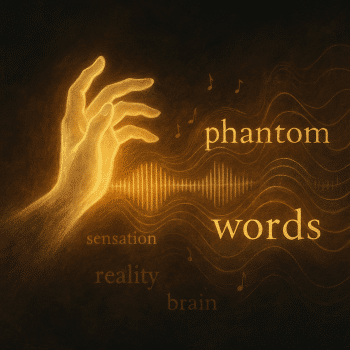
The itch on the missing hand
Imagine losing an arm, yet still feeling your fingers curl. Some people even feel pain in a leg that is no longer there. These strange experiences are called phantom limbs. The brain, it seems, doesn’t get the memo that part of the body is gone. Instead, it invents sensations, as if trying to keep the map of the body intact.
Phantoms of the body
The phenomenon of phantom limbs is astonishingly common. Up to 80 percent of amputees report sensations in their missing limb. Some describe tingling, warmth, or the need to scratch an itch that cannot be scratched. Others suffer real pain in a limb that no longer exists. The experiences are vivid, stubborn, and often deeply distressing.
Scientists once thought phantom pain was purely psychological — a form of denial or wishful thinking. But research has shown that it is far more physical. In the brain’s sensory cortex, each part of the body has a territory. When a hand is amputated, its territory in the cortex doesn’t vanish. Neighboring regions begin to invade it. Touch the face of an amputee, and they may feel it in their missing hand. The brain is reorganizing its map, and in the process, sensations arise that feel real, even when the body says otherwise.
Phantoms of language
The same strangeness happens in language. People who suffer strokes or brain injuries sometimes hear words that no one has spoken or believe they have said something they never did. Others experience “phantom words” in the form of auditory illusions, where random sounds seem to crystallize into recognizable words. Just as the body produces phantom limbs, the mind produces phantom words — linguistic echoes that suggest speech is less about sound and more about how the brain interprets patterns.
There are experiments where people listen to meaningless streams of noise, only to hear “words” appear suddenly. The brain, trained to find language in chaos, generates its own content. It fills the silence with invented meaning, a linguistic version of feeling an absent hand.
Why the brain invents
The common thread between phantom limbs and phantom words is that the brain hates gaps. It operates on maps, patterns, and predictions. When information is missing, it does not shrug — it improvises. Vision works this way, too. We all have a blind spot in each eye where the optic nerve exits, yet we never see a hole in our vision. The brain quietly fills it in with whatever background is nearby. In this sense, hallucination is not the exception but the default. Reality as we perceive it is always partly invented.
The mirror trick
One of the most remarkable treatments for phantom limb pain involves nothing more than a mirror. A patient places their intact limb next to a mirror and moves it while watching the reflection, which appears as the missing limb restored. Astonishingly, this illusion can reduce or even erase phantom pain. The mirror provides visual input that convinces the brain the limb is back, rewriting its sensory map.
The lesson here is profound: if pain can vanish because of a reflection, then perception is not a simple readout of the world. It is a negotiation between body, brain, and expectation.
Phantoms in daily life
We all experience minor versions of phantom sensations. Your phone buzzes in your pocket when it hasn’t. You hear your name in the murmur of a crowd. After removing glasses, you still “feel” them on your face. These everyday ghosts reveal how the brain constantly anticipates and fabricates, blurring the line between real and imagined.
Phantom phenomena also connect to creativity. Musicians often hear phantom notes or overtones that aren’t physically present. Readers sometimes feel a character’s voice in their heads more vividly than in the text. These are the brain’s inventions, adding layers to experience.
What this says about reality
If the brain invents sensations so convincingly, what does that say about reality? It suggests that reality, as we know it, is not raw data but a construction. Sensation is partly perception, partly imagination. Phantom limbs and phantom words reveal the scaffolding: the brain is less a passive receiver of the world and more an active builder.
For philosophers, this raises questions. If pain in a non-existent leg feels real, then what is “real”? If we can hear words in noise or feel a hand that is gone, then experience is not simply tied to the outside world but woven from the brain’s predictions and expectations.
Modern science and future therapies
Modern neuroscience embraces this predictive brain model. The brain is seen as a prediction machine, constantly guessing what comes next and updating when it is wrong. Phantom sensations are errors in this system — predictions that persist even without incoming data. But they also show us how flexible the brain is.
New therapies are building on this idea. Virtual reality is being used to treat phantom limb pain, giving patients digital limbs that they can see and control. In language rehabilitation, auditory illusions and AI-based speech therapy help stroke patients retrain their brains, filling gaps in ways that encourage real recovery.
Closing thought
Phantom limbs and phantom words remind us that the brain does not simply reflect the world; it creates one. Sometimes it creates too much. Sometimes it creates what is no longer there. But without this inventiveness, perception would collapse into holes and gaps.
Perhaps the strangest truth is also the most comforting: the world we feel, hear, and see is always part invention. And in those inventions — even the phantoms — lies the essence of being human.
✨“Reality is never just what is. It is also what the brain insists must be.” — Stanley Armani
Phantom Limbs & Phantom Words: Why the Brain Invents Sensations was authored by Stanley Armani. Stanley writes about the brain, learning, and the hidden patterns that shape how we think. His work explores the strange, the hopeful, and the extraordinary sides of human potential.