
The green predator
On the surface, the Venus flytrap looks innocent — a small plant with open jaws waiting in the sunlight. But behind those jaws is a biological calculator, running equations of survival. Before it shuts on prey, the flytrap does something extraordinary: it counts.
The false alarm problem
Closing a trap takes energy. If the plant slammed shut for every raindrop or speck of dust, it would exhaust itself and starve. So the Venus flytrap has evolved a test: it only snaps shut if its trigger hairs are touched twice within about twenty seconds. One touch alone isn’t enough. This is the plant’s arithmetic — a primitive way of adding up events and deciding if they matter.
The mathematics of hunger
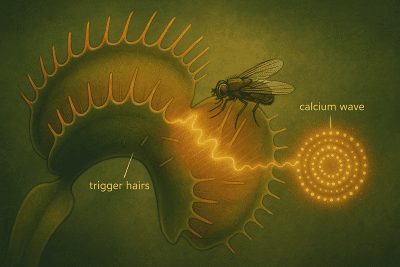
Each trap contains six or so sensitive hairs. Touch one, and an electrical signal called an action potential ripples through the leaf. Touch another — or the same one again — within the critical time window, and the plant logs a second signal. Two equals shut. But the counting doesn’t end there. Three, four, five touches trigger more than movement. They signal the start of digestion, the release of hormones and enzymes that break down the unlucky insect. The more the prey struggles, the more the plant “adds up,” and the stronger its digestive response becomes.

A plant’s memory clock
How does a plant with no brain keep count? Researchers have discovered that each touch releases a burst of calcium inside the cells. These calcium waves fade quickly but linger just long enough to overlap if a second signal arrives. Think of it as a biological stopwatch. If the second touch comes in time, the signals stack — and the trap reacts. If not, the clock resets. It’s a simple form of short-term memory, written not in neurons but in ions.
The experiments
In recent years, scientists have tested mutant flytraps that lack this counting ability. The results are clear: without the capacity to add up touches, the plants waste energy, snapping at raindrops or failing to mount a full digestive response. In other words, without math, the predator starves.
Nature’s quiet mathematician
The Venus flytrap reminds us that arithmetic is not just a human invention. Nature has been counting for millions of years. Bees measure angles when they dance, spiders gauge distances in their webs, and here, in the swamps of the Carolinas, a plant waits with an internal abacus of calcium and electricity.
What this says about intelligence
We tend to think intelligence requires a brain. But the flytrap shows that decision-making — even mathematical reasoning — can emerge from simpler systems. Counting, remembering, and acting on numbers are not exclusive to humans or even animals. They are strategies that life itself invents wherever survival demands it.
Closing thought
When a fly brushes past the hairs of a Venus flytrap, it unknowingly triggers a calculation. One touch, nothing. Two touches, jaws snap. More touches, and digestion begins. All of it without neurons, without thought — just the mathematics of hunger.
“Counting is older than brains. Even plants keep score.” — Stanley Armani
Plants That Count: The Venus Flytrap’s Ability to “Do Math” Before Snapping Shut was authored by Stanley Armani. Stanley writes about the brain, learning, and the hidden patterns that shape how we think. His work explores the strange, the hopeful, and the extraordinary sides of human potential.