
The summer the city danced
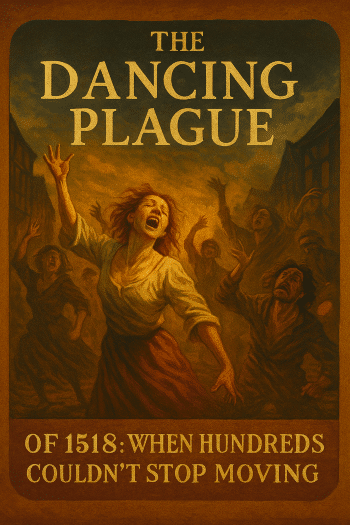
In July of 1518, the citizens of Strasbourg — then part of the Holy Roman Empire — witnessed something so strange it reads like fiction. A woman named Frau Troffea stepped into the street and began to dance. She wasn’t celebrating or performing; she seemed compelled. Hours passed. She did not stop. Days later, dozens joined her, their bodies jerking and swaying without pause. Within a month, hundreds of people were caught up in what became known as the dancing plague.
Dancing to death
The chronicles say some dancers collapsed from exhaustion. Others broke bones or suffered heart attacks. At least a few are said to have danced themselves to death. Musicians were even brought in, not to stop the madness, but to accompany it — a macabre attempt to “dance it out.” Authorities built stages and hired pipers, believing the only cure was to let the compulsion burn itself away. Instead, the dancing grew.
Theories of mass hysteria
Modern historians puzzle over the outbreak. One theory is mass hysteria, or what we’d now call mass psychogenic illness. In a time of famine, disease, and religious fear, the people of Strasbourg may have converted their anxiety into movement. Just as laughter or yawns can spread, so too can panic — or compulsion. The sight of neighbors dancing uncontrollably might have triggered the same in others, a feedback loop of distress and imitation.
Ergot and poisoned bread
Another explanation looks to food. Some scholars suggest the dancers ate rye contaminated with ergot, a fungus that produces hallucinogenic alkaloids. Ergot poisoning can cause convulsions, hallucinations, and bizarre behavior. It is the same substance from which LSD was later derived. If enough people consumed tainted bread, their spasms might have looked like a plague of dance.
Yet ergot poisoning usually causes muscle contractions so painful that movement becomes impossible. Could such agony really fuel days of rhythmic motion? Skeptics doubt it.
Religious fervor and punishment
Others see the outbreak as spiritual. Medieval Europe was a world of saints and sins, blessings and curses. Dancing frenzies had occurred before, often linked to the cult of St. Vitus, patron saint of epilepsy and nervous disorders. People believed St. Vitus could curse sinners with uncontrollable dancing. In Strasbourg, worshipers even marched the afflicted to a shrine of St. Vitus in the hope of healing.
In this view, the dancing plague was not a medical event but a religious one — a collective ritual of guilt, fear, and penance.

When the body becomes language
What makes the dancing plague so fascinating is how the body itself became the stage for history. In an era without psychiatry or neurology, distress found expression in movement. The dancers didn’t speak of their suffering; they danced it. Their twitching, sweating bodies became the message, written in rhythm rather than words.
It is a reminder that the boundary between mind and body is thinner than we think. Anxiety can knot a stomach, grief can stop a heart, belief can bend bone and muscle into strange obedience.
Echoes through time
The Strasbourg outbreak was not unique. Similar dance manias struck medieval and early modern Europe, from Aachen in the 14th century to Basel in the 15th century. Each time, people moved in frenzied groups, sometimes for days. The episodes faded as mysteriously as they appeared, leaving behind only chronicles, sermons, and baffled medical notes.
Today, we still see echoes. Reports of fainting spells in schools, laughing epidemics, or psychosomatic illnesses sweeping through groups share something with the Strasbourg dancers. Humans remain deeply social creatures, our bodies vulnerable to the moods and movements of others.
The mystery that remains
No single explanation satisfies. Mass hysteria makes sense, but it doesn’t explain why the hysteria was directed at dancing, rather than trembling or screaming. Ergot poisoning is plausible, but doesn’t fit the symptoms perfectly. Religious ritual played a role, but why did it spread so quickly and violently? The truth may be all of these at once: a society on edge, poisoned by hunger, bound by faith, erupting into movement because words could not hold their suffering.
Closing thought
In the summer of 1518, Strasbourg became a ballroom of desperation. Hundreds moved until their feet bled, their lungs heaved, their hearts gave out. Whether madness, poison, or prayer, the dancing plague reminds us that history’s strangest events often live in the space between body and belief.
“When words fail, the body speaks. In Strasbourg, it spoke in dance — until it broke.” — Stanley Armani
The Dancing Plague of 1518: When Hundreds Couldn’t Stop Moving was authored by Stanley Armani. Stanley writes about the brain, learning, and the hidden patterns that shape how we think. His work explores the strange, the hopeful, and the extraordinary sides of human potential.