Whispers of forbidden knowledge
In the early modern world, curiosity was dangerous. To question the heavens was to risk the wrath of the Church. To experiment with chemistry could invite charges of witchcraft. And yet, against this backdrop of fear, science did not die. It survived in whispers, letters, and gatherings so discreet they earned a name that has never lost its power: the invisible colleges.
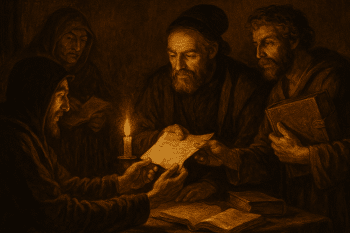
These were not institutions of stone and mortar. They were networks, fragile yet resilient, woven through parlors, taverns, and candlelit studies. Members were not bound by charters or uniforms but by trust — and the recognition that knowledge needed shelter from the eyes of power.
Salons, letters, and secrecy
An invisible college might look, on the surface, like a social evening: wine poured, polite conversation exchanged, music drifting from a corner. But beneath the civility, something daring was happening. Philosophers, mathematicians, alchemists, and physicians traded results. They carried notebooks with coded symbols, letters in Latin disguised as poetry, and allegories that turned chemical reactions into metaphors about birds or stars.
Letters were the lifeblood of these hidden networks. A scholar in Florence might send a manuscript disguised within a shipment of cloth. A Parisian alchemist might write to a London natural philosopher under the pretense of discussing weather. What appeared to be correspondence about crops could contain instructions for an air pump experiment.

Galileo’s whispering allies
Few figures embody the stakes better than Galileo Galilei. In 1633, condemned by the Inquisition, Galileo spent his final years under house arrest. Yet his ideas traveled freely. Loyal allies in the Republic of Letters — itself a vast invisible college — copied his works by hand, smuggled them across borders, and spread them like contraband scripture. To be part of such a network was to court danger, but also to participate in a collective act of defiance: to keep the universe open.
Boyle and the London circle
In England, Robert Boyle gathered a group of experimenters in the mid-17th century. They met privately to test new theories about air, chemistry, and mechanics. Their invisible college evolved into the Royal Society, one of the first official scientific bodies. But its origins were not in marble halls — they were in discreet rooms where men pumped air from glass globes, lit candles, and marveled at how flames died in a vacuum.
Secrecy as protection
Secrecy was not only a means of protection from persecution; it was also a way to safeguard reputations. An unproven experiment could ruin a scholar’s credibility if prematurely exposed. Within the invisible colleges, ideas could be tested, refined, and debated before being revealed to the world.
At times, secrecy itself became ritual. To be admitted into an invisible college was to be trusted with dangerous treasures. Members often used symbols — a triangle, a hand-drawn star, a coded phrase — as passwords of belonging. These were not just secret societies; they were lifeboats of discovery in stormy seas.
Kircher and the language of riddles
One of the most intriguing figures of the 17th century was Athanasius Kircher, a Jesuit polymath whose writings blended fact, myth, and allegory. He described magnetism as a cosmic force, deciphered hieroglyphs with more imagination than accuracy, and filled his books with elaborate illustrations. To modern eyes, his work looks fanciful. But to his peers, Kircher’s riddles concealed genuine experiments. Invisible colleges often read between his lines, interpreting metaphors as laboratory instructions. Science, in such hands, was a puzzle meant for initiates.
When silence failed
Of course, secrecy was never absolute. Some invisible colleges were exposed, their members punished or scattered. In Germany, alchemists faced accusations of sorcery. In France, certain philosophers were denounced for heresy. To be caught was not simply a matter of embarrassment; it could mean prison, exile, or the stake. And yet the networks kept reforming, finding new hosts like vines climbing fresh walls.
From secrecy to legitimacy
Over time, what began as invisible colleges gave birth to visible ones. The Royal Society in London, the Académie des Sciences in Paris, and other learned bodies emerged directly from these hidden gatherings. The transition from secrecy to legitimacy marked the Enlightenment: ideas once whispered in coded letters were now published in journals, open to scrutiny. But the spirit of the invisible colleges lingered — the thrill of sharing forbidden truths with a trusted few.
Echoes in the digital age
Invisible colleges did not vanish. They changed form. Today, scientists often rely on preprint servers, encrypted chats, and informal collaborations that bypass the slow machinery of academic journals. Activists in countries with censorship form networks that mirror the salons of the 1600s. Hackers share exploits in forums closed to outsiders. Wherever official institutions restrict, invisible colleges rise again, proving that the hunger for knowledge will always outpace control.
Even social media carries their shadow. Private groups of researchers, doctors, or citizen scientists swap insights long before institutions acknowledge them. In the 21st century, as in the 17th, discovery still thrives in the liminal space between official and underground.
Closing thought
The invisible colleges remind us that science has always been fragile, always in need of safe havens. Behind every breakthrough we celebrate publicly lies a history of secrecy, whispers, and quiet alliances. Knowledge is born not only in universities and laboratories but also in the margins — in coded letters, in candlelit rooms, in the trust between two curious minds.
“Every discovery begins as a secret. Every truth begins in whispers.” — Stanley Armani
The Invisible Colleges: Secret Networks of Science Before the Enlightenment was authored by Stanley Armani. Stanley writes about the brain, learning, and the hidden patterns that shape how we think. His work explores the strange, the hopeful, and the extraordinary sides of human potential.