
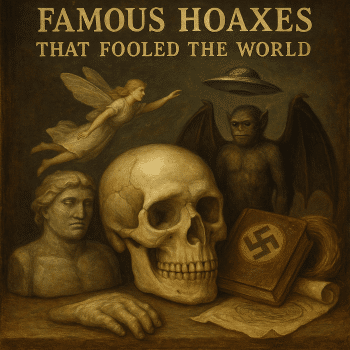
In 1912, a respectable English barrister named Charles Dawson strode into history with a skull in his hands. It was a curious thing: a human cranium fused with the jaw of an ape. Scientists hailed it as the “missing link” between man and monkey. Piltdown Man, as he was christened, was displayed in the British Museum for decades. Textbooks were rewritten, theories were adjusted, and egos inflated.
But forty years later, Piltdown was unmasked as a chimera — bones stained with chemicals, filed down, and glued together in Dawson’s garden shed. The greatest discovery in human history turned out to be one of the greatest cons.
The lesson? Humans love stories more than they love facts. And when a hoax flatters our preconceptions — English scientists rather liked the idea that the “first man” might be English — we are willing accomplices.
The great moon hoax
Go back a century earlier. In 1835, readers of the New York Sun opened their morning paper to astonishing news: astronomers had discovered life on the moon. Through the mighty telescope of Sir John Herschel, there were reports of sapphire lakes, fields of amethyst, and forests of crimson poppies. And beings — furry, winged “man-bats” who built temples and frolicked in meadows.
Circulation soared. The Sun became the most popular paper in America. Only later did it come out that the entire tale was fabricated, a satirical stunt. But by then, it hardly mattered. The hoax had worked: people bought papers, and newspapers learned a lasting lesson about the profit of sensationalism.
The Cottingley fairies
In the summer of 1917, two cousins in the Yorkshire village of Cottingley borrowed their father’s camera and took photographs of themselves with delicate, winged fairies. The images were whimsical, lovely — and so convincing that even Sir Arthur Conan Doyle, the creator of Sherlock Holmes, fell for them.
Doyle, desperate for signs of wonder in a world ravaged by war, published the photographs in The Strand Magazine as evidence of spiritual realities. It wasn’t until the 1980s that the cousins confessed the truth: they had cut the fairies out of a children’s book and posed with them.
The hoax lasted so long because it wasn’t just about photographs — it was about longing. When reality feels too brutal, fantasy becomes irresistible.
The War of the Worlds broadcast
On the night of October 30, 1938, radio listeners tuned in to hear Orson Welles narrate H. G. Wells’s War of the Worlds. Presented in the form of breaking news bulletins, the broadcast described Martians landing in New Jersey, vaporizing soldiers, and marching toward New York.
Some listeners, missing the introduction, believed it was real. Panic spread. Families fled their homes. Police were flooded with calls. America had been invaded — not by aliens, but by words.
Welles’s hoax revealed the fragile trust people place in the media, and the terrifying speed at which information can bypass reason. In many ways, it was a dress rehearsal for our own digital age, when rumor races faster than truth.
The case of the Cardiff Giant
On a chilly October day in 1869, workers digging a well behind a barn in Cardiff, New York, struck something hard. As they scraped away the soil, a human form began to emerge — not flesh, but stone. Ten feet tall, with chiseled features and a grim expression, the figure looked like a petrified man from another age.

News spread like wildfire. Farmers, preachers, and curiosity-seekers flocked to see the “giant.” Some proclaimed it evidence of the biblical Nephilim — the race of giants mentioned in Genesis. Others insisted it was proof that prehistoric humans once roamed the earth. The faithful and the curious both found what they wanted.
But the truth was stranger still. The Cardiff Giant had been planted. George Hull, a cigar-maker and atheist, had quarreled with a revival preacher about the literal truth of the Bible. Hull decided to prove a point — with a prank. He had a block of gypsum carved into the likeness of a man, buried it on a relative’s farm, and waited.
The ruse worked better than he imagined. Thousands paid admission to gaze at the giant. And then came P. T. Barnum, America’s great showman. When he couldn’t buy Hull’s giant, he had one of his own carved and declared the original a fake. “Why pay to see Hull’s stone man,” Barnum asked, “when mine is the real one?”
The public didn’t know whom to believe. Some visited both giants just to be sure — and paid for the privilege twice. The hoax had devoured itself, leaving behind not truth but entertainment.
Here was the real revelation: people will pay not only for authenticity, but for the spectacle of fraud itself.
The Hitler diaries
In 1983, the German magazine Stern announced a bombshell: Hitler’s long-lost diaries had been discovered. Historians, journalists, and the public were electrified. The leather-bound volumes seemed authentic, filled with mundane musings from one of history’s most infamous men.
But within weeks, forensic testing revealed the diaries were crude forgeries. Ink and paper dated after the war, handwriting inconsistent, content suspiciously banal. Stern was humiliated, millions wasted, and reputations ruined.
It was a hoax that thrived on humanity’s endless hunger for proximity to evil — and our readiness to believe when confronted with the lure of forbidden relics.
Crop circles
In the 1970s and 80s, vast and intricate geometric patterns began appearing in fields across England. Some said they were messages from extraterrestrials, etched by spacecraft. Mystics saw cosmic art, scientists debated wind currents and plasma vortices.
Then, in 1991, two pranksters named Doug Bower and Dave Chorley admitted they had made hundreds of them using planks, ropes, and a dash of Guinness-fueled mischief. By then, the phenomenon had gone global, with thousands of “circle makers” taking up the pastime.
The irony? Even after the confession, many still insisted the real circles must be alien. Once mystery takes root, truth rarely digs it out.
The Internet age: Nigerian princes and beyond
In the late 1990s and early 2000s, a new kind of hoax emerged — one delivered not by newspapers or radio, but by email. Millions received messages from “Nigerian princes” who needed help transferring fortunes out of their country. All you had to do was send your bank details.
The scam was so audacious that it seemed impossible anyone would fall for it. And yet people did — and still do. In today’s version, hoaxes take the form of deepfake videos, fake news articles, and AI-generated scams. The medium changes, but the mechanism is timeless: appeal to greed, trust, or fear.
Why we fall for hoaxes
Every era has its Piltdown Man, its Cottingley fairies, its viral deepfake. The details change — ape jaws and moon men traded for Photoshop and AI voices — but the psychology doesn’t.
We fall for hoaxes because:
- We want to believe. Hope, fear, or vanity make us complicit.
- We trust authority. If it’s in a museum, a newspaper, or a familiar voice on the radio, it feels safe.
- We like the story. Truth is often dull. Lies are cinematic.
The most successful hoaxes don’t just trick us. They tell us something about ourselves — what we wish were true, what we fear might be true, and how badly we want certainty in a chaotic world.
“Every great hoax is a mirror, and when we peer into it, we don’t see the trickster — we see our own hunger to be deceived” — Stanley Armani.
Famous Hoaxes That Fooled the World was authored by Stanley Armani. Stanley writes about the brain, learning, and the hidden patterns that shape how we think. His work explores the strange, the hopeful, and the extraordinary sides of human potential.