
Dear Sue,
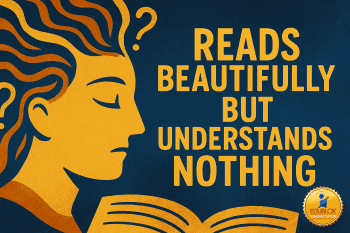
My son, now 10, has always loved books. From a very young age he would sit for hours paging through picture books, and as soon as he learned to read, he took off like a rocket. He reads out loud with such expression that his teachers say he could be an actor. People who hear him read think he is a very advanced reader.
But here’s the problem: the moment you ask him what he has read, he can’t tell you. It’s like the words go in one ear and out the other. For example, he recently read three pages of a storybook beautifully, without missing a single word. When I asked him who the main character was, he just shrugged. If I ask him to retell the story, he stares at me blankly. It breaks my heart, because I know he is trying.
We thought maybe he wasn’t paying attention, but this happens all the time, no matter how much we remind him to “concentrate.” His grades are also showing the same problem — he can read the questions perfectly, but then answers something completely unrelated. He is falling behind in social studies and science, not because he can’t read the words, but because he doesn’t seem to understand them.
At school, the teacher told me he just needs more practice, but practice hasn’t changed anything. I’ve tried sitting with him, making him slow down, even asking him to underline key sentences, but nothing seems to stick. He is starting to say, “I’m dumb,” and I don’t know how to encourage him anymore.
Sue, do you have any advice? Could this be dyslexia even though he reads so well? Or is there another explanation for why a child can sound like such a fluent reader but not remember or understand anything?
Desperate for answers,
Anna
Hello Anna
Thank you for sharing your story so honestly. You describe something I see often: a child who can read out loud beautifully but seems to understand very little. It can be confusing because we expect fluent reading to equal understanding, but comprehension is actually a much more complex process.
There are four main reasons why a child may struggle with reading comprehension:
1. Word recognition difficulties
Some children struggle with comprehension because they have difficulty reading words quickly and accurately. If they have to pause often to sound out words or misread them, there is little energy left for comprehension. Clearly, this is not the case for your son — his fluent and expressive oral reading shows that word recognition is not the problem.
2. Weak cognitive skills
Comprehension depends on cognitive skills such as working memory, attention, and processing speed. If working memory is weak, for example, a child can read every word correctly but forget the beginning of the sentence before reaching the end, making it difficult to grasp the overall meaning.
3. Limited vocabulary
Another common reason for comprehension problems is a lack of vocabulary. A child may decode the words correctly but not understand their meaning, which hinders proper comprehension.
4. Underdeveloped comprehension skills
Finally, comprehension itself is composed of skills that must be taught and practiced, including summarizing, sequencing, making inferences, comparing and contrasting, drawing conclusions, asking self-reflective questions, and more. A child who hasn’t been guided to use these strategies may sound fluent but still miss the meaning.
The good news is that comprehension can be improved. With the right support — strengthening cognitive skills, expanding vocabulary, and teaching comprehension strategies step by step — children like your son can move from reading words to truly understanding stories and information.
Please book a free consultation and assessment with us. That way, we can get to the root of the problem and recommend the best course of action for your son.
Warm regards,
Sue
More about Sue
Sue is an educational specialist in learning difficulties with a B.A. Honors in Psychology and a B.D. degree. Early in her career, Sue was instrumental in training over 3,000 teachers and tutors, providing them with the foundational and practical understanding to facilitate cognitive development among children who struggle to read and write. With over 30 years of research to her name, she conceptualized the Edublox teaching and learning methods that have helped thousands of children worldwide. In 2007, she opened the first Edublox reading and learning clinic; today, there are 30 clinics internationally. Sue treasures the “hero” stories of students whose self-esteem soars as their marks improve.