At 31, Jason Padgett was, by his own admission, “a shallow man.” He chased parties, not purpose. His world revolved around cheap thrills and fleeting lights. Then, one night in 2002, everything changed.
Outside a karaoke bar in Tacoma, Washington, two men attacked him from behind. The blows to his head were brutal. He staggered home, concussed and bleeding. But when he woke the next morning, something in his mind had rearranged itself.
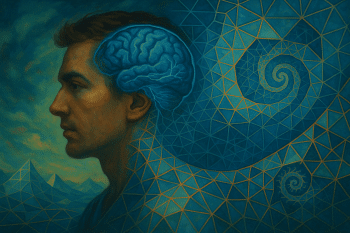
He saw the world differently — literally. The sunlight filtering through the curtains no longer appeared as smooth rays but as a cascade of interlocking polygons. Ripples in a puddle looked like concentric geometry. Every edge, every movement shimmered with pattern.
The trauma had unlocked something extraordinary. Jason Padgett, the man who’d barely passed high school math, had become a mathematical visionary.
Geometry everywhere
Padgett began to draw what he saw. Circles, spirals, and grids spilled from his pen — perfect geometric diagrams rendered by hand, without instruments. He could visualize fractals — the infinite patterns found in nature — in breathtaking detail.
He saw the world as a sequence of discrete frames, much like the frames of a film — proof, he believed, that reality is not continuous but pixelated. “I see shapes everywhere,” he explained. “It’s the geometry underlying everything.”
Doctors were baffled. Neuroscientists confirmed that he had developed acquired savant syndrome, one of the rarest conditions known to medicine. It occurs when a person, often after a brain injury, suddenly exhibits exceptional abilities in art, music, mathematics, or memory — talents they never possessed before.
Padgett’s brain injury had somehow re-wired his neural circuits, allowing access to regions usually silent or hidden.
The hidden brain
Savant syndrome — whether congenital or acquired — hints at vast, untapped potentials in the human brain. It suggests that genius may not always be built; sometimes, it is unlocked.
The classical savant, like Kim Peek (the inspiration for Rain Man), is born with unusual neural architecture — often accompanied by developmental challenges. Acquired savants, by contrast, are “ordinary” people whose brains, after injury, suddenly behave extraordinarily.
Neuroscientists propose that these changes stem from neuroplasticity — the brain’s ability to reorganize itself after trauma. Damage in one area may silence normal inhibition, freeing other regions to compensate, amplify, or become more active. What was once background noise becomes the main melody.
In Padgett’s case, scans revealed increased activity in the left parietal cortex, a region linked to visual-spatial processing and mathematical reasoning. His injury, paradoxically, had carved a new window into perception.
The beauty of numbers
Padgett’s new vision was not just mechanical. It was spiritual.
“I see the math in everything,” he said. “When I look at trees, I see their fractal branching. When I look at clouds, I see infinite patterns of geometry. It’s all connected — math, art, nature, consciousness.”
His drawings — dense, hypnotic webs of triangles, spirals, and waves — have been exhibited as mathematical art. To some, they resemble blueprints of the universe. To others, they are proof that mathematics is not invented by humans but revealed through us.
Padgett’s transformation invites an ancient question: are numbers our creation, or do they exist independently, woven into the fabric of existence, waiting for a mind attuned enough to see them?
The gift and the cost
But genius rarely comes free. After the attack, Padgett also had post-traumatic stress disorder. He became hypersensitive to noise, light, and crowds. For months, he barely left his house. His brain, while expanded in one dimension, had contracted in others.
He often described his mind as both “open” and “trapped.” The same sensitivity that allowed him to perceive mathematical beauty also made ordinary life unbearable. Only slowly did he learn to live in balance with his new perception.
Trauma had taken away his sense of safety — and given him the cosmos in return.
The mystery of acquired savants
Padgett is not alone. In 1994, a chiropractor named Tony Cicoria was struck by lightning and soon developed an overwhelming urge to play the piano — and the uncanny ability to compose classical music from memory.
In another case, an untrained man named Orlando Serrell was hit on the head with a baseball and gained the ability to remember every date and detail of his life thereafter.
Scientists refer to it as the paradox of injury: damage that disables one function can awaken another. Like a forest fire that clears deadwood, trauma can expose fertile ground for unexpected growth.
It’s tempting to see this as mystical — the universe giving compensation for pain — but it may simply reflect the latent complexity of the brain. Every mind holds hidden corridors; most of us never walk them.
A brain’s second language
Acquired savant syndrome also challenges our idea of intelligence as fixed. It suggests that talent might not be built solely through practice, but can, under rare circumstances, emerge through reorganization.
Padgett’s story doesn’t glorify injury; it glorifies adaptation. His brain, wounded, re-learned how to see. It turned chaos into order. His trauma rewrote his perception, but his courage transformed perception into purpose.
He later studied mathematics formally, co-authored a memoir (Struck by Genius), and began speaking publicly about his experience — urging others to see beauty where they once saw nothing.
The geometry of the mind
What happened in Jason Padgett’s brain might be an extreme version of what happens in all creative moments. When we experience loss, disruption, or even heartbreak, our neural circuits must adapt. Sometimes, in the reassembly, new pathways form — new ways of seeing.
Lightning, violence, or heartbreak: they all tear the map. But when the map is redrawn, something unfamiliar appears — a shape we couldn’t see before.
Maybe the difference between tragedy and transformation lies in whether we can bear to look at what appears in that light.
Closing line
“Sometimes the blow that breaks the skull opens the eye.” — Stanley Armani
The Accidental Genius: When a Blow to the Head Awakens the Brain was authored by Stanley Armani. Stanley writes about the brain, learning, and the hidden patterns that shape how we think. His work explores the strange, the hopeful, and the extraordinary sides of human potential.