
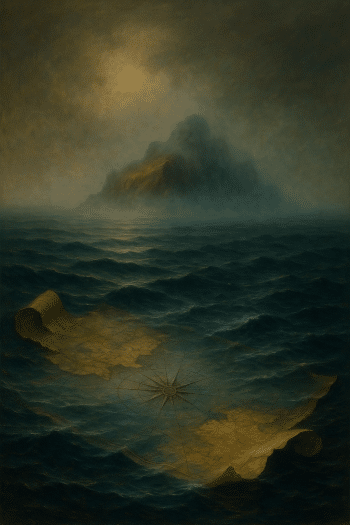
Some islands vanish with a whisper, some with a roar. One day, they are on maps, the next day, they are gone, leaving only blank blue space and bewildered sailors. They are the ghosts of geography, reminders that even the solid earth beneath our feet is more fragile than we think.
Phantoms on the map
For centuries, cartographers filled their charts with islands that never truly existed. The island of Hy-Brasil appeared off the west coast of Ireland in maps as late as the 19th century. Sailors swore they had seen its mist-covered shores, visible only once every seven years. Some claimed it was an enchanted land, while others believed it was a trick of fog and light.
Likewise, Sandy Island in the Coral Sea, near Australia, appeared on official maps until 2012, when a scientific expedition sailed right over its coordinates and found nothing but the deep ocean. Google erased it; nature had never drawn it.
Eaten by the sea
Other islands vanish because they cannot fight the tides. Storms, earthquakes, and rising seas consume them. In the Bay of Bengal, the island of New Moore (also known as South Talpatti) emerged after a cyclone in 1970, sparking a territorial dispute between India and Bangladesh. But the quarrel was short-lived: within four decades, the island was gone, swallowed by the ocean.
In the Maldives, Kiribati, and Tuvalu, whole nations fear the same fate. These islands are not fictions on a map, but homes, cultures, and futures hanging by a tide thread.
Vanishing acts of nature
Volcanoes can conjure islands overnight — and destroy them just as quickly. In 2013, an eruption off the coast of Japan created Nishinoshima, a smoking newborn island. For a time, it looked as though it would vanish beneath the waves, but instead it grew, devouring nearby land. The opposite happened with Surtsey, born of fire near Iceland in 1963, now steadily eroded by the sea.
The message is clear: islands are not permanent punctuation marks in the ocean. They are commas, ellipses, pauses in the restless grammar of the earth.
The meaning of vanishing lands
Why do disappearing islands haunt us? Because they blur the line between myth and matter. An island that is here today and gone tomorrow feels like a dream that tricked the cartographer’s pen. They remind us that our maps, like our knowledge, are always provisional.
To stand on a small island is to feel safe, anchored. To watch one vanish is to feel the opposite: how little we command, how easily the sea reclaims what it lent.
Closing line
“An island is a promise the ocean makes in sand — and every promise, in time, is broken.” — Stanley Armani
The Disappearing Islands of History was authored by Stanley Armani. Stanley writes about the brain, learning, and the hidden patterns that shape how we think. His work explores the strange, the hopeful, and the extraordinary sides of human potential.