
Dear Sue
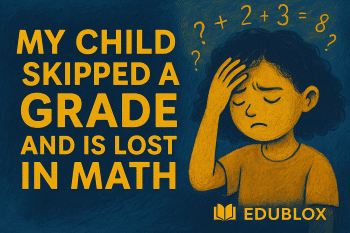
We recently moved from the U.S. to Spain, and because of age-based placement rules, my child skipped a grade. She’s now in 3rd grade, but never actually did 2nd-grade math. She’s struggling to keep up, and it’s affecting her confidence.
We’re also not sure whether it’s just the transition or something deeper, such as dyscalculia. She hasn’t been diagnosed, but math seems really abstract to her, and she’s falling behind. We want her to get support in English, and ideally, start at the level she’s really at — without making her feel like she’s “failing.”
Is that something Edublox can help with?
Abigail
Dear Abigail
Thank you for writing. What an exciting (and overwhelming!) transition this must be for your family.
You’ve raised such an important point. When a child skips a grade — especially in a subject like math, where concepts build step-by-step — it’s completely normal to see gaps emerge. And when a child is also adjusting to a new country, school, and language expectations, those gaps can feel even bigger.
At Edublox, we believe every child deserves to learn at their level — not where a system says they should be. That’s why we always begin with a gentle, informal assessment to find your child’s true starting point. There’s no shame, no pressure — just a path forward that builds confidence from the ground up.
The fact that your daughter finds math “abstract” is not uncommon, especially if dyscalculia is a concern. Whether it’s a learning difficulty or simply a lack of foundational understanding, we can help. Our tutors are trained to work with students who need extra support, and we do everything in English — so there’s no language barrier adding to the challenge.
The goal isn’t just to catch up — it’s to build confidence, restore joy, and create a strong foundation she can build on for years to come.
Warmly,
Sue
More about Sue
Sue is an educational specialist in learning difficulties with a B.A. Honors in Psychology and a B.D. degree. Early in her career, Sue was instrumental in training over 3,000 teachers and tutors, providing them with the foundational and practical understanding to facilitate cognitive development among children who struggle to read and write. With over 30 years of research to her name, she conceptualized the Edublox teaching and learning methods that have helped thousands of children worldwide. In 2007, she opened the first Edublox reading and learning clinic; today, there are 30 clinics internationally. Sue treasures the “hero” stories of students whose self-esteem soars as their marks improve.