
Dear Sue,
My child is a fairly confident reader, but spelling is another story. It’s as if the letters slip away the moment he starts writing. He constantly spells words phonetically — “frend” instead of “friend,” “becos” instead of “because.” We’ve tried lists, drills, and games, and nothing sticks. I’m starting to wonder: is there something deeper going on? And how do I actually help him improve?
A Frustrated Parent
Dear Parent,
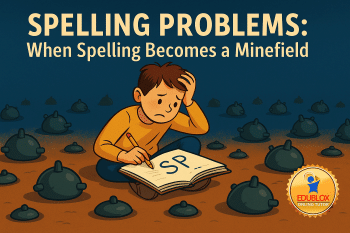
Spelling looks deceptively simple: a few letters, a set of rules, and enough red pen to make any parent twitch. But for many children, especially those with learning difficulties like dyslexia, spelling isn’t a skill – it’s a battlefield. Or more accurately, a minefield.
Behind every silent letter and shifting vowel sound is a cognitive process that needs to work precisely and reliably. When it doesn’t, the entire system crumbles.
The cognitive load of spelling
Spelling is more than matching sounds to letters. It taps into a whole network of skills, including:
- Visual memory – Remembering what a word looks like.
- Sequential memory – Keeping the order of letters in the correct sequence.
- Auditory processing – Distinguishing sounds and connecting them to graphemes.
- Working memory – Holding a string of letters or rules in mind while writing.
- Orthographic processing – Recognizing common patterns and exceptions.
When one or more of these are weak, spelling becomes unpredictable and exhausting.
Examples from the minefield
Let’s look at a few real-life spelling tripwires that leave children frustrated and adults scratching their heads.
1. Night becomes nite
Logical, right? The child hears /n/, /ai/, /t/ and writes what they hear. This points to a firm grasp of phonics but weak visual memory and no orthographic map for irregular patterns like “-ight.”
2. Does becomes duz
Phonetically accurate but orthographically way off. English is full of these rule-breakers, and a child who struggles with visual processing or orthographic memory can’t just “remember” these exceptions.
3. Because becomes becos, becuz, or even bakos
Here, you see a mix of phonetic guessing, sequencing issues, and visual memory breakdown. The child knows the word and says it correctly, but can’t stabilize the spelling.
4. Friend becomes frend
Again, it makes perfect sense phonetically. The problem lies in recognizing and retaining non-phonetic spellings, which requires strong visual memory and orthographic processing.
Why practice alone doesn’t fix it
When a child makes these kinds of errors, the instinctive solution is often to assign more practice: longer spelling lists, more dictation, more repetition.
But if the cognitive skills beneath spelling are shaky, more practice reinforces stress and failure. You can’t memorize your way out of a processing problem.
It’s like trying to ride a bicycle with a wobbly wheel. You don’t fix the balance by pedaling harder.
What actually helps
To move from chaos to clarity, we must build the brain’s underlying spelling machinery. That means strengthening:
- Visual and sequential memory.
- Auditory and phonological processing.
- Orthographic knowledge through structured exposure.
This is precisely the approach Edublox takes: developing the cognitive foundations that allow spelling to take root and thrive.
However — and this is key — you still need to teach spelling.
Cognitive training prepares the brain to learn, but it doesn’t replace systematic instruction. While the brain is being prepared, children need explicit teaching in:
- Spelling rules and patterns.
- Morphology (roots, prefixes, suffixes).
- Word families and common irregular words.
The best results come when cognitive training and direct instruction work hand in hand.
From minefield to mastery
When we stop treating spelling as a rote task and start seeing it as a cognitive puzzle, everything changes.
We stop blaming the child.
We start building the brain.
Because spelling isn’t just about rules.
It’s about processing. And yes — about teaching, too.
With the right tools, even a minefield can become a map to success.
Warmly,
Sue
More about Sue
Sue is an educational specialist in learning difficulties with a B.A. Honors in Psychology and a B.D. degree. Early in her career, Sue was instrumental in training over 3,000 teachers and tutors, providing them with the foundational and practical understanding to facilitate cognitive development among children who struggle to read and write. With over 30 years of research to her name, she conceptualized the Edublox teaching and learning methods that have helped thousands of children worldwide. In 2007, she opened the first Edublox reading and learning clinic; today, there are 30 clinics internationally. Sue treasures the “hero” stories of students whose self-esteem soars as their marks improve.