
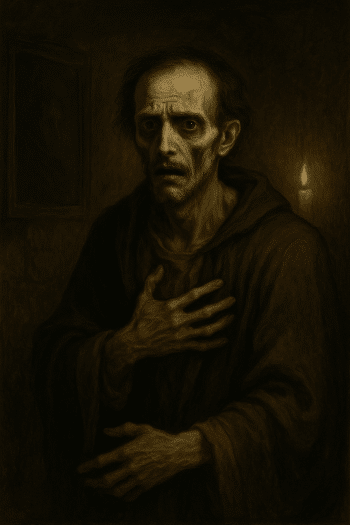
The woman who insisted she was dead
In 1880, a French neurologist named Jules Cotard met a patient who baffled him. She believed she had no brain, no nerves, no chest, no entrails. She insisted she did not need food because she no longer existed. Cotard called her condition le délire de négation — the delirium of negation. Today, we know it as Cotard’s Delusion: the belief that one is dead, missing body parts, or decomposing.
Living ghosts
For those who experience Cotard’s, daily life becomes a paradox. They walk, talk, breathe — yet they believe themselves to be corpses. Some describe smelling their own flesh rotting. Others insist their blood has dried up, or their organs are gone. A few believe they are immortal only because they cannot die twice.
It is more than a delusion; it is an existential fracture. To be alive yet convinced of death is to live in a ghost story written inside your own skull.
The neurology of nothingness
Modern brain scans show Cotard’s Delusion often arises from damage to areas involved in emotion and recognition, particularly the fusiform gyrus and the parietal lobes. In essence, the brain fails to connect the sight of the self with the feeling of being alive. The result is uncanny: the body is seen but not felt as real.
Some cases emerge after strokes, head trauma, or psychiatric illnesses like severe depression. It is as if the machinery of existence is intact, but the spark of “I am” flickers and dies.
When medicine meets metaphysics
Doctors treat Cotard’s with antidepressants, antipsychotics, or electroconvulsive therapy, and many patients recover. Yet the syndrome raises questions medicine alone cannot answer. What does it mean to believe you are dead while alive? Is “being alive” merely a conviction, a neural signal that can vanish? If existence depends on the brain’s wiring, then reality itself becomes negotiable.
A history of haunting cases
- In 1990, a Scottish man named Graham suffered a brain injury. He later told doctors, “I am dead. I’ve been taken to hell. Only my soul remains.” He stopped eating, convinced his organs were gone.
- Another patient traveled to cemeteries, believing he belonged there among the dead.
- Some have refused medical treatment, saying, “Why bother? You cannot cure death.”
The delusion is rare, but wherever it appears, it reads like a gothic tale — except it unfolds in hospital wards, not haunted castles.

Echoes in philosophy and art
Cotard’s Delusion is not just a medical oddity; it brushes against ancient questions. Philosophers from Descartes to Heidegger have asked: how do we know we exist? What assures us we are alive, not dreaming or deceived? Cotard’s patients embody these doubts in the most visceral way. Their condition is the nightmare of philosophy made flesh.
Artists, too, have found strange kinship with the syndrome. Novels and films often portray characters who wander the world believing themselves already dead, from Japanese horror stories to European existential cinema. Cotard’s Delusion gives a clinical name to an archetype as old as storytelling: the walking dead.
What it says about being human
At its core, Cotard’s reveals how fragile the sense of self is. We take for granted the simple conviction: I am alive. Yet that conviction is built from electrical signals, emotional feedback, and unconscious affirmations. If those connections fray, the certainty unravels.
To believe you are dead while alive is extreme, but it points to a truth for all of us: existence is partly biology, partly belief.
Closing thought
Cotard’s Delusion is both tragedy and revelation. For those who suffer, it is torment. For the rest of us, it is a mirror showing how much of life depends not just on living, but on knowing we live.
“To be alive is not only to breathe. It is to believe in breath.” — Stanley Armani
Cotard’s Delusion: The Syndrome of the Living Dead was authored by Stanley Armani. Stanley writes about the brain, learning, and the hidden patterns that shape how we think. His work explores the strange, the hopeful, and the extraordinary sides of human potential.