
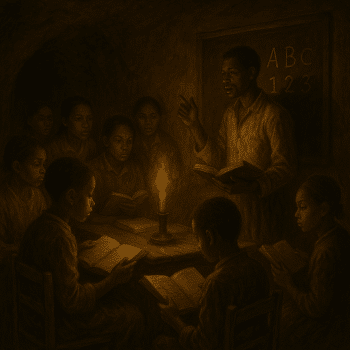
Classrooms without permission
Education is often pictured as neat rows of desks, chalk on a board, a teacher calling roll. But history tells another story — of schools that were never supposed to exist, lessons whispered in secret, and learning pursued in the shadows. Wherever knowledge was banned, humans created classrooms underground.
Hedge schools of Ireland
In the 18th and 19th centuries, after English laws suppressed Catholic education in Ireland, “hedge schools” emerged. They were often held outdoors behind hedgerows or in barns, taught by wandering teachers known as “hedge masters.” Children recited Latin and Greek declensions, copied arithmetic by firelight, and studied poetry forbidden in the official schools. Poorly paid but fiercely respected, the hedge masters carried Ireland’s cultural memory when authorities tried to erase it.
Freedom schools of America
During slavery in the United States, teaching enslaved people to read or write was often illegal. Still, secret classes met in stables, woods, and kitchens. The Bible was a common text, but literacy was more than religion — it was freedom itself. Frederick Douglass recalled learning the alphabet in defiance of the law, a step that opened the way to liberation.
A century later, during the Civil Rights Movement, “freedom schools” reappeared in the American South. They were designed to give African American children not only literacy but also lessons in history, citizenship, and dignity that the segregated schools denied them. Once again, knowledge became an act of rebellion.
Women’s schools in the shadows
In societies where women’s education was restricted, underground schools quietly flourished. In 19th-century Afghanistan, secret literacy circles formed for girls long before modern reforms. More recently, when the Taliban banned girls’ education, clandestine classrooms sprang up in basements and private homes. Teachers risked their lives to preserve what should never have been forbidden — the right to learn.
Polish “flying universities”
In partitioned Poland in the late 19th century, higher education for women and certain political groups was restricted. So students and professors created the “Flying University.” It had no fixed campus. Instead, classes met in apartments or rented halls, constantly shifting locations to avoid police detection. Among its students was a young woman named Marie Skłodowska, later known as Marie Curie, who carried that spirit of persistence into her scientific discoveries.

Secret schools of war
During World War II, Nazi occupation outlawed many forms of education in Poland, Czechoslovakia, and elsewhere. Yet professors and students organized covert universities, teaching banned subjects in attics and basements. Attending meant risking arrest or worse, but thousands chose knowledge over safety. In these hidden classrooms, culture and identity were preserved against regimes that sought to extinguish them.
Why underground schools mattered
What unites these stories is the recognition that knowledge is never neutral. To those in power, education can look dangerous because it shapes thought, identity, and resistance. To the learners, it is worth risking punishment because it shapes freedom, dignity, and possibility.
In hedge schools, literacy meant cultural survival. In slavery, it meant the hope of escape. In occupied Europe, it meant defiance. In each case, forbidden schools flourished not despite danger but because of it — the danger proved how valuable the knowledge was.
Echoes in today’s world
Even now, education sometimes happens underground. In refugee camps, volunteers set up informal classrooms. In places where girls are denied schooling, families create secret networks to share books and lessons. And in the digital world, students bypass firewalls and censorship to access forbidden knowledge. The underground classroom adapts, but it never disappears.
Closing thought
The history of underground schools reminds us that education is not just about classrooms and exams. It is about hunger — hunger for meaning, for selfhood, for a voice. When knowledge is forbidden, that hunger only grows stronger. And so the world keeps inventing schools in shadows, behind hedges, in basements, in basements of basements — wherever minds refuse to be chained.
“Education is never just permission. It is defiance, survival, and the human need to know.” — Stanley Armani
Education Underground: How Learning Thrived in Forbidden Schools Across History was authored by Stanley Armani. Stanley writes about the brain, learning, and the hidden patterns that shape how we think. His work explores the strange, the hopeful, and the extraordinary sides of human potential.