
Hello Sue,
I’ve done everything the school recommended. My daughter knows all her phonics sounds, can sound out words, and even does well with short spelling lists. But when she reads, it’s still slow and disconnected. She can pronounce the words but doesn’t seem to understand what she’s reading — it’s like the meaning isn’t there.
Her teacher says we just need to “keep practicing phonics,” but we’ve been at this for two years. I can’t help but wonder: Is phonics enough on its own to teach every child to read?
Cecilia
Dear Cecilia
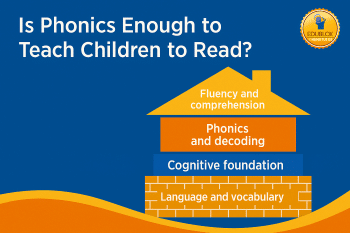
You’ve touched on one of the biggest misconceptions in reading instruction today. Phonics is essential — it teaches children how letters and sounds connect. But it’s not the whole house; it’s just the walls.
A well-built reading house needs much more than walls. Before a single brick of phonics can go up, two things must already be in place: the trench and the foundation. Without them, the structure will crack no matter how carefully you build.
1. The trench: Language and vocabulary
Every good house starts with a trench dug deep into the ground — this is where the structure finds stability. For reading, that trench is language and vocabulary.
A child must understand the words they’ll later learn to decode. Language — both spoken and heard — gives reading its meaning. It’s what allows us to connect the sound of “cat” to the image of a furry animal that purrs.
If this trench isn’t dug deeply enough, a child can sound out every syllable perfectly and still not grasp what the text means — like reading German fluently without understanding a word.
Children need years of conversation, stories, songs, and experiences to form that linguistic trench. Without it, phonics has nowhere to anchor meaning.
2. The foundation: Cognitive skills
Once the trench is prepared, you pour the foundation. In reading, that foundation is made of cognitive skills — attention, memory, sequencing, processing speed, and visual and auditory perception.
These are the invisible abilities that hold the reading process together. They allow a child to focus on print, remember what a word looked like a few lines ago, and follow the sequence of letters accurately.
If any part of that foundation is weak, reading will feel shaky and effortful, no matter how strong the phonics instruction.
3. The walls: Phonics and decoding
Now, and only now, can the walls go up. Phonics gives structure — the “how” of reading. It teaches children to decode, to translate written symbols into sounds.
Phonics is powerful, but it cannot stand on sand. Without the trench of language and the foundation of cognition, those decoding skills remain fragile. That’s why some children can recite every rule and still read haltingly or without comprehension.
4. The roof: Fluency and comprehension
Finally comes the roof — fluency and comprehension. This is where the house becomes a home. Fluent reading happens when decoding becomes automatic and understanding flows naturally. It’s the result of all the layers working together: cognitive strength, deep language, and solid phonics skills.
When any part is missing, the roof leaks — and comprehension suffers.
Why some children need more than phonics
Phonics alone works beautifully for children who already have a strong foundation in reading. But many struggling readers don’t. They need help building the underlying structure before phonics can take hold.
At Edublox, we not only build the walls and roof, but also strengthen the foundation of the house. That’s why our students don’t just decode words; they remember them, understand them, and eventually read with confidence and joy.
🌱 Sue’s takeaway
Phonics is vital, but it isn’t enough. Reading must be built like a house — first the trench of language and vocabulary, then the foundation of cognitive skills, then the walls of phonics and decoding, and finally the roof of fluency and comprehension. A house built on sand cannot stand, and neither can reading built on phonics alone.
Sue
More about Sue
Sue is an educational specialist in learning difficulties with a B.A. Honors in Psychology and a B.D. degree. Early in her career, Sue was instrumental in training over 3,000 teachers and tutors, providing them with the foundational and practical understanding to facilitate cognitive development among children who struggle to read and write. With over 30 years of research to her name, she conceptualized the Edublox teaching and learning methods that have helped thousands of children worldwide. In 2007, she opened the first Edublox reading and learning clinic; today, there are 30 clinics internationally. Sue treasures the “hero” stories of students whose self-esteem soars as their marks improve.