
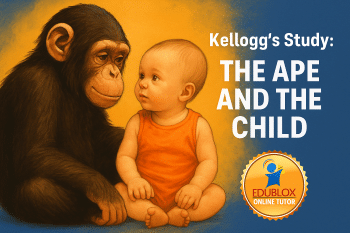
Winthrop Niles Kellogg (1898–1972) was a psychologist best known for his study, “The Ape and the Child,” which involved his observations of raising a chimpanzee infant alongside his son.
The 1930s produced some of the most unusual experiments in psychology, but few were as bold—or as controversial—as Winthrop Niles Kellogg’s. In an effort to explore the boundaries between human and animal development, Kellogg and his wife, Luella, undertook a study that would become famous under the title The Ape and the Child. Instead of observing primates in a laboratory, they brought one directly into their family home.
Kellogg’s idea was simple in outline but radical in practice: if a human infant and a young chimpanzee were raised side by side, treated alike in every respect, what similarities and differences would emerge? This question not only reflected curiosity about human uniqueness but also tapped into the growing scientific interest in comparative psychology.
Gua and Donald raised together
In June 1931, the Kelloggs welcomed into their Florida home a female chimpanzee named Gua, then seven and a half months old. At the time, their own son Donald was ten months old. For nine months, the two were raised almost as twins. The family kept careful day-by-day records, films, and systematic tests to document what unfolded.
Gua was dressed in napkins and later rompers, wheeled in a carriage, kissed good night, and given her meals in a high chair alongside Donald. She was not trained for circus-like stunts or tricks; instead, the Kelloggs intended to replicate, as faithfully as possible, what any attentive parents would do with a human child.
The experiment was unique in its immersive approach. Rather than observing animals at a distance, the Kelloggs lived with both children—human and chimpanzee—in the same household, blurring the lines between family life and science.
Gua becomes like a human
Over the months, Gua showed remarkable adaptability. She wore shoes and walked upright with surprising ease. She learned to eat with a spoon, drink from a cup, and even open doors before Donald mastered these skills. Her motor development was rapid, reflecting the biological advantage of primates, who mature earlier than humans.
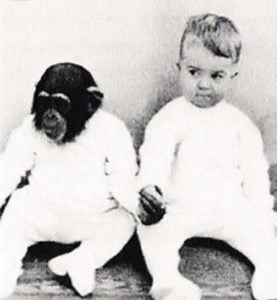
Perhaps most striking were Gua’s imitations of human affection and behavior. She hugged and kissed Donald and the parents, reacted with joy when they returned, and displayed distress when left alone—behaviors indistinguishable from those of a human toddler.
The chimpanzee also showed impressive comprehension of language. She could respond correctly to around ninety-five spoken words and phrases, such as “kiss Donald,” “shake hands,” or “show me your nose.” This capacity highlighted her ability to associate sounds with actions and objects, a cognitive feat that startled many observers.
Yet despite this human-like progress, there were limits. Gua never produced words herself, relying instead on grunts, squeals, and gestures to communicate her needs. Her toilet training also lagged behind Donald’s, hinting at more profound developmental differences.
“Definite limits “ to Gua’s humanization
For a time, Gua’s rapid progress seemed to outshine Donald’s. She climbed and jumped with agility, outperformed him in simple problem-solving tasks, and followed instructions more promptly. But as the experiment continued, a reversal occurred. Donald began to surge ahead in areas of symbolic thinking and verbal communication, leaving Gua behind.
The Kelloggs concluded that while non-human primates can acquire many social behaviors through close human association, there are definite limits to how far humanization can go. A chimpanzee could learn to use utensils, mimic affection, or even understand spoken commands, but she could not cross the threshold into human speech or higher-order reasoning.
These findings echoed broader truths about development: although anthropoids mature earlier, their intellectual growth plateaus sooner. A chimp may reach puberty by age four, while humans take more than a decade. The extended human childhood provides time for the brain to develop advanced cognitive and linguistic skills—capacities beyond the reach of even our closest relatives.
Legacy of the experiment
When the study ended after nine months, Gua was returned to the primate colony from which she had come. Donald continued his life as a human child, but the experience left its mark on the field of psychology. The Kelloggs published their findings in 1933 in the book The Ape and the Child, which remains a reference point in comparative psychology.
The experiment demonstrated vividly that environment shapes behavior, but it also underscored the enduring differences between species. A chimpanzee could be taught to live like a child, but not to think or speak like one. In this way, the study offered both a confirmation of nurture’s power and a reminder of nature’s boundaries.
Modern readers often view the experiment with mixed feelings. While scientifically intriguing, raising an ape and a child together raises ethical questions about both human and animal welfare. Yet it is precisely this tension—between curiosity and controversy—that has kept the study alive in textbooks, documentaries, and public imagination.
Nearly a century later, Winthrop Niles Kellogg’s bold undertaking continues to fascinate. It shows the lengths to which science has gone in exploring the nature of human uniqueness, and why the story of Donald and Gua remains one of the most unusual experiments in the history of psychology.
At Edublox, we support families facing learning challenges. Through cognitive training and live online tutoring, we help students with dyslexia, dysgraphia, dyscalculia, and other learning difficulties take steps toward confidence and success. Book a free consultation to explore how we can help.