
Statistics is often introduced through dry worksheets and abstract numbers, but it does not have to be taught that way. One of the best ways to help students understand statistics is to connect it to everyday experiences they already recognize and enjoy.
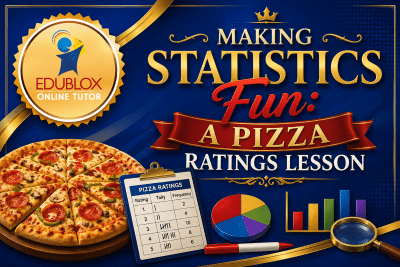
A simple example is a lesson based on pizza restaurant ratings. Students rate a restaurant on a scale from 1 to 5 and then use the results to explore important statistical concepts, such as tally tables, frequency distributions, mean, median, mode, percentages, and bar graphs. Because the topic feels familiar and realistic, students tend to engage more naturally with the mathematics.
Activities like these also help students see that statistics is not just about calculation. It is about interpreting information, spotting patterns, and making sense of data. Students can discuss questions such as whether most customers liked the restaurant, whether the average rating is high or low, and what the data suggests overall. In this way, statistics becomes practical and meaningful rather than mechanical.
Visual presentation also plays an important role. Colorful graphs, themed images, and step-by-step problem solving can make lessons feel less intimidating and more approachable. When students enjoy the process, they are often more willing to participate, think critically, and persist through more challenging tasks.
Another advantage of real-world statistics lessons is that they naturally integrate multiple skills. Students practice counting, organizing information, calculating averages and percentages, reading tables, and creating graphs — all within a single activity. They are not only learning mathematics; they are learning how data is used in everyday life.
For many students, especially those who struggle with traditional math instruction, this type of hands-on, visually engaging approach can make statistics feel more accessible and enjoyable.
Below is an example of a statistics lesson based on pizza restaurant ratings. It shows how real-world themes can be used to teach statistics concepts in a more engaging way.