
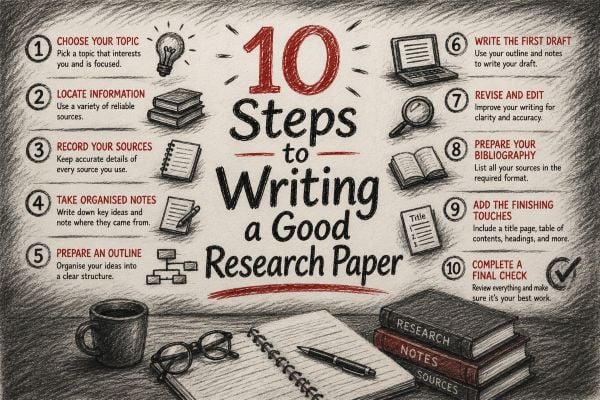
Writing a good research paper requires careful planning, reliable sources, and clear writing. Following these ten steps will help you produce a well-organised and informative paper.
Step 1. Choose a focused topic
Choose a topic that interests you and is neither too broad nor too narrow.
For example:
- Too broad: The Effects of Pollution
- Too narrow: The Effects of Pollution on Geese in the Northeast Section of Duluth, Minnesota
- Just right: The Effects of Pollution in Yosemite National Park
A focused topic makes research easier and leads to a stronger paper.
Step 2. Find reliable information
Gather information from a variety of trustworthy sources, such as:
- books
- encyclopaedias
- scholarly journals
- government websites
- educational websites
- reputable newspapers and magazines
Avoid relying on a single source.
Step 3. Record your sources
As you research, keep a record of every source you use. Record the author, title, publisher, publication date, website address (if applicable), and the date you accessed online sources.
Keeping accurate records now will save time later when preparing your bibliography.
Step 4. Take organised notes
Write down the important facts, ideas, statistics, and quotations from each source.
Keep your notes organised by topic, and clearly indicate which source each note came from.
Step 5. Prepare an outline
Before you begin writing, organise your ideas into a logical outline.
A simple outline might look like this:
- Introduction
- Main Point 1
- Main Point 2
- Main Point 3
- Conclusion
A good outline keeps your paper organised and helps your ideas flow logically.
Step 6. Write the first draft
Use your outline and notes to write your first draft.
At this stage, focus on getting your ideas onto paper rather than trying to make every sentence perfect.
Remember to cite any quotations, facts, or ideas that come directly from your sources.
Step 7. Revise and edit
Read through your paper carefully.
Check that:
- your ideas are clear,
- your paragraphs flow logically,
- your spelling and grammar are correct,
- your sentences are concise,
- and your facts are accurate.
It often helps to take a break before proofreading so you can spot mistakes more easily.
Step 8. Prepare your bibliography
List every source you used.
Arrange your bibliography according to the citation style required by your teacher (such as APA, MLA, or Harvard).
Step 9. Add the finishing touches
If required, include:
- a title page,
- a table of contents,
- page numbers,
- headings,
- figures or tables (if applicable),
- and correctly formatted citations.
Follow your teacher’s instructions carefully.
Step 10. Complete a final check
Before submitting your paper, ask yourself:
- Have I answered the research question?
- Is my paper well organised?
- Have I checked spelling and grammar?
- Have I cited all my sources correctly?
- Is my bibliography complete?
- Have I followed all formatting requirements?
A careful final review can prevent small mistakes from affecting your marks.