
When the lights go out
Imagine walking into a pitch-black room. For a moment, you’re helpless — reaching, fumbling, straining your ears. Now imagine the darkness never lifts. For many, blindness seems like a curtain drawn over the world. Yet the brain has a secret: it doesn’t surrender. It rewires, reshuffles, and retools. And in that darkness, it finds new ways to see.
The brain’s hidden talent: Cross-modal plasticity
The human brain is not a rigid circuit board but a living, shape-shifting network. When sight is lost, the occipital lobe — the patch of brain usually dedicated to vision — doesn’t sit idle. Instead, it’s repurposed. Blind individuals often show activation in their visual cortex when reading Braille, following rhythms, or localizing sounds.
Neuroscientists call this cross-modal neuroplasticity. In plain terms: one sense moves out, another moves in. It’s a rental agreement written in neurons.
The sound of shapes: Human echolocation
Some blind individuals develop the extraordinary ability to echolocate. By producing mouth clicks, tapping a cane, or snapping fingers, they can interpret returning echoes to gauge distance, direction, and even texture.
Brain scans of echolocators reveal that their “visual” cortex lights up during this process. In other words, they are literally seeing with sound. One man could distinguish between parked cars and moving vehicles by the quality of the echo. Another could identify the outline of a tree from across the street.
The eyes are silent, but the visual brain is very much awake.
Touch as vision
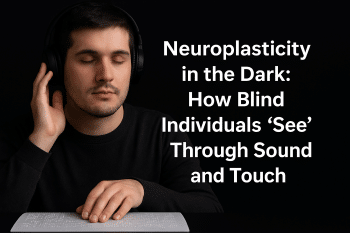
Braille is more than bumps on a page. For the blind, those tiny raised dots are transformed into letters, words, stories. Functional MRI scans show that as fingers glide over Braille, the visual cortex activates.
This means that blind readers aren’t just feeling words. They are, in a real neurological sense, seeing them with their fingertips. Raised-line drawings and tactile maps take this further: the hands become the eyes, tracing landscapes in relief.
Superpowers born of plasticity
Blind individuals often outperform sighted people in specific cognitive tasks. Their auditory memory tends to be sharper; their ability to pick apart complex soundscapes is uncanny. Many can hold long strings of information in working memory or detect subtle differences in pitch that escape the rest of us.

This isn’t mere compensation. It’s the brain flexing its adaptive muscles, turning loss into specialization.
Technology joins the conversation
Scientists and inventors have long wondered: if the brain can rewire itself, can we feed it new data streams? The answer is yes. Devices like The vOICe convert images from a camera into soundscapes, which users learn to interpret as visual patterns. BrainPort transmits visual signals as tiny electrical pulses on the tongue. Within weeks, users can navigate hallways or identify objects.
What seems like science fiction is, in truth, the brain doing what it has always done: making sense of whatever signals it can get.
The bigger lesson
Neuroplasticity in blind people is not just a story of adaptation — it’s a mirror held up to the rest of us. It reminds us that the brain is astonishingly flexible, that “hardwired” is mostly a myth, and that learning is never limited to childhood.
Lose one sense, and the brain amplifies another. Suffer injury, and it recruits new pathways. Struggle with a skill, and with repetition, the brain physically reshapes itself to meet the demand.
Closing thought
Darkness, it turns out, does not extinguish vision. It transforms it. The blind do not simply hear or touch more keenly; they see differently. Their brains show us resilience in its rawest form — proof that even when the lights go out, the mind can find its own sunrise.
✨“When sight is lost, the brain doesn’t go dark. It rewires, listens, touches — and invents new ways of seeing.” — Stanley Armani
Neuroplasticity in the Dark: How Blind Individuals “See” Through Sound and Touch was authored by Stanley Armani. Stanley writes about the brain, learning, and the hidden patterns that shape how we think. His work explores the strange, the hopeful, and the extraordinary sides of human potential.