
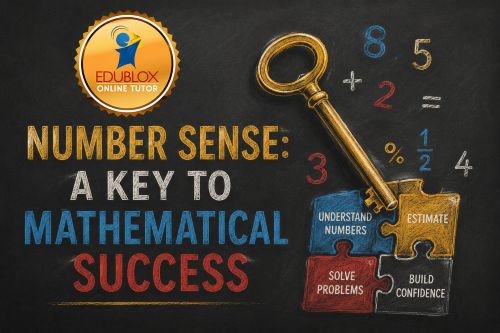
Many children can count to 100, yet still struggle to understand what numbers really mean. They may memorize facts, complete worksheets, and even pass tests, but without number sense mathematics often feels like a collection of rules rather than a meaningful system.
When parents think about mathematics, they often picture multiplication tables, long division, or algebra. Yet long before children encounter these topics, they begin developing a more fundamental ability: number sense. Number sense is an intuitive understanding of quantities, numerical relationships, and the ways numbers can be combined, separated, compared, and represented. It allows a child to recognize that 49 is close to 50, that 8 can be broken into 5 and 3, or that an answer of 302 to 31 + 27 cannot possibly be correct.
Number sense is much more than the ability to count or memorize number facts. It is a flexible understanding of numbers that gives those facts meaning. Research has repeatedly linked early numerical competence with later achievement in mathematics (Duncan et al., 2007; Jordan et al., 2009). A child may memorize procedures without developing this foundation. As mathematics becomes more complex, however, weak number sense often turns mathematics into a confusing collection of rules rather than a system that makes sense.
What number sense looks like
Number sense is made up of several closely connected abilities. Children learn to recognize small quantities without counting each object, compare the size of numbers, understand place value, estimate, use benchmarks such as 5, 10, and 100, and represent the same number in different ways. For example, 24 may be understood as two tens and four ones, 20 + 4, 6 × 4, or a number positioned between 20 and 30 on a number line.
Children with strong number sense do not rely on one rigid method. Instead, they choose strategies that best fit the problem. To solve 9 + 7, a child might move one from 7 to 9 and calculate 10 + 6. To solve 48 + 25, the child may add 20 and then 5. These strategies reflect an understanding of how numbers relate to one another rather than simple memorization. The National Mathematics Advisory Panel (2008) emphasized that proficiency requires both conceptual understanding and fluent access to useful facts and procedures.
Why it predicts later success
Early number competence matters because almost every area of mathematics builds on it. Place value supports multi-digit calculation and decimals. Part-whole relationships support fractions. Understanding numerical magnitude supports estimation and algebraic reasoning. In a longitudinal study, kindergarten number competence predicted mathematics outcomes through later elementary school (Jordan et al., 2009). Duncan et al. (2007) similarly found that school-entry mathematics knowledge was a powerful predictor of later academic achievement.
When the foundation is weak, children may compensate by counting every item, copying procedures, or memorizing answers without understanding. These strategies may work for a while, but they place a heavy burden on attention and working memory. The difficulty often becomes more apparent when problems involve larger numbers, unfamiliar wording, or several steps.
Possible signs of weak number sense
Children with weak number sense often count from one instead of counting on, confuse the value of digits in multi-digit numbers, struggle to compare numbers, cannot estimate whether an answer is reasonable, have difficulty breaking numbers apart, rely on a single procedure, or cannot explain why a method works.
Finger counting alone is not proof of a problem. Fingers provide a meaningful visual and physical model. The concern arises when a child remains completely dependent on counting every quantity and does not gradually develop more efficient strategies.
How parents can strengthen number sense
Number sense develops through meaningful experiences with numbers, discussion, visual models, games, and purposeful practice. Adults can ask children to estimate before counting, place numbers on an empty number line, compare two possible answers, or show the same quantity in different ways. Questions such as “How do you know?”, “Can you solve it another way?”, and “Does that answer make sense?” encourage mathematical reasoning.
Board games with numbered spaces are especially valuable because they connect spoken number words, written numerals, physical movement, and numerical magnitude. Ramani and Siegler (2008) found that playing a simple linear number board game produced broad and lasting improvements in young children’s numerical knowledge. Everyday situations such as shopping, cooking, sharing food, measuring ingredients, estimating travel time, and discussing scores also provide valuable opportunities.
Balancing understanding and fluency
Conceptual understanding and fluency are partners rather than opposites. Children benefit from knowing basic facts efficiently because automatic recall frees mental resources for more complex reasoning. However, fluency should be built on relationships and strategies rather than pressure to answer instantly. A learner who understands doubles, making ten, and place value has meaningful pathways for remembering facts.
Effective instruction therefore combines explicit teaching, visual models, guided practice, discussion, and opportunities to apply ideas. The goal is not simply to produce quick answers, but to help children become accurate, flexible, and confident mathematical thinkers.
Try this at home
Choose a number between 20 and 100. Ask your child to show it in at least four ways: with a drawing, as tens and ones, as two addition sentences, and on a number line. Then ask what number is 10 more, 10 less, and closest to it.
This activity gives parents a natural opportunity to identify and correct misconceptions without making the conversation feel like a test.
Conclusion
Number sense is the foundation on which all later mathematics is built. It supports calculation, estimation, problem-solving, and the ability to learn increasingly complex mathematical concepts. Children who struggle do not necessarily lack ability; they may simply need more time and better opportunities to connect symbols with quantities and procedures with meaning.
Parents and educators can strengthen this foundation by making numbers visible in everyday life, encouraging multiple strategies, and valuing explanations as much as answers. When children develop a flexible feel for numbers, mathematics becomes less about remembering isolated rules and more about understanding relationships.
Edublox offers an integrated approach that combines cognitive training with academic tutoring for students with dyscalculia and other learning challenges. We support families worldwide. Book a free consultation to discuss your child’s learning needs.
References:
- Duncan, G. J., Dowsett, C. J., Claessens, A., Magnuson, K., Huston, A. C., Klebanov, P., Pagani, L. S., Feinstein, L., Engel, M., Brooks-Gunn, J., Sexton, H., Duckworth, K., & Japel, C. (2007). School readiness and later achievement. Developmental Psychology, 43(6), 1428–1446. https://doi.org/10.1037/0012-1649.43.6.1428
- Jordan, N. C., Kaplan, D., Ramineni, C., & Locuniak, M. N. (2009). Early math matters: Kindergarten number competence and later mathematics outcomes. Developmental Psychology, 45(3), 850–867. https://doi.org/10.1037/a0014939
- National Council of Teachers of Mathematics. (2014). Principles to actions: Ensuring mathematical success for all.
- National Mathematics Advisory Panel. (2008). Foundations for success: The final report of the National Mathematics Advisory Panel. U.S. Department of Education.
- Ramani, G. B., & Siegler, R. S. (2008). Promoting broad and stable improvements in low-income children’s numerical knowledge through playing number board games. Child Development, 79(2), 375–394. https://doi.org/10.1111/j.1467-8624.2007.01131.x
- Siegler, R. S., & Ramani, G. B. (2008). Playing linear numerical board games promotes low-income children’s numerical development. Developmental Science, 11(5), 655–661. https://doi.org/10.1111/j.1467-7687.2008.00714.x