
Many children with dyslexia can sound out words correctly, yet still struggle to become fluent readers. They may read the same word repeatedly without recognizing it instantly the next time they encounter it. Reading remains slow, effortful, and mentally exhausting because too much cognitive energy is spent decoding individual words.
This often happens because fluent reading depends on more than phonics alone. It also depends on orthographic processing and orthographic mapping — two closely related but distinct processes involved in learning to read.
Understanding these concepts helps explain why some children quickly develop fluent reading skills while others continue to struggle despite years of instruction and practice.
What is orthographic processing?
Orthographic processing refers to the brain’s ability to recognize, analyze, remember, and work with written language patterns. It involves processing letters, letter sequences, spelling patterns, and familiar word forms efficiently.
Strong orthographic processing helps readers:
- recognize common spelling patterns,
- distinguish between similar-looking words,
- store and remember how words are spelled,
- and process written language rapidly and accurately.
For example, skilled readers immediately recognize that “night” is a correctly spelled English word while “ngiht” looks incorrect. They do not need to consciously sound out every letter because their brains automatically process orthographic patterns.
Orthographic processing plays an important role in reading fluency, spelling, and word recognition.
What is orthographic mapping?
Orthographic mapping is the process by which the brain permanently stores words for rapid, automatic retrieval.
During orthographic mapping, the brain connects at least three aspects of a word:
- its pronunciation,
- its spelling,
- and its meaning.
As these elements become bonded together in long-term memory, the word becomes instantly recognizable. The reader no longer needs to sound out the word letter by letter.
This process allows fluent readers to recognize thousands of familiar words almost instantly.
Orthographic mapping is therefore one of the foundations of fluent reading, accurate spelling, and efficient reading comprehension.
Orthographic processing vs. orthographic mapping
Although the terms are related, they do not mean exactly the same thing.
Orthographic processing refers to the brain’s ability to process and work with written language patterns efficiently.
Orthographic mapping is the process by which specific words are permanently stored in long-term memory for automatic recognition.
In simple terms:
- orthographic processing requires the visual perceptual processing of written patterns,
- while orthographic mapping requires visual memory and long-term storage of written words linked to their sounds and meanings.
Both are essential for fluent reading development.
The brain’s automatic word-recognition system
Research shows that reading depends on multiple brain systems working together efficiently.
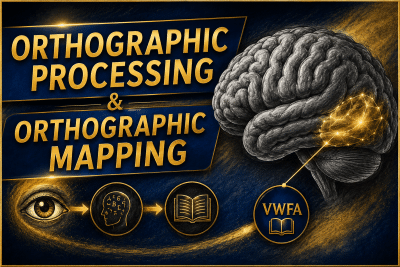
One important area, located in the left occipitotemporal region of the brain, is often referred to as the visual word form area (VWFA) or the brain’s “visual dictionary.” This area allows skilled readers to recognize familiar words rapidly and automatically.
Beginning readers rely heavily on sounding out words. Fluent readers, however, increasingly rely on automatic word recognition because many words have already been orthographically mapped and stored in long-term memory.
When this automatic recognition system develops inefficiently, children may continue decoding the same words repeatedly without developing reading fluency.
Why some plateau despite phonics instruction
Phonics instruction is critically important because it teaches children how letters and sounds correspond. Structured literacy approaches such as Orton-Gillingham can be highly effective in developing decoding skills.
However, some children continue to struggle even after learning phonics rules. They may decode accurately yet remain slow, hesitant readers.
This often occurs because fluent reading requires more than decoding alone. It also requires efficient orthographic mapping, rapid retrieval, automatic word recognition, and the development of the brain systems involved in fluent reading.
A child may learn to sound out a word correctly during a lesson but fail to store that word efficiently for future automatic recognition.
The role of cognitive skills
Orthographic processing and orthographic mapping rely on several cognitive skills working together efficiently. These include phonological awareness, attention, processing speed, rapid naming, sequential processing, visual perceptual processing, visual memory, and long-term memory.
Visual-perceptual processing helps the brain recognize, analyze, and discriminate among written letter patterns and word forms. Visual memory and long-term memory help store those patterns for rapid and automatic retrieval.
When these cognitive systems are weak, children may repeatedly decode the same words, failing to develop fluent word recognition. Reading can remain slow and mentally demanding because too much cognitive effort is spent analyzing individual words.
This is one reason some children require more than just phonics instruction. Fluent reading depends not only on decoding skills, but also on how efficiently the brain processes, stores, and retrieves written language over time.
The importance of repetition and automaticity
Fluent reading develops gradually through repeated exposure, structured practice, cumulative review, and the development of automaticity.
Many struggling readers require significantly more repetition and reinforcement than typical readers before words become stable and automatic.
This principle has long been recognized by educators working with struggling learners. Reading skills strengthen through repeated, meaningful practice over time, allowing the neural pathways involved in reading to become increasingly efficient.
Without sufficient repetition and reinforcement, reading skills may remain fragile and inconsistent.
Final thoughts
Reading fluency is not simply the ability to sound out words. Fluent reading depends on the brain’s ability to efficiently process written language patterns, permanently store words in long-term memory, and retrieve them rapidly and automatically.
Orthographic processing and orthographic mapping, therefore, play central roles in reading development.
Understanding these processes helps explain why some children struggle to move beyond effortful decoding — and why effective dyslexia intervention often requires more than phonics instruction alone.
Edublox offers dyslexia treatment based on four pillars: structured literacy instruction, cognitive training, orthographic mapping, and the application of sound learning principles. We work with families worldwide. Book a free consultation to explore how we can support your child’s learning journey.
Orthographic Processing and Orthographic Mapping was authored by Sue du Plessis (B.A. Hons Psychology; B.D.), a dyslexia specialist with 30+ years of experience in learning disabilities.
Edublox is proud to be a member of the International Dyslexia Association (IDA), a leading organization dedicated to evidence-based research and advocacy for individuals with dyslexia and related learning difficulties.