
Introduction
Few learning difficulties have been studied as extensively as dyslexia. Over the past 125 years, researchers have proposed a variety of explanations for why some individuals struggle to learn to read despite adequate intelligence, opportunity, and instruction. At different times, dyslexia has been attributed to visual problems, language difficulties, auditory deficits, attentional weaknesses, genetic influences, and differences in brain development.
As scientific methods improved, researchers began testing these theories and refining their understanding of reading and reading failure. Some studies confirmed existing ideas, while others challenged long-held assumptions. Together, they transformed dyslexia from a poorly understood condition into one of the most researched learning difficulties in the world.
The studies and researchers reviewed below represent some of the most important milestones in that journey. While no single study explains every aspect of dyslexia, each contributed a vital piece to the puzzle and helped shape modern thinking about reading difficulties.
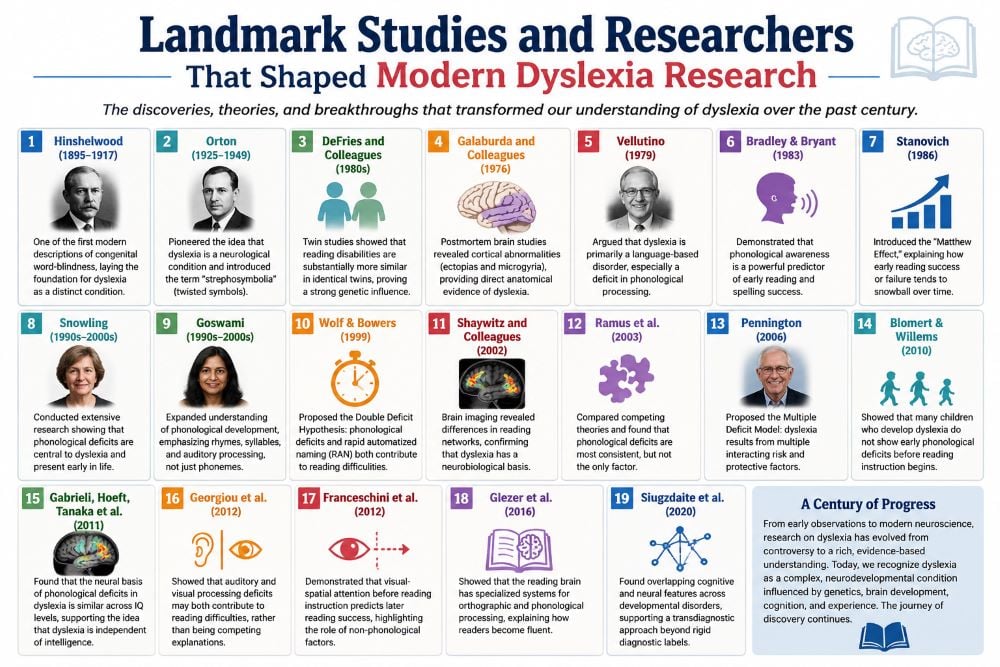
1. James Hinshelwood (1895–1917): Dyslexia Is Real
Although the term dyslexia had already been introduced by Rudolf Berlin in 1887, Scottish ophthalmologist James Hinshelwood played a crucial role in bringing attention to the condition. Through detailed case studies, he described intelligent children who struggled to learn to read despite normal vision, adequate schooling, and otherwise typical development.
Hinshelwood referred to the condition as “congenital word blindness.” He believed that affected individuals had difficulty recognizing written words due to a developmental weakness in the brain’s visual memory for words. Although later researchers would challenge aspects of his explanation, his observations were remarkably accurate.
Most importantly, Hinshelwood helped establish that severe reading difficulties could occur in otherwise capable learners. At a time when struggling readers were often viewed as lazy, inattentive, or intellectually limited, his work laid the foundation for the scientific study of dyslexia.
2. Samuel Orton (1925–1937): The First Neurological Theory
American neurologist Samuel Torrey Orton is often regarded as one of the pioneers of dyslexia research. Working with children who struggled to learn to read, he observed symptoms such as letter reversals, directional confusion, poor spelling, and difficulties learning written language.
Based on these observations, Orton proposed his famous theory of “strephosymbolia,” meaning “twisted symbols.” He suggested that dyslexia resulted from mixed cerebral dominance, causing confusion in the perception of letters and words.
Although Orton’s theory is no longer accepted in its original form, his influence remains profound. He shifted attention from the eyes to the brain, helping establish the idea that reading difficulties could have neurological origins. His work also inspired the multisensory instructional approaches that later evolved into the Orton-Gillingham method.
3. DeFries and Colleagues: Dyslexia Runs in Families
One of the most important questions in dyslexia research has been whether reading difficulties are inherited. Beginning in the 1980s, a series of twin studies led by John DeFries and colleagues provided compelling evidence that genetics plays a significant role.
By comparing identical twins, who share nearly all their genes, with fraternal twins, who share only about half their genes, researchers found that reading disabilities were substantially more similar in identical twins. These findings demonstrated that genetic factors contribute strongly to individual differences in reading ability.
These studies transformed the field. Dyslexia could no longer be explained simply by poor teaching, inadequate motivation, or unfavorable home environments. While environmental factors remained important, the evidence clearly showed that heredity plays a major role in reading development.
4. Albert Galaburda et al. (1985): Dyslexia and Brain Development
A major breakthrough came when Albert Galaburda and colleagues conducted postmortem examinations of the brains of individuals who had experienced dyslexia. Their findings revealed subtle abnormalities in the cerebral cortex, including ectopias and microgyria—small disruptions in normal brain organization.
These discoveries provided some of the first direct anatomical evidence that dyslexia is associated with differences in brain development. The findings helped establish dyslexia as a neurodevelopmental condition rather than merely an educational or behavioral problem.
Galaburda’s work also launched an entirely new line of research. Scientists began investigating how differences in brain development might influence language, reading, and learning, paving the way for modern neuroimaging studies.
5. Frank Vellutino (1979): The Rise of the Phonological Theory
For much of the twentieth century, dyslexia was widely viewed as a visual disorder. This began to change with the publication of Frank Vellutino’s influential book, Dyslexia: Theory and Research.
Vellutino carefully reviewed the available evidence and argued that many apparent visual symptoms of dyslexia could be explained by underlying language difficulties. In particular, he emphasized weaknesses in phonological processing—the ability to perceive, remember, and manipulate the sounds of language.
His work marked a turning point in dyslexia research. Over the following decades, phonological explanations became increasingly dominant, shaping assessment practices, intervention programs, and scientific theories of reading disability. Whether researchers ultimately agreed or disagreed with all aspects of the phonological deficit theory, Vellutino’s contribution fundamentally changed the direction of the dyslexia field.
6. Bradley and Bryant (1983): Phonological Awareness and Reading
In a landmark study, Lynette Bradley and Peter Bryant demonstrated a strong relationship between children’s phonological awareness and their ability to learn to read. Children who were better able to recognize and manipulate speech sounds generally made greater progress in reading and spelling.
The study helped establish phonological awareness as one of the most important predictors of reading success. It also influenced classroom practice by encouraging educators to include phonological awareness activities in early literacy instruction.
Although later researchers would debate the precise nature of the relationship, Bradley and Bryant’s work played a major role in the rise of the phonological deficit theory of dyslexia.
7. Keith Stanovich (1986): Matthew Effects in Reading
Keith Stanovich introduced the concept of the Matthew Effect in reading, borrowing the term from the biblical principle that “the rich get richer and the poor get poorer.”
Stanovich argued that children who learn to read successfully tend to read more, acquire larger vocabularies, and develop stronger language skills. Struggling readers, by contrast, often read less, limiting their opportunities to improve. As a result, the achievement gap between strong and weak readers widens over time.
The Matthew Effect remains one of the most influential concepts in literacy research and helps explain why early intervention is so important.
8. Margaret Snowling: Refining the Phonological Deficit Theory
Few researchers have done more to advance our understanding of dyslexia than Margaret Snowling. Over decades of research, she helped refine and strengthen the phonological deficit theory, arguing that difficulties in processing language sounds are a central characteristic of many individuals with dyslexia.
Snowling’s work demonstrated that phonological difficulties can be identified long before formal reading instruction begins and often persist into adulthood. Her research also highlighted the close relationship between spoken language and reading development.
By combining rigorous research with practical applications, Snowling helped shape modern approaches to dyslexia assessment, diagnosis, and intervention.
9. Usha Goswami: Expanding Our Understanding of Phonological Development
While phonological awareness became increasingly important in reading research, Usha Goswami argued that phonological development is more complex than simple awareness of individual speech sounds.
Her research emphasized the importance of larger sound units, such as rhymes and syllables, in early reading development. She also explored how auditory processing and speech rhythm may contribute to reading difficulties.
Goswami’s work broadened the discussion beyond phonemes alone and helped researchers develop a more nuanced understanding of the relationship between spoken language and reading acquisition.
10. Wolf and Bowers (1999): The Double Deficit Hypothesis
For many years, researchers focused primarily on phonological deficits as the defining characteristic of dyslexia. Maryanne Wolf and Patricia Bowers challenged this view by proposing the Double Deficit Hypothesis.
Their research showed that some struggling readers have difficulties not only with phonological processing but also with rapid automatized naming (RAN)—the ability to quickly name familiar symbols, letters, numbers, colors, or objects. They found that children with deficits in both areas often experienced the most severe reading difficulties.
The Double Deficit Hypothesis broadened the field’s understanding of dyslexia and highlighted the importance of both reading fluency and decoding.
11. Sally Shaywitz and Colleagues (2002): Brain Imaging and Reading Networks
Advances in brain imaging allowed researchers to observe the reading brain in action. Using functional magnetic resonance imaging (fMRI), Sally Shaywitz and colleagues identified differences in the neural networks used by skilled and struggling readers.
Their research showed reduced activation in left-hemisphere posterior reading systems among individuals with dyslexia, accompanied by increased activity in other brain regions that appeared to compensate for reading difficulties.
These findings provided compelling evidence that dyslexia is associated with differences in how the brain processes written language and helped establish neuroscience as a major area of dyslexia research.
12. Franck Ramus et al. (2003): Testing Competing Theories of Dyslexia
By the early 2000s, researchers had proposed numerous explanations for dyslexia, including phonological, auditory, visual, and cerebellar theories. Franck Ramus and colleagues sought to evaluate these competing explanations by examining multiple cognitive abilities in adults with dyslexia.
Their findings showed that phonological deficits were the most consistent characteristic, but they also found evidence of additional difficulties in some individuals but not others.
The study helped explain why no single theory could account for every case of dyslexia and paved the way for more comprehensive models of reading disability.
13. Bruce Pennington (2006): The Multiple Deficit Model
Bruce Pennington challenged the search for a single cause of dyslexia by proposing the Multiple Deficit Model. Rather than viewing dyslexia as the result of one underlying weakness, he argued that reading difficulties arise from multiple interacting risk and protective factors.
These factors may include phonological processing, language development, attention, memory, processing speed, genetics, and environmental influences. Different individuals may arrive at similar reading difficulties through different developmental pathways.
Pennington’s model transformed modern thinking about dyslexia and remains one of the most influential theoretical frameworks in the field.
14. Blomert and Willems (2010): Not All Dyslexic Children Show Early Phonological Deficits
One of the strongest arguments for the phonological deficit theory was the belief that phonological difficulties could be identified before children learned to read. Blomert and Willems challenged this assumption.
Following children from kindergarten into the early school years, they found that many children who later developed dyslexia did not show obvious phonological deficits before formal reading instruction began.
Their findings suggested that phonological difficulties may not be the sole pathway to dyslexia and encouraged researchers to consider a broader range of contributing factors.
15. Gabrieli, Hoeft, Tanaka et al. (2011): Dyslexia Is Independent of IQ
For many years, dyslexia was often defined as an unexpected difficulty learning to read despite average or above-average intelligence. This led to the widespread use of IQ-achievement discrepancy models in diagnosis.
Using neuroimaging techniques, Gabrieli, Hoeft, Tanaka, and colleagues demonstrated that the brain basis of the phonological deficit in dyslexia was similar across individuals with different IQ levels. In other words, the underlying neural characteristics of dyslexia did not depend on intelligence.
The study helped weaken support for IQ-discrepancy definitions of dyslexia and reinforced the view that dyslexia is a specific reading difficulty rather than a consequence of low intelligence.
16. Georgiou et al. (2012): Auditory and Visual Processing May Both Matter
For decades, researchers have debated whether dyslexia is primarily an auditory-phonological disorder or whether visual processing difficulties also play a role. Georgiou and colleagues examined both possibilities.
Their findings suggested that auditory and visual processing deficits are not necessarily competing explanations. Instead, different processing weaknesses may coexist and contribute to reading difficulties in different ways.
The study encouraged researchers to move beyond simple either-or explanations and consider how multiple cognitive processes interact during reading development.
17. Franceschini et al. (2012): Visual-Spatial Attention Predicts Reading Acquisition
One of the most influential studies of the past two decades examined whether pre-reading visual-spatial attention could predict later reading success.
Franceschini and colleagues found that preschool children’s performance on visual-spatial attention tasks predicted their future reading ability. Importantly, these measures predicted reading development even before formal reading instruction began.
The findings revived interest in visual-attentional factors in dyslexia and demonstrated that reading acquisition may depend on more than phonological skills alone.
18. Glezer et al. (2016): Orthographic Processing and the Reading Brain
As researchers learned more about the brain’s reading network, attention increasingly turned to orthographic processing—the ability to recognize and remember written words and letter patterns.
Using advanced neuroimaging techniques, Glezer and colleagues demonstrated that parts of the reading network show distinct sensitivity to orthographic and phonological information. Their findings provided evidence that skilled reading depends on both systems working together.
The study helped explain how readers progress from laborious decoding to rapid, automatic word recognition and strengthened interest in orthographic processing and orthographic mapping.
19. Siugzdaite et al. (2020): Beyond Diagnostic Labels
Traditionally, researchers studied dyslexia, ADHD, dyscalculia, and other developmental disorders as separate conditions. Siugzdaite and colleagues challenged this approach by examining patterns of brain organization across diagnostic categories.
Their findings suggested that developmental disorders may share overlapping cognitive and neural characteristics. Rather than neatly fitting into distinct categories, many learning difficulties appear to lie along interconnected developmental pathways.
The study reflects a growing trend in modern research: moving away from rigid labels and toward a deeper understanding of the cognitive and neural systems that underlie learning and development.
Conclusion: What 125 Years of Research Have Taught Us
The history of dyslexia research is not the story of a single discovery. Rather, it is the story of scientists gradually uncovering the many factors that contribute to reading success and reading failure.
Over the past century, researchers have proposed visual theories, phonological theories, auditory theories, genetic explanations, attentional theories, and multiple-deficit models. Some theories gained widespread acceptance, while others were modified or challenged by new evidence. Each contributed important insights and advanced the field.
One lesson emerges repeatedly from the landmark studies reviewed here: dyslexia is complex. No single factor explains every case. Genetics, brain development, phonological processing, rapid naming, visual attention, orthographic processing, and broader cognitive systems all appear to play a role. Different individuals may arrive at similar reading difficulties through different developmental pathways.
The field has also become increasingly interdisciplinary. What began with observations by physicians and neurologists now includes contributions from psychologists, educators, geneticists, neuroscientists, and cognitive scientists. Modern researchers are less concerned with defending a single theory and more interested in understanding how multiple factors interact to influence reading development.
Although many questions remain unanswered, these landmark studies transformed dyslexia from a poorly understood condition into one of the most intensively studied learning difficulties worldwide. Their legacy continues to shape how dyslexia is understood, assessed, and treated today.
Edublox provides support for students with dyslexia, dyscalculia, and other learning difficulties. We help students worldwide overcome academic challenges and reach their full potential. Book a free consultation today to discuss your child’s needs and explore how we can help them succeed.
Landmark Studies in Dyslexia Research was authored by Sue du Plessis (B.A. Hons Psychology; B.D.), an educational specialist with 30+ years’ experience in the learning disabilities field.