
We discuss 45 signs of dyslexia in children — the typical errors dyslexic kids make in reading and writing, and how dyslexia shows up in the classroom.
We specialize in helping children overcome dyslexia signs and symptoms. Book a free consultation to discuss your child’s learning needs.
Table of contents:
- A mom tells her story
- What is dyslexia?
- Signs of dyslexia in reading
- Signs of dyslexia in writing
- Signs of dyslexia in the classroom
A mom tells her story
One day after school, Jonathan’s mom told him to remove his lunchbox from his schoolbag, put his shoes away, and drop his clothes in the washing basket. About 10 minutes later, she popped into his room, only to see him sitting on his bed — still in his school uniform.
“Jonathan was always in trouble with me because I thought he wasn’t listening,” says his mom, Ann. “I thought he was lazy.”
To make matters worse, seven-year-old Jonathan often received poor behavior reports at school and was mocked by his friends because he couldn’t read or spell.
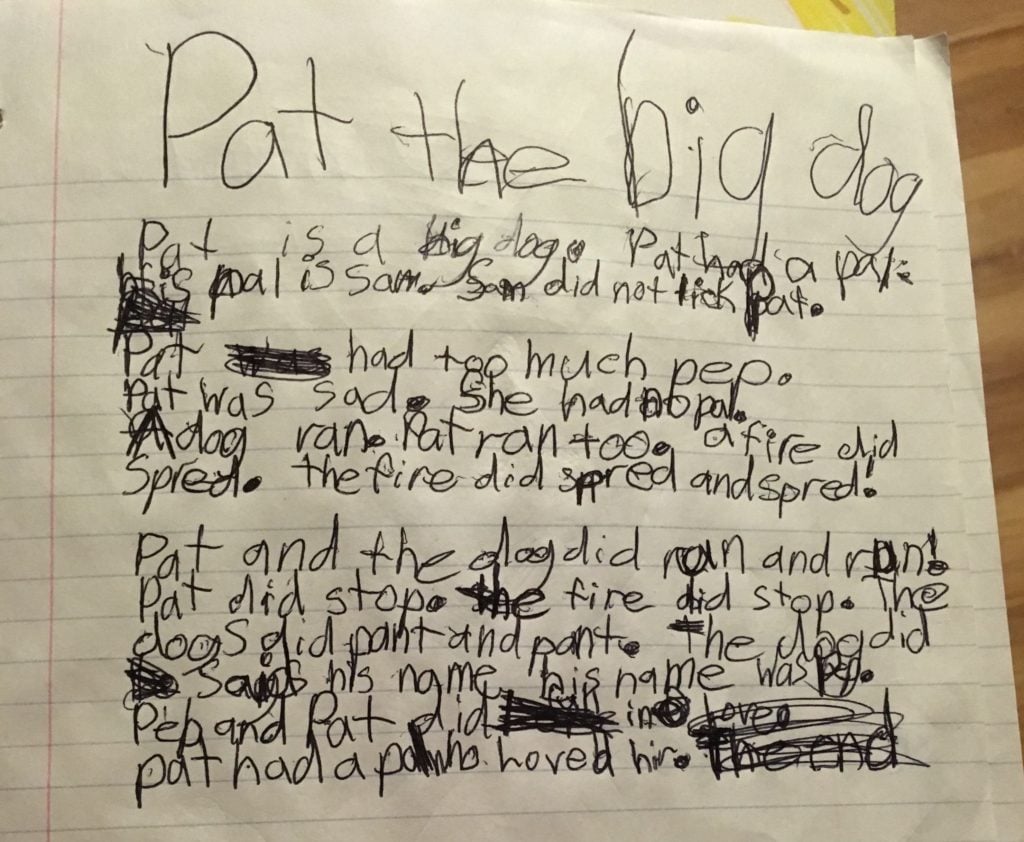
At the end of 2nd grade, Ann and her husband, John, were told their son might have to repeat the year. He was swapping the letters “b” and “d,” he couldn’t spell, his concentration was poor, and he struggled to distinguish left from right.
“Jonathan didn’t want to go to school,” Ann says. “He said he wished he were dead so he wouldn’t have to battle anymore.”
It turns out Jonathan wasn’t lazy.
He has dyslexia.
What is dyslexia?
The term dyslexia comes from the Greek words dys (meaning difficult) and lexis (meaning word).
Developmental dyslexia refers to reading difficulties in children and youth. It is different from reading problems caused by brain injury later in life.
Historically, dyslexia was defined as a discrepancy between reading ability and intelligence — the idea that a “true dyslexic” child was bright but struggled unexpectedly with reading.
However, brain imaging studies such as those by Tanaka et al. (2011) and Simos et al. (2014) found no meaningful brain differences between poor readers of different IQ levels. Poor readers, regardless of IQ, showed reduced activity in specific reading-related brain areas.
Today, the British Dyslexia Association describes dyslexia broadly as:
“A combination of abilities and difficulties defined by its characteristics that affect the learning process in one or more areas of reading, spelling, and writing.”
The Diagnostic and Statistical Manual of Mental Disorders, Fifth Edition, uses the term Specific Learning Disorder with impairment in reading. It considers dyslexia “specific” because it is not primarily due to:
- Intellectual disability
- Global developmental delay
- Hearing or vision disorders
- Neurological or motor disorders
In short, dyslexia is a specific difficulty in learning to read, spell, and write — despite adequate instruction and opportunity.
Signs of dyslexia in reading
When you look closely at how children with dyslexia read, clear patterns emerge. They may:
- Read a word on one page, but do not recognize the same word on the next.
- Read single words slowly and inaccurately without contextual clues.
- Misread words with similar shapes (e.g., form instead of from).
- Add or omit letters (cold → could).
- Reverse letter sequences (was → saw).
- Confuse orientation letters (b/d, p/q, m/w, n/u).
- Substitute similar-looking words (house → horse).
- Substitute meaning-related words (trip → journey).
- Omit small words (a, the, of).
- Drop suffixes (talking → talk).
- Read aloud in a slow, choppy, monotone way.
- Become visibly tired after short reading sessions.
- Show poor reading comprehension but strong listening comprehension.
- Lose their place, skip lines, or reread lines.
- Avoid reading tasks.
- Frequently ask for breaks.
- Complain of headaches, eyestrain, or dizziness.
- Squint, tilt their head, or cover one eye while reading.
- Say the words “move” on the page.
Signs of dyslexia in writing
Children with dyslexia usually show a considerable difference between their ability to tell you something and write it down. They may:
- Avoid writing.
- Write everything as one continuous sentence.
- Struggle with punctuation, not using capitals or periods, or using them randomly.
- Struggle to understand the difference between a complete sentence and a sentence fragment.
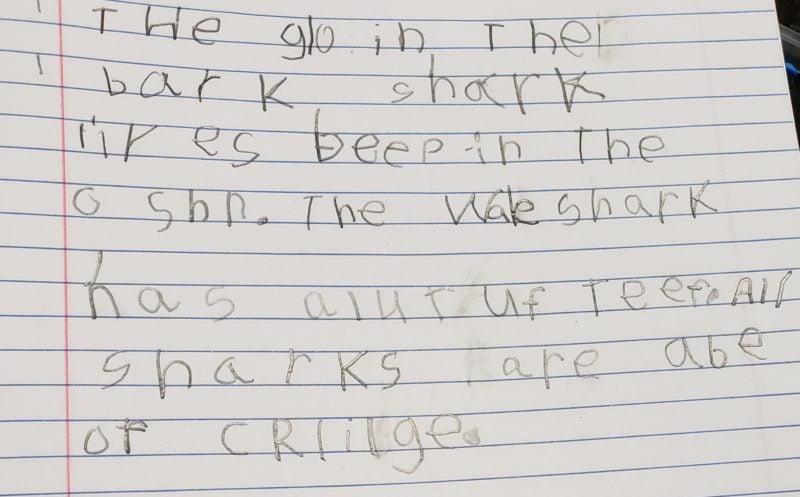
- Misspell many words, even simple ones they are “sure” they know how to spell.
- Mix up b and d, m and n, and other look-alike letters.
- Take a very long time to write.
- Produce messy or illegible handwriting.
- Use odd spacing between words or ignore margins completely.
- Use a mix of print and cursive, and uppercase and lowercase letters.
- Fail to notice spelling errors when rereading their work — they read what they meant to write, not what they actually wrote.
- Switch hands when writing beyond the typical age for establishing hand dominance.
Signs of dyslexia in the classroom
If a child has dyslexia, their teacher may notice many of the reading, writing, and spelling errors listed above. Signs of dyslexia that often show up specifically in the classroom include:
- Noticeable and unexpected low achievement.
- Conspicuous disorganization.
- Distractibility or a short attention span.
- Persistent left/right confusion.
- Difficulty making sense of instructions.
- Difficulty remembering words and learning new words.
- Immature speech (such as “gween” for “green”).
- Inability to always understand what is said to them.
- Difficulty finding appropriate words when telling stories.
- Trouble with time, counting, and calculating.
- Difficulty sequencing days of the week and months of the year.
- Failure to finish work on time.
- Appearance of being lazy, unmotivated, or frustrated.
- Awkwardness or clumsiness.
Overcoming the signs of dyslexia
While children do not ‘outgrow’ dyslexia, it can be overcome with proper treatment. Below are success stories of children who overcame their dyslexia signs and symptoms and the difference it made to their lives:
Authored by Sue du Plessis (B.A. Hons Psychology; B.D.), a reading specialist with 30+ years of experience in the learning disabilities field.
References:
- American Psychiatric Association (2022). Diagnostic and statistical manual of mental disorders (5th ed. revised). Washington, DC: American Psychiatric Publishing.
- Simos, P. G., Rezaie, R., Papanicolaou, A. C., & Fletcher, J. M. (2014). Does IQ affect the functional brain network involved in pseudoword reading in students with reading disability? A magnetoencephalography study. Frontiers in Human Neuroscience, 7(932).
- Tanaka, H., Black, J. M., Hulme, C., Stanley, L. M., Kesler, S. R., Whitfield-Gabrieli, S., Reiss, A. L., Gabrieli, J. D. E., & Hoeft, F. (2011). The brain basis of the phonological deficit in dyslexia is independent of IQ. Psychological Science, 22(11): 1442-51.
- Wood, T. (2011). Overcoming dyslexia for dummies. Indianapolis: Wiley Publishing, Inc.