
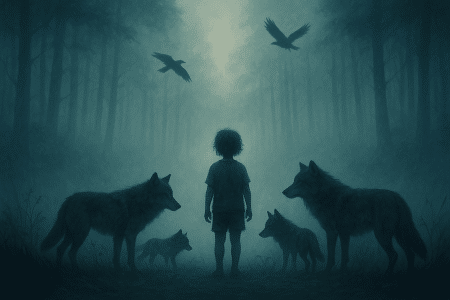
What happens when a child grows up without human contact—and what it reveals about how we learn. Discover 15 real (and debated) cases of feral children and their impact on language development, brain growth, and early learning.
Feral children are minors who have lived isolated from human contact from a very young age, often without proper socialization, language exposure, or care. Some are raised (or survive) among animals, while others are severely neglected or confined by abusive guardians. As a result, they may display animal-like behaviors—walking on all fours, growling, or lacking speech.
Though some stories are exaggerated or disputed, feral children provide a rare and powerful window into human development. They reveal what happens when the brain is deprived of the experiences it expects—and needs—to develop normally.
15 Cases of Feral Children
Below is a curated list of well-known cases. Some are carefully documented; others are based on limited or disputed evidence. Together, they paint a consistent picture: without early human interaction, development is deeply disrupted.
1. Victor of Aveyron (France, 1797)

Found alone in the woods at around age 12, Victor had survived for years without human contact. Dr. Jean Marc Gaspard Itard attempted to teach him language and social behavior. Victor never acquired normal speech but did develop emotional connections. His case helped lay the foundations of modern developmental psychology.
2. Oxana Malaya (Ukraine, 1991)
At age 3, Oxana was neglected by her alcoholic parents and began living in a dog kennel, where she adapted to the animals around her. By the time she was found at 8, she barked, ran on all fours, relied on her sense of smell, and had very limited language. After her rescue, she received intensive therapy and gradually learned to speak and interact with others. Although she never fully caught up developmentally, she made significant progress.
3. Genie (USA, 1970)
Not quite feral, but severely isolated. Genie was confined from 20 months to 13 years old with almost no human interaction. She couldn’t speak and showed major developmental delays when found. After the rescue, she learned some words but never developed normal grammar. Her case became key evidence for a critical period in language development.
4. Kamala and Amala (India, 1920)
Perhaps the most famous (but disputed) case. These two girls were allegedly found in a wolf den in Midnapore. Father Singh, a missionary, claimed they howled, preferred raw meat, and walked on all fours. Kamala lived longer and eventually learned to walk upright and speak a few words. However, later evidence suggests they may have had developmental conditions, and parts of the story were likely exaggerated.
5. John Ssebunya (Uganda, 1988)
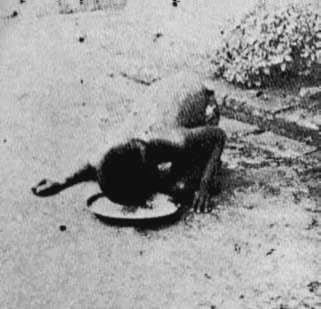
After witnessing his father murder his mother, John fled into the forest at age 3. He reportedly lived with vervet monkeys for several years. When rescued around age 6, he showed monkey-like behaviors such as climbing, eating fruit, and making high-pitched sounds. He later learned to speak and joined a children’s choir, eventually touring internationally.
6. Marina Chapman (Colombia, 1950s)
Kidnapped and abandoned in the jungle at around age 5, Marina claims she survived for several years with capuchin monkeys. She says they taught her how to find food and avoid danger. Eventually discovered by hunters, she was later sold into domestic servitude before being rescued and adopted. Her memoir sparked both interest and skepticism, but she maintains her story is true.
7. The Leopard Boy (India, 1912)
Discovered near Lucknow, this boy was reportedly found among leopards after hunters killed the animal believed to have raised him. He displayed unusual behaviors, including growling, darting movements, and an extreme fear of humans. Documentation is limited, and much of the story remains uncertain, but attempts to rehabilitate him were unsuccessful.
8. The Chicken Boy of Fiji (1978)
A young boy was found living in a chicken coop after years of neglect. He pecked at food, flapped his arms, and made clucking sounds. Like other cases of severe isolation, his behavior reflected his environment. With care and education, he made some progress, but he struggled to fully adapt to normal social life.
9. Ivan Mishukov (Russia, 1996)
At age 4, Ivan ran away from an abusive home and survived on the streets of Moscow with a pack of stray dogs. He fed them scraps and, in return, they protected him from danger. When authorities captured him, they had to separate him from the dogs first. Unlike many cases, Ivan adjusted well and later lived a relatively normal life.
10. The Gazelle Boy (Sahara Desert, 1950s)

A French anthropologist reportedly observed a boy running with gazelles in the Sahara. He moved quickly on all fours and was able to evade capture. Little is known about his origins, and the story remains largely anecdotal, but it has become part of the lore surrounding feral children.
11. Madina (Russia, 2013)
At just 3 years old, Madina lived in extreme neglect, surrounded mainly by dogs. When found, she walked on all fours, barked, and showed limited response to human interaction. Because she was still young, she responded well to intervention and quickly began learning language and social behavior, showing how early rescue can change outcomes.
12. Ivan the Bear Boy (Russia, 2008)
A boy was discovered living in a remote cabin under severe neglect, with stories claiming a bear had cared for him. While the animal element is likely exaggerated, he was found unable to speak and displaying animal-like behaviors. The case blends fact and folklore but reflects the effects of extreme isolation.
13. Daniel, the Andes Goat Boy (Peru, early 1990s)
Daniel was reportedly abandoned in the Andes and survived among goats. He moved on all fours, had adapted joints, and ate grass and roots. Rescued around age 12, he was fearful of humans and resisted clothing. Documentation is limited, and much of the account comes from local reports.
14. Shamdeo (India, 1972)
Found at about 4 years old in Uttar Pradesh, Shamdeo was reportedly living with wolves. He showed behaviors such as eating raw meat and avoiding human contact. Although he later showed small signs of social awareness, he never developed speech and remained severely impaired throughout his life.
15. The Monkey Girl of Sekandra (India, 2017)
A girl around 8 years old was found in a forest, moving and vocalizing in ways similar to monkeys. Rescuers reported she crawled, screeched, and ate from the ground. Authorities later suggested she may have been abandoned due to a disability rather than raised by animals. She showed some improvement after receiving care, but her early history remains unclear.
What we learn from feral children
These stories do far more than confirm the importance of education. They show that a human being can—and must—be educated to become fully human.
A bear does not have to learn to be a bear; it simply is one. A duck needs no lessons in duckmanship. An ant leads a perfectly satisfactory life without instruction. Even when isolated from birth, animals usually retain their instincts. A cat raised among dogs will still behave like a cat.
Humans are different.
A child enters the world remarkably unequipped. The knowledge needed to function as a human being is not dormant, waiting to unfold. It must be built, step by step, through experience and interaction.
This is why feral children struggle so profoundly. When early interaction is missing, it is not only social development that is affected—learning itself is disrupted at its foundation. One of the clearest patterns is language: children who miss out early may learn words later, but rarely develop full, fluent speech.
But language is only part of the picture. These children also struggle with attention, memory, sequencing, and logical thinking. These abilities do not develop automatically. They require interaction, repetition, and structured experience. Without these, the brain does not build the pathways needed for efficient learning.
Learning is layered. Development moves from sensory input to pattern recognition, to memory, to language, and finally to reasoning. When early layers are weak or missing, later learning becomes slow, effortful, and often incomplete.
The problem is not just missed content—it is missed development.
Traditional approaches often focus on more practice—more reading, more math, more exposure. But if the underlying cognitive structures are not in place, progress remains limited. Learning cannot simply be accelerated; it must sometimes be rebuilt from the ground up.
Feral children represent the extreme edge of deprivation, but their stories carry a broader message. The brain depends on early experience. Learning is not automatic. Foundations matter.
And that is where real change begins.
Edublox offers cognitive training and live online tutoring to students with dyslexia, dysgraphia, dyscalculia, and other learning disabilities. Our students are in the United States, Canada, Australia, and elsewhere. Book a free consultation to discuss your child’s learning needs.
- What Are Feral Children? 15 Real Stories was authored by Sue du Plessis (B.A. Hons Psychology; B.D.), an educational specialist with 30+ years of experience in the learning disabilities field.
- Edublox is proud to be a member of the Institute for the Advancement of Cognitive Education (IACE), an organization dedicated to improving learning through cognitive education and mediated learning approaches.