The scientist of memory’s shadow
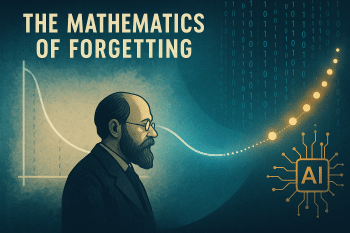
In the 1880s, a German psychologist named Hermann Ebbinghaus sat alone, memorizing lists of nonsense syllables. Day after day, he tested how much he could recall. What emerged was not just data, but a curve that described the rhythm of human forgetting. At first, memory falls off a cliff. Later, it slopes gently. This became known as the forgetting curve.
The shape of forgetting
Ebbinghaus discovered that most information evaporates quickly. Within an hour, half can be gone. By a day, only about a third remains. After that, the decline slows; what survives often stays for the long haul. Forgetting, it turns out, has a shape. Memory doesn’t trickle away randomly — it obeys a curve.
Spaced repetition before algorithms
Ebbinghaus also noticed something hopeful: review the material at the proper intervals, and the curve bends. Forgetting slows, memory strengthens. This insight is the backbone of modern study techniques like spaced repetition. Long before flashcard apps, one man’s self-experiments revealed the mathematics of how to remember.
Enter the machines
Fast-forward 140 years. AI researchers now use algorithms to predict not just the general curve of forgetting but the specific probability that you will forget a single fact at a given moment. Systems like SuperMemo, Anki, and AI-driven learning platforms adapt in real time, deciding the exact day when you should see that French verb or that medical formula again.
Curves meet codes
AI models treat your memory like data points in a giant equation. Every time you recall a fact, it shifts the curve a little higher. Every time you stumble, the system recalibrates. The machines are, in a way, drawing your personal forgetting curve. Where Ebbinghaus saw one universal slope, AI plots thousands of individual ones.

The paradox of forgetting
Forgetting is not failure — it’s function. A brain that remembered everything would be paralyzed by clutter. Ebbinghaus’s curve and AI predictions together show us the balance: memory is strongest when forgetting is managed, not eliminated.
Why this matters now
In an age where knowledge doubles every few years, we can’t afford to rely on brute force memory. We need strategies, and AI offers them. But the root lesson is older: the rhythm of remembering is mathematical, predictable, almost musical. Ebbinghaus heard it in nonsense syllables. Today’s algorithms play the same tune in silicon.
Closing thought
The mathematics of forgetting may sound cold, but it carries hope. If forgetting has a shape, remembering can have one too. And when humans and machines study together, the cliff of forgetting becomes less steep, the slope more forgiving, and memory something we can sculpt rather than fear.
“Forgetfulness is not the end of memory. It’s the reason memory endures.” — Stanley Armani
The Mathematics of Forgetting: Ebbinghaus’s Curve Meets Modern AI Predictions was authored by Stanley Armani. Stanley writes about the brain, learning, and the hidden patterns that shape how we think. His work explores the strange, the hopeful, and the extraordinary sides of human potential.