
More than decoration
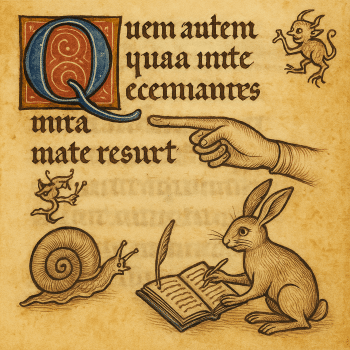
Leafing through a medieval manuscript, you might sense something whispering from the margins: a pointing finger, a doodled rabbit fleeing from slimy snails, a scribe’s terse complaint about translation. These scribbles—marginalia—aren’t idle doodles. They’re encrypted trace-letters of thought: little curiosities that crack open how medieval readers thought, reacted, and lived.
Pointing fingers and octopus reminders
One favorite tool: the manicula, a tiny pointing hand sketched beside text to mark a juicy passage or raise a silent question. Sometimes it’s just a finger. Other times—playful and baroque—the scribe turned the limb into an octopus, tears curling into tentacles, almost feeling perky at its own intensity.
Marginal monsters and suppressed laughter
Then there are the bizarre drawings—snails attacking knights, fighting rabbits, or disembodied body parts—that spill from the margins of sacred texts. These grotesques were neither purely decorative nor fully theological. Scholars now see them as visual punchlines, mnemonic anchors, or even private protests against rigid authority. In their wild humor, they remind us that the margin is where the mind lets go of decorum.
Secret notes and tiny complaints
Some marginal notes were literal or critical. A frustrated monk wrote, “Whoever translated these Gospels did a very poor job!” scrawled in Latin-Dutch, his pen shaking with annoyance. Others hide more subtle personal messages—reasons why a scribe selected a particular text or jotted down a local proverb beside a lesson, offering rare glimpses of their intellectual habits.

Visual mnemonics and playful memory aids
Marginal imagery also helped readers remember. Snails, rabbits, assassinated knights—these bizarre visuals served as memory pegs and visual commentary. Rich colors and strange scenes made the page linger in the mind, long after the text was forgotten.
Hidden messages in decoration
In some manuscripts, borders and initials conceal messages: the initial “S” might curve into an abbreviation reminding readers “nota bene” (note well). It’s a whisper folded into art: reminding readers where to pay attention or how the scribe intended meaning to be read.
Marginalia as a human fingerprint
Every scribble—from the doodle to the sigh—makes the manuscript human. The margins were not neutral zones but imaginative spaces where readers argued, joked, and let slip who they were. They remind us that reading was not passive but dialogic: a conversation across centuries.
Closing thought
Marginalia are the echoes of long-quiet minds, pointing, scribbling, mocking, agreeing, disagreeing. They show that thinking doesn’t always happen in tidy lines: sometimes it blooms sideways, in scribbles, in clues, in marginal escapes.
“Sometimes the smartest thoughts hide in the edges—where the mind breaks free of expectation.” — Stanley Armani
The Secret Life of Marginalia: What Medieval Notes Reveal was authored by Stanley Armani. Stanley writes about the brain, learning, and the hidden patterns that shape how we think. His work explores the strange, the hopeful, and the extraordinary sides of human potential.