
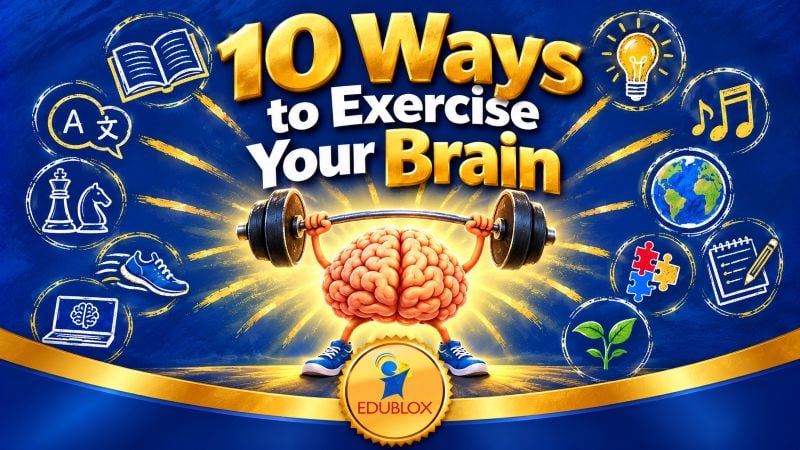
We know that physical exercise helps keep our muscles strong and our hearts healthy. But what about our brains? Just as our bodies benefit from regular activity, our brains benefit from being challenged, stimulated and engaged in learning.
The human brain has a remarkable ability to adapt and change throughout life. This ability, known as neuroplasticity, allows the brain to form and strengthen neural connections in response to learning and experience. Although certain cognitive abilities, particularly processing speed, may decline with age, others, such as vocabulary and accumulated knowledge, can remain stable or even improve for many years. Growing older does not mean that learning must come to an end.
The familiar saying “use it or lose it” contains an important truth: regularly engaging in mentally stimulating activities helps us maintain and develop the skills we use. However, not all brain exercises produce the same benefits. Becoming better at a particular puzzle, for example, does not necessarily mean that our memory or intelligence will improve across the board. The best approach is to combine different activities that challenge the brain in meaningful ways.
Here are ten ways to give your brain a workout.
1. Learn a new language
Learning another language is one of the most demanding activities you can undertake. It involves remembering vocabulary, understanding grammatical rules, recognizing unfamiliar sounds and learning to express ideas in new ways. Language learning engages several cognitive processes, including attention, memory, auditory perception and mental flexibility.
You don’t need to become fluent to benefit from the challenge. Start with a few words and phrases each day, gradually build your vocabulary and practice constructing sentences. Listening to conversations, reading simple texts and speaking with native speakers can make the experience more rewarding. And if you eventually visit a country where the language is spoken, you’ll have an excellent opportunity to put your new skills into practice.
2. Play board games that require thinking
Board games can provide an enjoyable mental workout, particularly when they require planning, reasoning, memory and decision-making. Chess is a classic example. Players must analyze situations, anticipate their opponent’s moves and think several steps ahead. Other possibilities include checkers, bridge, Scrabble, strategy games and memory games. Even a game such as Trivial Pursuit can challenge your ability to retrieve information from long-term memory.
Choose games that require you to think rather than relying entirely on chance. Better still, play against someone whose skills challenge your own. As you improve, increase the difficulty or try a different game. The aim is to keep learning rather than simply repeating something you have already mastered.
3. Learn to play a musical instrument
Learning to play an instrument is a wonderful way to challenge the brain because it requires several abilities to work together. When playing the piano, for example, you must read musical notation, recognize patterns, remember sequences, coordinate your hands and listen carefully to the sounds you produce. These activities engage attention, auditory processing, memory, motor coordination and timing.
Learning an instrument also provides opportunities for repetition and gradual improvement. A piece of music that initially seems impossible can become manageable through systematic practice. You don’t need to start young or aim to become a professional musician. Adults can learn to play the piano, guitar, violin or almost any other instrument. The important thing is to choose something you enjoy and practice regularly.
4. Break out of your daily routine
Much of everyday life is performed almost automatically. We follow the same route to work, shop at the same supermarket and complete familiar tasks without giving them much thought. Although routines are useful, occasionally doing things differently can encourage us to pay closer attention.
Try taking a different route to work, exploring an unfamiliar neighborhood or visiting a place you have never been before. You might also try preparing a new recipe, rearranging a familiar activity or learning how to use an unfamiliar piece of technology. These experiences require observation, decision-making and sometimes problem-solving. Simply changing your route will not necessarily make you more intelligent, but introducing novelty into your daily life can create valuable opportunities for learning.
5. Challenge yourself with crossword puzzles
Crossword puzzles are a convenient and enjoyable way to exercise certain mental skills. They require you to interpret clues, retrieve words from memory, draw on general knowledge and consider alternative answers. Other puzzles, such as Sudoku, logic problems and number puzzles, challenge different abilities.
Keep a puzzle book nearby and use those spare moments when you would otherwise reach for your phone. However, remember that practice tends to improve the skills being practiced. Becoming an expert crossword solver does not automatically improve every aspect of cognition. For a broader challenge, alternate between different kinds of puzzles and gradually increase their difficulty.
6. Explore online brain games
The internet offers an enormous selection of games designed to challenge attention, memory, reasoning, processing speed and problem-solving. Some involve remembering sequences, others require identifying patterns, making quick decisions or solving increasingly difficult problems. These activities can be entertaining and provide structured opportunities for practice.
However, it is important to distinguish between improving performance on a particular game and improving general cognitive abilities. Research into commercial brain-training programs has produced mixed results, particularly regarding how well improvements transfer to unrelated everyday tasks. Choose games that challenge you, monitor your progress and vary the activities you practice. For people with specific cognitive weaknesses, carefully structured training that progressively increases task demands may be more useful than playing random games.
7. Exercise your body
One of the best-supported ways to promote brain health is through regular physical exercise. Walking, swimming, cycling, dancing and other forms of aerobic activity improve cardiovascular health and support blood flow to the brain. Research also suggests that regular physical activity can benefit aspects of cognition, including executive functioning and memory, particularly in older adults.
You don’t have to become a marathon runner. A brisk daily walk is an excellent starting point. Activities that combine movement with mental demands, such as learning dance steps or participating in a sport, can provide an additional challenge because they require coordination, attention and planning. Physical activity also supports sleep and emotional well-being, both of which are important for effective thinking and learning.
8. Read, write and discuss what you learn
Reading exposes the brain to new information, vocabulary, ideas and perspectives. Whether you enjoy novels, biographies, history or science, reading requires you to interpret language, follow sequences, remember information and make connections.
But don’t stop at reading. Writing about what you have learned adds another dimension to the exercise. It requires you to organize information, retrieve relevant details and express your thoughts clearly. You might keep a journal, write short articles, summarize interesting books or exchange letters with friends. Discussing what you have read can also be valuable. Explaining an idea to someone else often reveals how well you understand it.
Choose subjects that genuinely interest you, but occasionally venture beyond your usual reading material. Learning something unfamiliar provides a different kind of challenge.
9. Learn a new practical skill
Learning doesn’t have to take place in a classroom or involve books. You can challenge your brain by learning photography, gardening, woodworking, painting, computer programming, sewing or cooking. Practical skills often involve planning, remembering instructions, recognizing patterns, solving problems and coordinating movements.
Imagine learning photography. You must understand lighting, composition, camera settings and how different adjustments affect the final picture. Initially, every step requires conscious thought. With practice, some processes become more automatic, allowing you to tackle increasingly complex challenges. This illustrates an important principle of learning: skills develop through instruction, practice, feedback and repetition. Choose something you’ve always wanted to learn and give yourself permission to be a beginner.
10. Stay socially and mentally engaged
Meaningful social interaction is another important part of maintaining cognitive health. Conversations require us to listen, interpret language, remember information, respond appropriately and consider other people’s perspectives. Social activities can also provide opportunities to learn new things and solve problems together.
Join a book club, volunteer, attend a class, participate in community activities or arrange regular gatherings with friends. Activities that combine social interaction with learning may be particularly rewarding. A discussion group, language class or community project can challenge several abilities simultaneously. Research has linked greater social engagement with better cognitive health, although this does not mean that socializing alone can prevent cognitive decline. The important thing is to remain involved, curious and connected to the world around you.
Keep challenging your brain
The brain is not a muscle, but the comparison is useful in one important respect: abilities develop through use, practice and appropriate challenges. Neuroplasticity makes learning possible throughout life. Whenever we acquire a new skill, practice a difficult task or strengthen an existing ability, the brain can adapt in response to experience.
However, there is no single activity that exercises every cognitive skill, and no brain game can guarantee protection against dementia or age-related decline. A varied approach is therefore best. Combine mental challenges with physical activity, adequate sleep, social interaction and opportunities to learn.
Most importantly, don’t simply repeat activities that have become easy. Challenge yourself to improve, master something unfamiliar and gradually take on more demanding tasks.
Your brain has an extraordinary capacity to learn. Give it opportunities to do so, whatever your age.