

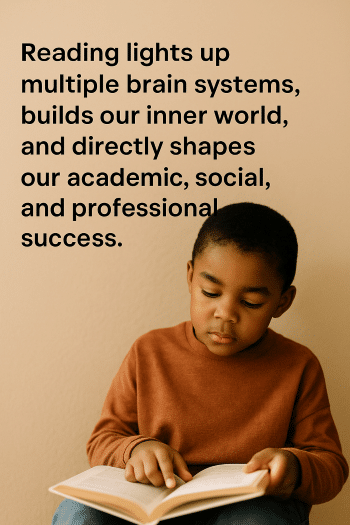
Reading may look like a quiet, passive act — a person, a book, and a cozy chair. However, beneath that stillness is a cognitive fireworks show. Reading lights up multiple brain systems, builds our inner world, and directly shapes our academic, social, and professional success. Here are 40 evidence-based reasons why reading isn’t just important — it’s essential.
Cognitive development and neurological impact
- Enhances brain connectivity – Reading stimulates and strengthens the brain’s default mode network (DMN), enhancing its capacity for memory, introspection, and empathy (Andrews‑Hanna, 2012).
- Increases gray matter – Regular reading and intensive reading instruction have been shown to increase gray matter volume in regions associated with language and executive function (Krafnick et al., 2011).
- Improves theory of mind – Fictional narratives sharpen our ability to understand and interpret others’ thoughts and emotions. By immersing in characters’ inner lives, fiction acts as a “mental gym” for social cognition (Kidd & Castano, 2013).
- Promotes neuroplasticity – Both children and adults show measurable changes in the brain’s visual word form area (VWFA) and increased connectivity between visual and language regions after learning to read or undergoing literacy training—clear evidence of neuroplastic adaptation (Dehaene, 2009).
- Activates mirror neurons – Emotionally rich or action-driven stories activate brain regions that simulate characters’ experiences. This mirror neuron activity fosters emotional empathy and deepens learning through embodied simulation (Speer et al., 2009; Hsu et al., 2014).
- Sustains crystallized intelligence – Longitudinal studies show that consistent reading and print exposure across the life-span helps preserve vocabulary, knowledge, and comprehension. These habits buffer against age-related decline in verbal cognition, supporting lifelong intellectual resilience (Stanovich & Cunningham, 1992).
Literacy and language proficiency
- Builds vocabulary faster than conversation – Children’s books contain approximately 50% more rare words than child-directed speech or prime-time television. This richer exposure accelerates vocabulary growth, providing young readers access to a more linguistically diverse environment than everyday conversation (Hayes & Ahrens, 1988).
- Improves grammar through implicit learning – Regular exposure to well-formed written language helps readers subconsciously internalize syntactic patterns. Over time, this builds intuitive grammatical competence—even without direct instruction (Rebuschat, 2013).
- Boosts spelling and decoding – Repeated reading strengthens connections between graphemes (letters) and phonemes (sounds), supporting automatic word recognition and accurate spelling. This process, known as orthographic mapping, is fundamental to fluent literacy (Ehri, 1988).
- Enhances language acquisition in bilinguals – Bilinguals consistently outperform monolinguals on metalinguistic tasks, such as judging grammatical correctness and analyzing word structures. Reading in both languages deepens this awareness and enhances cognitive flexibility and attentional control (Bialystok, 2001).
- Supports lifelong language development – A meta-analysis of nearly 100 studies (ages 2–21) found strong links between print exposure and language outcomes—including oral language, comprehension, spelling, and general knowledge. These effects grow stronger with age, peaking in early adulthood (Mol & Bus, 2011).
Development and early education
- Predicts academic success – Early reading proficiency is among the strongest predictors of later academic achievement. Children who read well by third grade are significantly more likely to excel across subjects and complete high school (Snow et al., 1998).
- Supports phonological awareness – Phonological awareness—the ability to hear and manipulate sounds in spoken language—is a foundational skill for learning to read and spell. Reading strengthens this awareness by reinforcing sound-symbol patterns (Moats & Tolman, 2009).
- Improves self-regulation in children – Regular reading, especially shared reading experiences, supports attention control and impulse regulation. Children exposed to structured reading routines demonstrate stronger self-regulation skills in early childhood (Piccolo et al., 2022).
- Boosts narrative skills – Exposure to stories builds children’s ability to structure, sequence, and express ideas—skills essential for both social communication and academic writing (Barton-Hulsey et al., 2022).
- Inspires curiosity – Reading introduces children to unfamiliar ideas, cultures, and perspectives—sparking curiosity and motivating them to explore beyond their immediate experiences (Gopnik et al., 2017).
Academic and professional performance

- Correlates with academic achievement across subjects – Reading proficiency is not just linked to language arts but also predicts stronger math and science performance. Large-scale assessments like the OECD’s PISA consistently show that students with higher reading literacy score better across all domains (OECD, 2019).
- Fuels independent learning – Skilled readers can access knowledge independently—whether in school, at work, or for personal growth. Reading enables learners to teach themselves, opening the door to lifelong education and professional development (Cunningham & Stanovich, 1998).
- Strengthens critical thinking – Students with stronger reading skills demonstrate better analysis, inference, evaluation, and explanation abilities. Deep, reflective reading fosters the reasoning skills essential for critical thinking and informed decision-making (Ramadhani et al., 2023).
- Improves writing quality – Greater reading volume improves spelling, vocabulary, and syntax—all of which contribute directly to writing quality. Readers develop more sophisticated language models, which they transfer to their writing (Cunningham & Stanovich, 1991).
- Enhances test performance – Children with higher reading volume outperform peers on verbal intelligence, comprehension, and general knowledge measures—all strong predictors of standardized test success (Stanovich & Cunningham, 1992).
Emotional, psychological, and social development
- Reduces stress – Just six minutes of reading can lower stress levels by up to 68%, making it more effective than taking a walk or listening to music (Lewis, 2009)*.
- Improves emotional regulation – Developmental bibliotherapy—using children’s literature to explore feelings—helps children identify and manage emotions, regulate impulses, and build self-awareness (Heath et al., 2017).
- Fosters empathy – Stories with diverse characters and emotional depth help readers feel with others. Bibliotherapy builds compassion and social awareness by allowing children to “step into others’ shoes,” strengthening emotional connection and care for others (Heath et al., 2017; Mar et al., 2009).
- Offers identity affirmation – Representation in literature fosters belonging and self-esteem. When children see their own backgrounds, challenges, or cultures reflected in stories, it validates their experiences and encourages positive self-identity (Heath et al., 2017).
- Helps process trauma – Bibliotherapy has been shown to support adolescents through trauma, grief, and family transitions (Pardeck, 1994).
Cognitive health and aging
- Delays cognitive decline – Regular participation in cognitive activities like reading is linked to a 33% lower risk of Alzheimer’s disease and slower decline in global cognition and working memory—even after adjusting for age and education (Wilson et al., 2013).
- Strengthens memory – Plot-based reading exercises working memory and boosts retention. Lifelong cognitive activities—especially starting in childhood—are associated with better mental resilience and memory function in older age (Wilson et al., 2002).
- Encourages metacognition – Skilled readers monitor and adjust their comprehension strategies—planning, evaluating, revising—as they read. Such metacognitive awareness correlates with improved text comprehension and is a marker of effective learning (Ahmadi et al., 2013).
- Improves focus and attention span – Neuroimaging shows enhanced activation in attentional networks during deep reading (Jacobs, 2015). In children, stronger reading skills are linked to better sustained attention, which in turn supports reading comprehension (Arrington et al., 2014).
Life skills and career development
- Improves communication skills – Reading extensively enriches vocabulary and expressive language, directly transferring into stronger speaking and writing abilities. For example, one study found that extensive reading led to measurable gains in spoken fluency and expressive skills through enhanced word knowledge (Krashen, 2004).
- Expands background knowledge – Readers accumulate a broad base of factual and contextual knowledge that supports critical thinking, adaptability, and cross-cultural competence—attributes highly valued in professional settings and recommended as foundational “21st‑century skills” by leading educational frameworks (Hirsch, 2003).
- Helps decision-making – Reading builds a richer base of factual and contextual knowledge, improving judgment, critical evaluation, and decision-making. Information-rich individuals are more capable of weighing alternatives and anticipating outcomes (Stanovich & West, 2007).
- Increases employability – Low literacy is strongly linked with underemployment, unemployment, and job instability. Individuals with higher reading levels are more likely to complete school successfully and gain access to career opportunities (OECD, 2013).
- Promotes lifelong learning – Engaging regularly with reading cultivates self-directed learning habits; studies show strong correlations between information literacy and a sustained commitment to ongoing personal and professional development (Büyükgoze, 2023).
Broader benefits
- Encourages creativity – Reading diverse texts enhances imagination and creative thinking. A study in Brazilian primary school students found significant positive correlations between reading skills and creativity, supporting the role of literacy in developing original thinking (Bezerra et al., 2022).
- Inspires innovation – Many creative breakthroughs emerge from connecting disparate ideas across fields. Reading widely encourages analogical reasoning and fosters the kind of associative thinking that underpins innovation (Johnson, 2011).
- Facilitates cultural empathy – Literature provides intimate access to lives, values, and customs different from one’s own. Reading multicultural narratives improves cultural competence and fosters empathy by helping readers see the world through others’ eyes (Chaudhary, 2018).
- Develops perseverance – Grappling with complex texts and layered meanings builds intellectual stamina. The effort required to comprehend difficult material nurtures persistence, patience, and a growth mindset—skills that extend far beyond the reading experience (Guthrie et al., 2004).
- Builds mental resilience – Reading stories of adversity and triumph allows readers to rehearse life’s challenges emotionally. Engaging with such narratives has been shown to bolster coping mechanisms and build psychological strength, especially in youth (Mar et al., 2006).
Final word
Reading is far more than a scholastic milestone or a leisure activity — it is a transformative process that molds the brain, opens the heart, and unlocks the world. Whether you’re looking to enhance your child’s cognitive development, fortify your own mind, or enjoy a quiet moment, reading delivers on every front.
Edublox offers cognitive training and live online tutoring to students with dyslexia, dysgraphia, dyscalculia, and other learning disabilities. Our students are in the United States, Canada, Australia, and elsewhere. Book a free consultation to discuss your child’s learning needs.
References:
- Ahmadi, M. R., Ismail, H. N., & Abdullah, M. K. K. (2013). The importance of metacognitive reading strategy awareness in reading comprehension. English Language Teaching, 6(10), 235–246.
- Andrews-Hanna, J. R. (2012). The brain’s default network and its adaptive role in internal mentation. The Neuroscientist, 18(3), 251–270.
- Arrington, C. N., Kulesz, P. A., Francis, D. J., Fletcher, J. M., & Barnes, M. A. (2014). The contribution of attentional control and working memory to reading comprehension and decoding. Scientific Studies of Reading, 18(5), 325–346.
- Barton-Hulsey, A., Sevcik, R. A., & Romski, M. A. (2017). Narrative language and reading comprehension in students with mild intellectual disabilities. American Journal on Intellectual and Developmental Disabilities, 122(5), 392–408.
- Bezerra, R. L. M., Alves, R. J. R., & Azoni, C. A. S. (2022). Creativity and its relationship with intelligence and reading skills in children: An exploratory study. Psicologia: Reflexão e Crítica, 35(17).
- Bialystok, E. (2001). Bilingualism in Development: Language, Literacy, and Cognition. Cambridge University Press.
- Büyükgoze, H. (2023). Linking beliefs in reading with lifelong learning tendencies among undergraduates: The mediating role of enthusiasm for reading. Psychology in the Schools.
- Chaudhary, A. A. (2018). Exploring the impact of multicultural literature on empathy and cultural competence in elementary education. Remittances Review, 3(2), 183–205.
- Cunningham, A. E., & Stanovich, K. E. (1998). What reading does for the mind. American Educator, 22(1–2), 8–15.
- Cunningham, A. E., & Stanovich, K. E. (1991). Tracking the unique effects of print exposure in children: Associations with vocabulary, general knowledge, and spelling. Journal of Educational Psychology, 83(2), 264–274.
- Dehaene, S. (2009). Reading in the Brain: The New Science of How We Read. Penguin.
- Ehri, L. C. (1998). Grapheme-phoneme knowledge is essential to learning to read words in English. In J. L. Metsala & L. C. Ehri (Eds.), Word Recognition in Beginning Literacy (pp. 3–40). Lawrence Erlbaum Associates Publishers.
- Guthrie, J. T., Wigfield, A., Barbosa, P., Perencevich, K. C., Taboada, A., Davis, M. H., Scafiddi, N. T., & Tonks, S. (2004). Increasing reading comprehension and engagement through concept-oriented reading instruction. Journal of Educational Psychology, 96(3), 403–423.
- Hayes, D. P., & Ahrens, M. G. (1988). Vocabulary simplification for children: A special case of ‘motherese’? Journal of Child Language, 15, 395–410.
- Heath, M. A., Smith, K., & Young, E. L. (2017). Using children’s literature to strengthen social and emotional learning. School Psychology International, 38(5), 541–561.
- Hirsch Jr., E. D. (2003). Reading comprehension requires knowledge of words and the world. American Educator, 27, 10-26.
- Hsu, C. T., Conrad, M., & Jacobs, A. M. (2014). Fiction feelings in Harry Potter: Haemodynamic response in the anterior insula correlates with immersive reading experience. Neuroreport, 25(17), 1356–1361.
- Gopnik, A., O’Grady, S., Lucas, C. G., Griffiths, T. L., Wente, A., Bridgers, S., Aboody, R., Friedman, A., & Kushnir, T. (2017). Changes in cognitive flexibility and hypothesis search across human life history from childhood to adolescence to adulthood. Proceedings of the National Academy of Sciences, 114(30), 7892–7899.
- Jacobs, A. M. (2015). Neurocognitive poetics: Methods and models for investigating the neuronal and cognitive-affective bases of literature reception. Frontiers in Human Neuroscience, 9.
- Johnson, S. (2011). Where Good Ideas Come From: The Natural History of Innovation. Riverhead Books.
- Kidd, D., & Castano, E. (2013). Reading literary fiction improves theory of mind. Science, 342(6156).
- Krafnick, A. J., Flowers, D. L., Napoliello, E. M., & Eden, G. F. (2011). Gray matter volume changes following reading intervention in dyslexic children. NeuroImage, 57(3), 733–743.
- Krashen, S. D. (2004). The Power of Reading: Insights from the Research (2nd ed.). Libraries Unlimited.
- Lewis, D. (2009). Galaxy Stress Research: Mindlab International Study. Sussex University, UK. [* While the 68% figure is widely cited, the original data was part of a marketing study and not peer-reviewed.]
- Mar, R. A., Oatley, K., Hirsh, J., dela Paz, J., & Peterson, J. B. (2006). Bookworms versus nerds: Exposure to fiction versus non-fiction, divergent associations with social ability, and the simulation of fictional social worlds. Journal of Research in Personality, 40(5), 694–712.
- Mar, R. A., Oatley, K., & Peterson, J. B. (2009). Exploring the link between reading fiction and empathy: Ruling out individual differences and examining outcomes. Communications, 34(4), 407–428.
- Moats, L. C., & Tolman, C. A. (2009). The speech sounds of English: Phonetics, phonology, and phoneme awareness (Module 2). In Language Essentials for Teachers of Reading and Spelling (LETRS). Boston, MA: Sopris West.
- Mol, S. E., & Bus, A. G. (2011). To read or not to read: A meta-analysis of print exposure from infancy to early adulthood. Psychological Bulletin, 137(2), 267–296.
- OECD (2013). OECD Skills Outlook 2013: First Results from the Survey of Adult Skills. OECD Publishing.
- OECD (2019). PISA 2018 Results (Volume I): What Students Know and Can Do. OECD Publishing.
- Pardeck, J. T. (1994). Using literature to help adolescents cope with problems. Adolescence, 29(114), 421–427.
- Piccolo, L. D. R., Weisleder, A., Oliveira, J. B. A., Mazzuchelli, D. S. R., Lopez, A. S., Neto, W. D., Cates, C. B., & Mendelsohn, A. L. (2022). Reading aloud, self-regulation, and early language and cognitive development in Northern Brazil. Journal of Developmental & Behavioral Pediatrics, 43(2), e70–e78.
- Ramadhani, N., Salija, K., & Baa, S. (2023). The correlation between students’ critical thinking skills and their reading comprehension. Klasikal: Journal of Education, Language Teaching and Science, 5(1), 33–45.
- Rebuschat, P. (2013). Measuring implicit and explicit knowledge in second language research. Language Learning, 63(3), 595–626.
- Snow, C. E., Burns, M. S., & Griffin, P. (Eds.) (1998). Preventing Reading Difficulties in Young Children. National Academy Press.
- Speer, N. K., Reynolds, J. R., Swallow, K. M., & Zacks, J. M. (2009). Reading stories activates neural representations of visual and motor experiences. Psychological Science, 20(8), 989–999.
- Stanovich, K. E., & Cunningham, A. E. (1992). Studying the consequences of literacy within a literate society: The cognitive correlates of print exposure. Memory and Cognition, 20(1), 51–68.
- Stanovich, K. E., & West, R. F. (2007). Natural myside bias is independent of cognitive ability. Thinking & Reasoning, 13(3), 225–247.
- Wilson, R. S., Beckett, L. A., Barnes, L. L., Schneider, J. A., Bach, J., Evans, D. A., & Bennett, D. A. (2002). Individual differences in rates of change in cognitive abilities of older persons. Psychology and Aging, 17(2), 179–193.
- Wilson, R. S., Boyle, P. A., Yu, L., Barnes, L. L., Schneider, J. A., & Bennett, D. A. (2013). Life-span cognitive activity, neuropathologic burden, and cognitive aging. Neurology, 81(4), 314–321.
Authored by Sue du Plessis (B.A. Hons Psychology; B.D.), an educational specialist with 30+ years of experience in the learning disabilities field.
Edublox is proud to be a member of the International Dyslexia Association (IDA), a leading organization dedicated to evidence-based research and advocacy for individuals with dyslexia and related learning difficulties.