
Working memory is critical to learning. Strong working memory can make learning easier and more efficient, while weak working memory can make learning slower, more effortful, and more frustrating. Here are ten reasons why working memory is important.
What is working memory?
Working memory is the mental ability to temporarily store and manipulate information. Its functioning is distinct from the vast storage capacity of long-term memory and is crucial for optimal learning and development.
Working memory allows us to hold information in mind while using it. In writing a letter, for example, you must be able to keep the last sentence in mind as you compose the next. Likewise, to solve an arithmetic problem like (3 × 3) + (4 × 2) in your head, you need to keep the intermediate results in mind (i.e., 3 × 3 = 9) to be able to solve the entire problem.
Dr. Tracy Alloway from Durham University’s School of Education explains, “Working memory is a bit like a mental jotting pad, and how good this is in someone will either ease their path to learning or seriously prevent them from learning.”
The distinction between short-term and working memory remains a debated topic, and the terms are often used interchangeably. Some scholars claim that some manipulation of remembered information is needed to qualify the task as one of working memory. For example, repeating digits in the same order they were presented would thus be a short-term memory task, while repeating them backward would be a working memory task.
Another viewpoint is that of Nelson Cowan, who says short-term memory refers to the passive storage of information when rehearsal is prevented, with a storage capacity of around four items. However, when rehearsal is allowed and controlled attention is involved, it is a working memory task, and the capacity is closer to seven items.
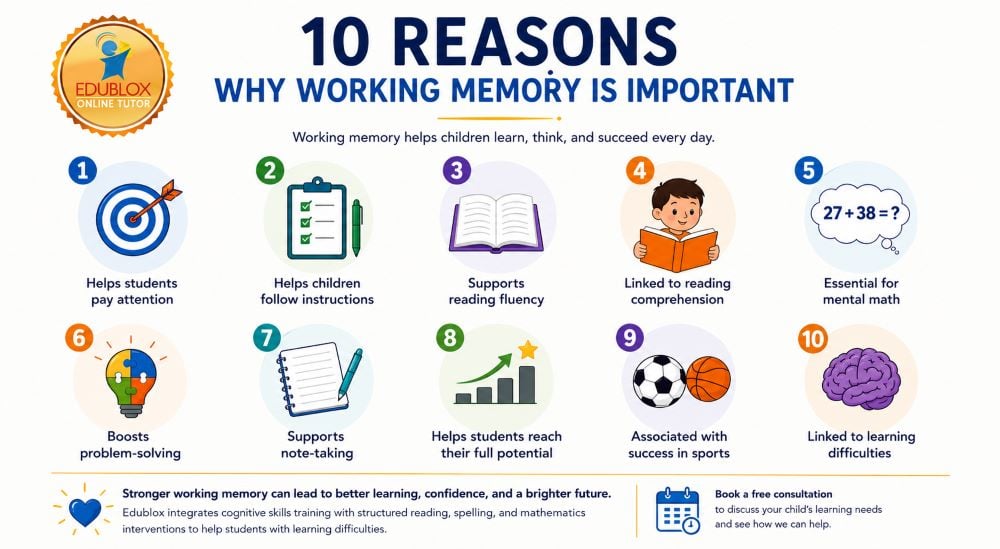
Working memory is key to learning. Here are ten ways children use working memory to learn.
1. Working memory helps students pay attention
Students’ ability to pay attention during class and schoolwork requires them to process and retain information via working memory.
Students with strong working memory are likely to maintain focus and attention in various academic settings. They can more readily be left to work independently because they’re capable of processing and remembering instructions and task goals.
One of the most consistent findings in research studies is that students with ADHD have poor working memory, particularly when they have to remember visual information, such as graphs or images. Students with ADHD are four times more likely to have working memory problems compared to peers without attention problems.
2. Working memory helps children follow instructions
Many classroom instructions involve multiple steps. A teacher might ask students to take out a workbook, turn to a particular page, complete an exercise, and then hand it in.
Children with weak working memory often remember only part of the instruction. By the time they complete the first step, they may have forgotten the rest.
At home, these children may appear not to listen when asked to complete a series of tasks, when in reality they simply cannot retain all the information long enough to act on it.
Parents may notice that their child remembers the first instruction but forgets the second or third. Teachers often observe the same pattern in the classroom. As a result, children with weak working memory are sometimes described as inattentive, forgetful, or unable to follow directions, when the real problem lies in their ability to retain and manipulate information.
3. Working memory helps children become fluent readers
Working memory is responsible for many of the skills children use to learn to read. Auditory working memory helps children hold on to the sounds letters make long enough to sound out new words. Visual working memory helps them remember what those words look like so they can recognize them throughout the rest of a sentence.
When these memory processes function well, children do not have to sound out every word they encounter. This allows reading to become faster, smoother, and more fluent. Unfortunately, learning to read is often more difficult for children with weak working memory skills.
As reading becomes more automatic, less working memory is needed for decoding individual words, allowing more mental resources to be devoted to understanding the text. This is one reason why weak working memory can affect both reading fluency and reading comprehension.
4. Working memory is linked to reading comprehension
Research has shown a distinct link between working memory and reading comprehension.
When students with weak working memory skills read a paragraph, they may forget what was at the beginning of the paragraph by the time they get to the end. As a result, reading comprehension suffers. In these cases, the problem lies in the memory system rather than the language system.
5. Mental math requires working memory
Mental math places heavy demands on working memory. To solve a problem in your head, you must hold information in mind while performing calculations.
Consider the problem 27 + 38. A child must remember the numbers, add the ones, carry the ten, and keep track of the intermediate result while continuing with the calculation. Each step depends on information being held and manipulated in working memory.
Children with weak working memory often lose track of intermediate results or forget part of the problem before they have finished solving it. As a result, mental calculations can be slow, effortful, and error-prone.
6. Working memory boosts problem-solving
Problem-solving depends heavily on working memory. To solve a problem, we must hold information in mind, consider different options, and keep track of our progress toward a solution.
Research from the University of Michigan found that improving working memory can boost problem-solving ability and improve fluid intelligence—the ability to solve new problems, use logic in unfamiliar situations, and identify patterns.
Children with strong working memory are often better able to think through complex problems because they can keep relevant information active in their minds while working toward a solution. When working memory is weak, important pieces of information may be forgotten before the problem is solved, making the task more difficult.
7. Working memory supports note-taking
Taking notes requires students to listen, identify important information, hold it in mind, and write it down—all at the same time.
Students with weak working memory often struggle to keep up because they may forget part of what the teacher has said before they have finished writing it down. As a result, their notes may be incomplete or inaccurate.
Strong working memory helps students keep information active long enough to process it, organize it, and record it effectively.
8. Working memory helps students reach their full potential
Researchers from Durham University surveyed over three thousand children and concluded that children who underachieve at school may have poor working memory rather than low intelligence. They found that 10% of schoolchildren across all age groups have poor working memory, which seriously affects their learning.
The researchers found that poor working memory is rarely identified by teachers, who often describe children with this problem as inattentive or having lower levels of intelligence. Without appropriate intervention, poor working memory in children can affect long-term academic success into adulthood and prevent children from achieving their potential.
9. Working memory is associated with success in sports
A study from Karolinska Institutet in Sweden showed a strong link between executive functions, such as working memory, and achievement in sports. The study showed that working memory and other cognitive functions in children and young people were associated with success on the soccer pitch.
Executive functions help us regulate behavior, adapt to changing situations, solve problems, and control impulses. Working memory is one of the most important executive functions.
Strong results for several executive functions were found to be associated with success on the pitch, even after controlling for other factors that could conceivably affect performance. The clearest link was seen for simpler forms of executive function, such as working memory, which develops relatively early in life.
10. Poor working memory contributes to learning difficulties
Working memory deficits have been documented in different learning difficulties, and improving working memory is often an important part of intervention.
Weiss and colleagues tested 52 musicians, of whom 24 had dyslexia and 28 did not, and compared the performance of the two groups in various auditory tests. On most auditory processing tests, the dyslexic musicians scored as well as their nondyslexic counterparts and better than the general population. However, they performed much worse on tests of auditory working memory, including memory for rhythm, melody, and speech sounds.
Moreover, these abilities were intercorrelated and highly correlated with their reading accuracy, meaning that the dyslexic musicians with the poorest working memory tended to have the lowest reading accuracy. Conversely, those with better working memory tended to be more accurate.
Conclusion
Working memory plays a role in almost every aspect of learning, from paying attention and following instructions to reading, mathematics, and problem-solving. When working memory is weak, learning becomes more difficult than it needs to be. The good news is that working memory can be strengthened, and improving this important cognitive skill can make learning easier, more efficient, and more successful.
Improving working memory is often an important part of overcoming learning difficulties. Edublox integrates cognitive training with live online tutoring to help students with dyslexia, dysgraphia, dyscalculia, and other learning difficulties. Book a free consultation to discuss your child’s learning needs and see how we can help.
.
Key takeaways
10 Reasons Why Working Memory Is Important was authored by Sue du Plessis (B.A. Hons Psychology; B.D.), an educational specialist with 30+ years’ experience in the learning disabilities field.
.
References and sources:
- Cowan, N. (2001). The magical number 4 in short-term memory: A reconsideration of mental storage capacity. Behavioral and Brain Sciences, 24.
- Maehler, C., & Schuchardt, K. (2016). Working memory in children with specific learning disorders and/or attention deficits. Learning and Individual Differences, 49, 341–347.
- Vestberg, T., Reinebo, G., Maurex, L., Ingvar, M., & Petrovic, P. (2017). Core executive functions are associated with success in young elite players. PloS one, 12(2), e0170845.
- Weiss, A. H, Granot, R. Y., & Ahissar, M. (2014). The enigma of dyslexic musicians. Neuropsychologia, 54, 28-40.