
Reading skills are the mental tools children need to decode, read, understand, and think about what they’ve read. Reading may look effortless once mastered, but it’s actually one of the most complex things the brain ever learns to do.
Before children can “read to learn,” they must first “learn to read.” But for many children, this is not an easy journey. Reading difficulties are common, and not because a child is lazy or slow. Reading involves vision, hearing, memory, language, and logic, all working together. If one part is weak, the whole process can break down.
Just as building a house requires a strong foundation, children need a solid foundation to master the art of reading. In this guide, we explain the essential reading skills a child needs, how reading skills develop, what can go wrong, and how to help.
.
Table of contents:
- Reading skills checklist
- 8 Essential reading skills
- 4 Stages of reading development
- 4 Types of reading difficulties
- 10 Practical reading strategies
- When strategies aren’t enough
- Key takeaways
Reading skills checklist
Wondering if your child or a student might be struggling with reading? Review the checklist below.
| Possible signs of reading difficulty | ✔️ / ☐ |
|---|---|
| Struggles to sound out new or unfamiliar words | ☐ |
| Reads slowly, word by word, without natural rhythm | ☐ |
| Can read aloud but doesn’t understand what they’ve read | ☐ |
| Skips words, loses place, or rereads the same line | ☐ |
| Avoids reading whenever possible | ☐ |
| Doesn’t know many common words for their age | ☐ |
| Forgets what they’ve just read | ☐ |
| Gets frustrated, anxious, or embarrassed when reading aloud | ☐ |
📌 If you checked two or more boxes, your child or student may be missing foundational reading skills that need support.
8 Essential reading skills
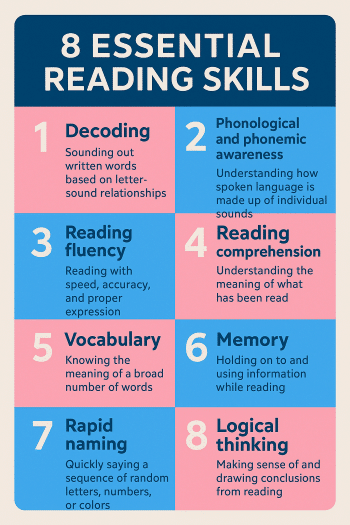
Before a child can become a confident, independent reader, they need to build a set of core mental abilities. These aren’t just school-taught subjects — they’re brain-based skills that make reading possible.
Some of these skills develop naturally through experience and exposure to relevant situations.. Others need to be explicitly taught and strengthened, especially for children who struggle.
Below are eight essential skills that support reading success. If one or more of these is weak, reading may feel frustrating or even impossible, no matter how bright or motivated a child is.
1. Decoding
To be a good reader, a child must first be able to decode — that is, to “sound out” written words based on how letters and letter groups represent sounds.
Decoding relies on three key steps:
- Recognizing letter-sound relationships, like knowing that g sounds different in goat and giraffe
- Breaking words into sounds, such as /m/ /ă/ /n/ for man
- Blending sounds to read the whole word
Without strong decoding skills, reading becomes a slow and frustrating process. And when all their energy is spent on figuring out words, there’s little mental space left for understanding what they’ve read.
🔑 Why it matters: Fluent readers decode automatically — they don’t have to stop and think about every word. That frees up attention for comprehension.
Although some children pick up decoding naturally, most benefit from explicit phonics instruction, which teaches letter-sound patterns, blending, and common spelling rules.
2. Phonological and phonemic awareness
Before children can decode words, they need to understand that spoken words are made of individual sounds — and that those sounds can be played with, pulled apart, and put back together. This skill is called phonological awareness.
Phonological awareness is all about hearing sounds, not seeing letters. It includes:
- Recognizing rhymes (cat, hat, mat)
- Clapping out syllables in words (el-e-phant)
- Noticing the first sound in a word (/d/ in dog)
- Breaking a word into sounds (segmenting) and putting sounds together (blending)
One part of phonological awareness is essential: phonemic awareness — the ability to hear, identify, and manipulate the smallest sound units in words, called phonemes. For example, changing the /h/ in hat to /c/ makes a new word: cat.
🔑 Why it matters: Without a strong sense of how spoken language is built from sounds, learning to match letters to sounds becomes extremely difficult.
Phonological awareness is a listening skill and should start before formal reading instruction. It’s often taught through songs, rhymes, games, and hands-on activities, long before a child picks up a book.
3. Reading fluency
Fluent readers don’t just read accurately — they read smoothly, quickly, and with natural expression. This is called reading fluency, and it’s a crucial step between sounding out words and understanding the meaning of a text.
A fluent reader can:
- Recognize many words instantly, without having to sound them out
- Read aloud with appropriate pace, pauses, and intonation
- Read silently at a speed that supports comprehension
Fluency depends on strong word recognition. When children have to stop and sound out every word, their brain is working so hard on decoding that comprehension often suffers as a result.
Some words, like the, one, or said, can’t be sounded out easily. These are called irregular words, and fluency helps children recognize them on sight.
🔑 Why it matters: Fluency is the bridge between decoding and comprehension. A child who stumbles over every word will struggle to understand what they’re reading.
Fluency grows through practice, repetition, and confidence. Reading aloud, re-reading favorite books, and listening to fluent models of reading can all help.
4. Reading comprehension
Reading without understanding isn’t really reading — it’s just word calling. Comprehension is the ability to make sense of what’s read, connect it to what you already know, and think about its meaning.
Strong comprehension includes:
- Understanding the main idea of a passage
- Remembering key details
- Making predictions or inferences
- Figuring out unfamiliar words using context
- Noticing cause and effect, opinions, or arguments
Some children can decode words perfectly but still struggle to answer questions about what they’ve read. This may be due to limited background knowledge, poor vocabulary, or weak memory and reasoning skills.
🔑 Why it matters: Comprehension is the purpose of reading. Without it, fluent reading is just words on a page — not understanding.
Good comprehension depends on many other skills working together — especially decoding, fluency, vocabulary, and memory. It can be improved through discussion, questioning, summarizing, and teaching children to actively think while they read.
5. Vocabulary
Knowing how to pronounce a word isn’t enough — children also need to know what that word means. A strong vocabulary is essential for reading comprehension and overall academic success.
Vocabulary includes:
- Everyday words (like apple, run, family)
- Subject-specific words (like planet, photosynthesis, democracy)
- Rare or challenging words found in books (like archipelago or melancholy)
Children grow their vocabulary through conversation, being read to, independent reading, and direct instruction. The more words they know, the easier it is to understand what they read — and to learn even more new words.
🔑 Why it matters: If a child doesn’t understand key words in a sentence, the whole passage can lose its meaning.
For example, knowing how to say the word archipelago won’t help a child reading about Lofoten in Norway — unless they also understand that it means a group of islands.
6. Memory
Reading is more than just recognizing words — it’s also about holding onto information while processing what comes next. That’s where memory plays a vital role, especially working memory.
Working memory is like a mental sticky note. It allows a child to:
- Remember what they just read in the previous sentence
- Connect new ideas to what they already know
- Keep track of the story while decoding individual words
Without strong working memory, a child might read a whole paragraph and then forget what it was about.
Other types of memory also support reading:
- Short-term memory helps hold small bits of information briefly
- Visual memory helps recognize letters, words, and patterns
- Visual sequential memory helps keep letters and words in the right order
- Long-term memory helps retain vocabulary, story structures, and facts over time
🔑 Why it matters: Reading involves constantly holding and linking ideas — across words, sentences, and entire texts. Weak memory can make reading feel like trying to hold water in your hands.
7. Rapid naming
Rapid naming is the ability to quickly recognize and name familiar items — like letters, numbers, colors, or common objects — out loud. It may seem like a simple task, but it plays a surprisingly important role in reading.
When children read, they constantly retrieve words, sounds, and meanings from memory. Rapid naming measures how quickly the brain can access and verbalize stored information — in other words, how fast a child can retrieve things they already know from long-term memory.
Children with reading difficulties, especially dyslexia, often struggle with rapid naming tasks. They may know the word or symbol but can’t retrieve it fast enough to support fluent reading.
🔑 Why it matters: If it takes too long to pull up known information, reading slows down and comprehension breaks down — even when decoding skills are strong.
Rapid naming is sometimes referred to as a “hidden” skill because it doesn’t typically appear in everyday classroom tasks, yet it’s one of the clearest predictors of reading fluency challenges.
8. Logical thinking
Reading isn’t just about decoding words — it’s also about making sense of ideas. That’s where logical thinking comes in. It helps children connect facts, follow a storyline, and figure out what’s happening even when it’s not stated directly.
Logical thinking involves:
- Understanding cause and effect (e.g., She forgot her lunch, so she was hungry)
- Making inferences (e.g., The lights were off and the house was quiet — no one was home)
- Comparing and contrasting ideas
- Following a sequence of events
Reading is sometimes called “reasoning with print” — because it requires children to think clearly, spot connections, and draw conclusions from what they’ve read.
🔑 Why it matters: Logical thinking helps children go beyond the words on the page to figure out meaning, notice patterns, and understand the bigger picture.
Without strong logical reasoning, a child may read fluently but still miss the point of the story or struggle to answer “why” and “how” questions.
4 Stages of reading development
Children don’t learn to read all at once; they progress through predictable stages. Understanding these stages can help parents know what to expect, when to be concerned, and how to support their child’s reading growth best.
Each stage builds on the one before it. Some children move quickly through them, while others need more time and support. The goal is to eventually reach fluent, automatic reading with strong comprehension.
1. Pre-alphabetic stage
At this stage, children do not yet understand that letters represent sounds. Instead, they might rely on visual clues to guess what a word says, like recognizing the word monkey by the shape of the letters or a picture nearby.
They may “read” a favorite logo or book from memory, even though they’re not truly decoding. For example, a child might recognize the word Coca-Cola because of the font and color, not because they understand the letters.
🧠 Children in the pre-alphabetic stage are still learning how print works. They may know that text moves from left to right and that books tell stories, but they don’t yet use letter-sound knowledge to read words.
2. Partial alphabetic stage
At this stage, children begin to realize that letters are connected to sounds — a significant breakthrough. They may recognize a few letter-sound pairings and start using them to guess words, especially the first letter.
For example, if they see the word get, they might focus on the g and say “go” or “gorilla,” using only partial clues. Their guesses are based on the first sound and possibly the word’s shape or context, rather than the full set of letters.
At this point, children are starting to decode, but they don’t yet handle all the sounds in a word.
🧠 Readers in the partial alphabetic stage have taken a big step forward. But because they’re only using part of the word to make guesses, they still make frequent errors and need help strengthening their letter-sound skills.
3. Fully alphabetic stage
At this stage, children can decode words by sounding out every letter or letter group. They understand that letters represent specific sounds — and they can blend those sounds to read a word they’ve never seen before.
For example, even if a child has never read the word bug, they can figure it out by blending the sounds /b/ /ŭ/ /g/.
With repeated exposure, the brain begins to store the word bug as a unit, so the child no longer has to sound it out every time.
🧠 Fully alphabetic readers are true decoders. They use their knowledge of phonics and spelling patterns to read unfamiliar words — a huge step toward fluent reading.
This stage often overlaps with the beginning of real reading confidence. The more words a child decodes, the more they recognize on sight.
4. Consolidated alphabetic stage
By this stage, children no longer need to decode every single letter in a word. Instead, they start to recognize chunks of letters and common patterns — such as -ing, -ent, or th — and process them as single units.
For example, after reading the words sent, went, and bent several times, a child stores the pattern -ent in memory. So when they see a new word like dent, they don’t have to decode all four letters separately — just d and -ent.
This saves time and mental effort, allowing more attention to be devoted to comprehension.
🧠 Readers at the consolidated stage are building a mental “bank” of word parts and whole words. This makes reading smoother, faster, and more automatic.
This is the beginning of fluent reading, where decoding happens with little conscious thought, and real understanding becomes the focus.
4 Types of reading difficulties
Even with solid teaching and strong support at home, some children still struggle to learn to read. This doesn’t mean they’re lazy or not trying — it usually means that one or more underlying skills haven’t developed properly.
Here are four common types of reading difficulties, what they look like, and how they affect a child’s ability to read and understand.
1. Poor decoding
Children with decoding difficulties struggle to “sound out” new words. They may guess based on the first letter or rely on pictures and context.
Signs include:
- Difficulty matching letters to sounds
- Guessing words that look similar but aren’t the same
- Struggling to read unfamiliar or made-up words (e.g., splog or binter)
Poor decoders often avoid reading because it feels slow and frustrating. In some cases, hearing or visual processing challenges may be involved.
2. Poor fluency
These children can decode words but do so slowly and with great effort. Their reading lacks rhythm and expression, and they may lose track of what they’re reading.
Signs include:
- Reading word by word, with frequent pauses
- Little or no expression when reading aloud
- Avoiding reading because it feels exhausting
Fluency problems are often linked to poor word recognition and weak rapid naming.
3. Poor comprehension
Some children can read smoothly and pronounce words correctly, but don’t understand what they’ve read.
This type of difficulty is called specific reading comprehension deficit.
Signs include:
- Trouble answering questions about the text
- Forgetting key details right after reading
- Difficulty making inferences or seeing the “big picture”
Children with poor comprehension may have weak vocabulary, limited background knowledge, impaired reasoning skills, or poor memory.
4. Mixed reading difficulties
Many struggling readers don’t fit neatly into one category. They may struggle with decoding, fluency, and comprehension simultaneously. This combination is often seen in children with dyslexia.
Signs include:
- Difficulty reading and understanding even simple texts
- Slow progress despite regular practice
- Ongoing frustration with reading in general
Mixed difficulties require a comprehensive approach that builds multiple foundational skills simultaneously, rather than simply increasing reading time or repetition.
10 Practical reading strategies
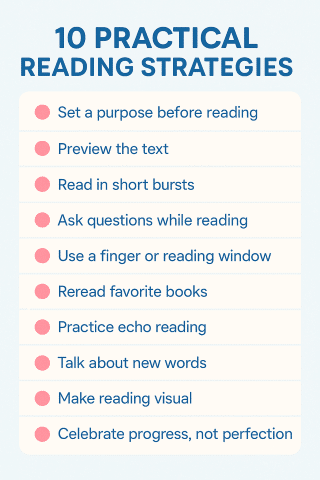
While developing core reading skills takes time, using the right strategies can make reading easier and more enjoyable, especially for children who struggle. These simple techniques can be used at home or in the classroom to support fluency, comprehension, and confidence.
1. Set a purpose before reading
Before the child starts reading, talk about why they’re reading. Are they looking for facts? Trying to enjoy a story? Setting a purpose improves focus and memory.
2. Preview the text
Skim through headings, pictures, and bold words before reading. This builds interest and helps the child predict what the text will be about.
3. Read in short bursts
Break reading into chunks. A tired or overwhelmed child won’t retain much, so keep sessions short and frequent, especially for struggling readers.
4. Ask questions while reading
Pause now and then to ask, “What just happened?” or “Why do you think she did that?” This keeps the child engaged and helps build comprehension.
5. Use a finger or a reading window
Some children lose their place easily. Use a finger, ruler, or reading window to help them track words line by line.
6. Reread favorite books
Rereading builds fluency and confidence. Even if you’re tired of The Gruffalo, the child is gaining valuable practice every time they read it.
7. Practice “echo reading”
You read a sentence with expression, then the child repeats it like an echo. This models fluent reading and builds confidence.
8. Talk about new words
When the child encounters an unfamiliar word, don’t just define it — talk about it, use it in a sentence, and connect it to what they already know.
9. Make reading visual
Draw pictures of what’s happening in the story, or let the child act out a scene. These visual and hands-on activities deepen comprehension — and make reading more memorable.
10. Celebrate progress, not perfection
Notice effort. Praise persistence. Reading success doesn’t come overnight — but with the right strategies, your child or student will get there.
📌 Tip: Don’t worry about using every strategy at once. Select one or two that align with the child’s current needs and build upon them.
When strategies aren’t enough
Even with the right strategies and plenty of support at home, some children still struggle. They may guess words, read without understanding, or avoid reading altogether.
This isn’t a sign of failure — it simply means the child may need more than strategies alone. They may be missing one or more of the core reading skills we outlined earlier, like decoding, working memory, or phonemic awareness.
That’s where professional intervention comes in.
At Edublox, we go beyond surface strategies. Our programs strengthen the foundational skills children need to read with confidence and understanding. Whether a child has mild difficulties or a diagnosed learning disorder like dyslexia, our programs are designed to strengthen:
- Preparatory reading skills — like phonemic awareness, working memory, rapid naming, and logical thinking
- Supportive reading skills — like decoding, fluency, and vocabulary
- Reading strategies — like comparing and contrasting, identifying the main idea and details, sequencing events, and recognizing story elements
📌 Don’t wait for frustration to build. Early intervention can change the game.
👉Watch our customer review playlist and book a free consultation to discuss your child’s or student’s reading needs.
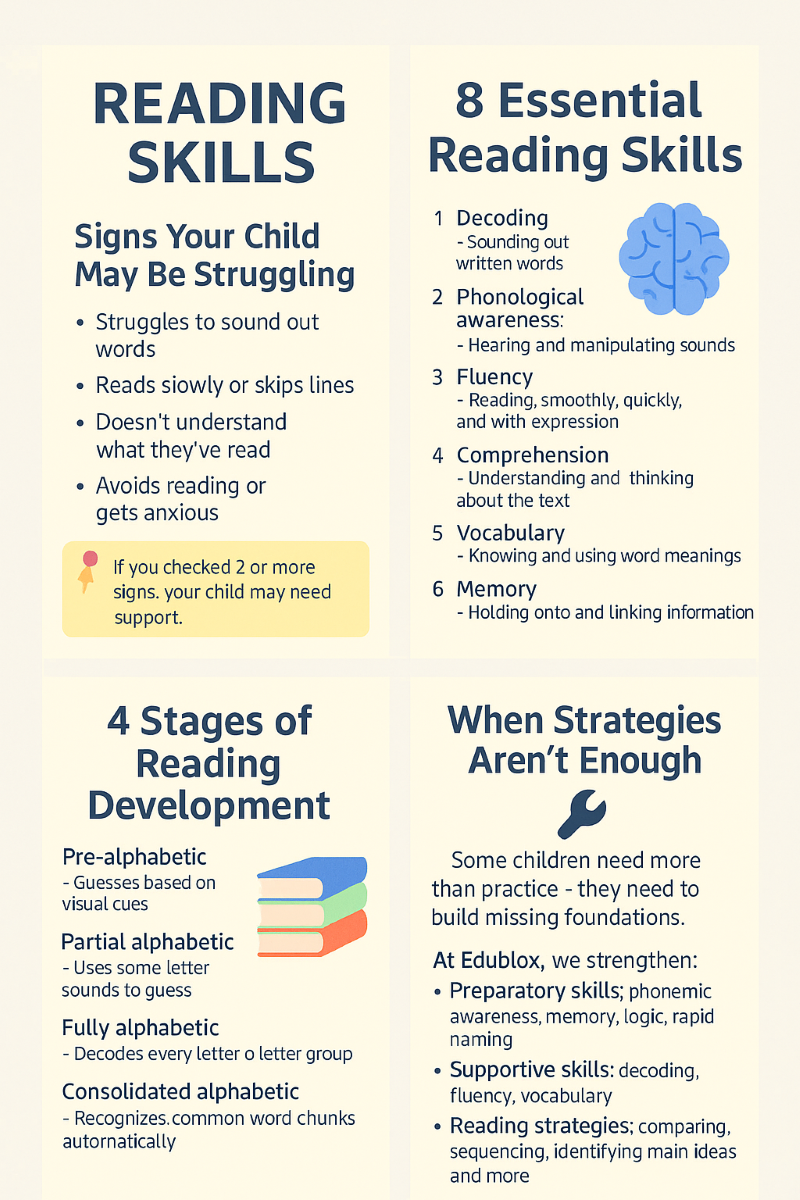
Key takeaways
Authored by Sue du Plessis (B.A. Hons Psychology; B.D.), a reading specialist with 30+ years of experience in learning disabilities.