
Dyslexia is one of the most misunderstood learning difficulties. Some people think it is simply a reading problem. Others believe it is caused by poor teaching, low intelligence, or a lack of effort. None of these explanations tells the full story.
Over the years, researchers have learned a great deal about dyslexia, how it affects the brain, and why some children struggle to learn to read despite having normal intelligence and adequate instruction. While debates continue about how dyslexia should be defined, there is broad agreement that reading difficulties are real, common, and often require specialized intervention.
The following facts will help you better understand what dyslexia is, what causes it, how it affects learning, and why there is reason for hope.
What is dyslexia?
1. The word “dyslexia” comes from Greek and was coined in 1884
The term dyslexia was introduced by German ophthalmologist Rudolf Berlin in 1884. He combined the Greek words dys (meaning “difficulty”) and lexis (“word” or “language”) to describe patients who lost the ability to read despite normal speech and intelligence.
2. James Hinshelwood called it “congenital word-blindness”
In the early 1900s, Scottish ophthalmologist James Hinshelwood described children with normal intelligence who had unexpected difficulty learning to read. He called the condition congenital word-blindness and believed it originated in the brain rather than the eyes.
3. Dyslexia affects up to 20% of the population
Research suggests that dyslexia affects approximately one in five individuals, making it one of the most common learning difficulties worldwide.
4. Dyslexia is not tied to IQ
Dyslexia affects individuals across the intelligence spectrum. Some of the brightest students struggle with reading, spelling, and writing, while excelling in other academic areas.
5. Dyslexia varies in severity
Some individuals experience mild difficulties that remain unnoticed for years, while others face severe challenges that require intensive support. Dyslexia exists on a continuum rather than as an all-or-nothing condition.
What causes dyslexia?
6. Dyslexia often runs in families
Research consistently shows that genetics plays an important role. Children with a parent or close relative who has dyslexia are more likely to experience reading difficulties themselves.
7. Deficits in phonological processing are a core factor
Many individuals with dyslexia struggle to recognize, store, and manipulate the sounds of language. Difficulties with phonemic awareness can make decoding and spelling particularly challenging.
8. Dyslexia is often caused by multiple interacting deficits
For many years, dyslexia was viewed primarily as a phonological processing disorder. While phonological weaknesses remain important, research now suggests that many individuals with dyslexia experience a combination of difficulties.
Studies have identified weaknesses in processing speed, attention, working memory, executive functioning, visual-spatial processing, and sequencing as contributing factors in many individuals with dyslexia. In fact, one study found that only a small percentage of children with dyslexia had a phonological deficit in isolation.
This multiple-deficit perspective helps explain why no two individuals with dyslexia look exactly alike.
9. There are different types of dyslexia
Reading difficulties associated with phonological processing weaknesses are often called phonological or dysphonetic dyslexia. Difficulties related to orthographic or visual word recognition processes have been described as surface, dyseidetic, or orthographic dyslexia.
What are the symptoms of dyslexia?
10. Dyslexia symptoms vary from person to person
Although symptoms differ from one individual to another, dyslexia is characterized by persistent difficulties with accurate and/or fluent word reading, spelling, and written language. Common signs include:
- Difficulty decoding unfamiliar words
- Slow, effortful reading
- Frequent guessing when reading
- Difficulty recognizing common sight words automatically
- Poor spelling, even after repeated practice
- Letter reversals and letter-order errors
- Omitting letters, syllables, or entire words while reading
- Difficulty reading aloud
- Reduced reading fluency
- Poor reading comprehension caused by slow or inaccurate word recognition
Not every person with dyslexia displays all of these symptoms, but most experience a combination of reading and spelling difficulties that persist despite adequate instruction and normal intelligence.
11. Reading often remains slow and effortful
Even when individuals with dyslexia learn to decode accurately, reading may never become fully automatic. Many continue to read more slowly than their peers because they must devote conscious effort to recognizing words that skilled readers identify instantly.
12. Poor spelling is often more persistent than poor reading
Many adults with dyslexia become reasonably competent readers but continue to struggle with spelling. Spelling requires accurate storage and retrieval of word patterns, making it one of the most persistent challenges associated with dyslexia.
What happens in the brain?
13. The dyslexic brain differs from the typical reader’s brain
Brain imaging studies have identified differences between the brains of skilled readers and those of individuals with dyslexia. Researchers have found reduced activity in brain areas involved in word analysis, phonological processing, and rapid word recognition.
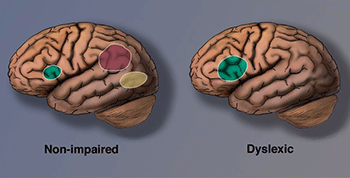
Particularly important is the visual word form area (VWFA), located in the left occipitotemporal region of the brain. This area enables skilled readers to recognize words quickly and automatically. When this system does not develop efficiently, reading remains slow and effortful.
14. Brain differences may be a consequence rather than a cause
For many years, researchers assumed that brain differences caused dyslexia. More recent research suggests the relationship may be more complex.
In one study, children with dyslexia were compared not only to typically developing readers of the same age but also to younger children who read at the same level. Although the dyslexic children showed less gray matter than age-matched peers, they did not differ from the younger children with similar reading ability.
These findings suggest that some brain differences may reflect differences in reading experience rather than being the original cause of reading difficulties.
15. Neuroplasticity offers hope
One of the most exciting discoveries in neuroscience is that the brain can change in response to learning and experience. This ability is known as neuroplasticity.
Research has shown that learning new skills can alter both the structure and function of the brain. Studies involving musicians, bilinguals, and even adults learning to read for the first time demonstrate that the brain remains capable of change throughout life.
For individuals with dyslexia, this means that effective intervention can strengthen the neural pathways involved in reading and learning.
Can dyslexia be overcome?
16. Early intervention can prevent academic and emotional problems
Reading difficulties affect far more than reading. Children who struggle to read often experience frustration, reduced self-confidence, and declining academic performance.
Without appropriate intervention, these difficulties can persist into adolescence and adulthood. Early identification and support can help prevent many of the academic and emotional consequences associated with dyslexia.
17. Accommodations are not the same as intervention
Accommodations, such as extra time on tests or access to audiobooks, can help students cope with the demands of school. However, accommodations do not teach reading skills.
Intervention aims to improve the underlying skills required for reading and spelling. While accommodations may be necessary, they should not be viewed as a substitute for effective instruction and intervention.
18. Children with dyslexia can succeed
A diagnosis of dyslexia does not determine a child’s future. With appropriate support, many individuals with dyslexia become successful students, professionals, entrepreneurs, artists, scientists, and leaders.
The path may be different, and progress may take more time and effort, but dyslexia does not limit what a person can achieve. With the right intervention, persistence, and encouragement, children with dyslexia can thrive both academically and personally.
Final thoughts
Dyslexia is far more complex than many people realize. It cannot be explained by a single symptom, a single brain difference, or a single cause. Research increasingly suggests that dyslexia often arises from multiple interacting factors, which helps explain why no two individuals with dyslexia are exactly alike.
The encouraging news is that the brain is not fixed. Neuroplasticity enables the brain to change in response to learning and experience. With appropriate intervention, many children and adults can strengthen the skills that support reading, spelling, and learning.
Most importantly, dyslexia is not a measure of intelligence or potential. Many successful people have struggled with reading difficulties and gone on to excel in their chosen fields. While the journey may be more challenging, dyslexia does not determine a child’s future.
Understanding dyslexia is the first step. Taking action is the next.
Key takeways
Edublox provides support for students with dyslexia, dyscalculia, and other learning difficulties. We help students worldwide overcome academic challenges and reach their full potential. Book a free consultation to discuss your child’s learning needs and discover how we can help.
.
References and sources for 18 Facts About Dyslexia Every Parent Should Know:
- Byrne, B. (2011). Evaluating the role of phonological factors in early literacy development: Insights from experimental and behavior-genetic studies. In S. A. Brady, D. Braze, & C. A. Fowler (Eds.), Explaining individual differences in reading: Theory and evidence (pp. 175-195). New York: Psychology Press.
- Dunson, W. E. (2013). School success for kids with dyslexia & other reading disabilities. Waco, TX: Prufrock Press Inc.
- Elliott, J. G., & Grigorenko, E. L. (2014). The dyslexia debate. Cambridge: Cambridge University Press.
- Fawcett, A. (2001). Dyslexia at school: A review of research for the DfES. (Unpublished review for the Department for Education and Skills, the British Dyslexia Association and the Dyslexia Institute).
- Fern-Pollak, L., & Masterson, J. (2016). Dyslexia and the English writing system. In V. Cook & D. Ryan (Eds.), The Routledge handbook of the English language (pp. 223-234). New York: Routledge.
- Gentry, J. R. (2006). Breaking the code: The new science of beginning reading and writing. Portsmouth, NH: Heinemann.
- Hinshelwood, J. (1917). Congenital word-blindness. London: Lewis.
- Howes, N. L., Bigler, E. D., Lawson, J. S., & Burlingame, G. M. (1999). Reading disability subtypes and the test of memory and learning. Archives of Clinical Neuropsychology, 14(3), 317–339.
- Krafnick, A. J., Flowers, D. L., Luetje, M. M., Napoliello, E. M., & Eden, G. F. (2014). An investigation into the origin of anatomical differences in dyslexia. Journal of Neuroscience, 34(3), 901-908.
- Lyon, R. (2001). Measuring success: Using assessments and accountability to raise student achievement. Retrieved April 22, 2025, from ProjectPro website: http://projectpro.com/ICR/Research/Releases/NICHD_Testimony1.htm
- Maguire, E. A., Woollett, K., & Spiers, H. J. (2006). London taxi drivers and bus drivers: A structural MRI and neuropsychological analysis. Hippocampus, 16(12), 1091-1101.
- Martin, A., Kronbichler, M., & Richlan, F. (2016). Dyslexic brain activation abnormalities in deep and shallow orthographies: A meta-analysis of 28 functional neuroimaging studies. Human Brain Mapping, 37, 2676–2699.
- Mather, N., & Wendling, B. J. (2012). Essentials of dyslexia assessment and intervention. Hoboken, NJ: Wiley.
- Menghini, D., Carlesimo, G. A., Marotta, L., Finzi, A., & Vicari, S. (2010a). Developmental dyslexia and explicit long-term memory. Dyslexia, 16(3), 213-225.
- Menghini, D., Finzi, A., Benassi, M., Bolzani, R., Facoetti, A., Giovagnoli, S., … Vicari, S. (2010b). Different underlying neurocognitive deficits in developmental dyslexia: A comparative study. Neuropsychologia, 48(4), 863–72.
- Molfese, D. L., Molfese, V. J., Barnes, M. E., Warren, C. G., & Molfese, P. J. (2008). Familial predictors of dyslexia: Evidence from preschool children with and without familial dyslexia risk. In G. Reid, A. J. Fawcett, F. Manis, & L. Siegel (Eds.). The SAGE handbook of dyslexia (pp. 99-120). London: Sage.
- Moura, O., Simões, M. R., & Pereira, M. (2015). Executive functioning in children with developmental dyslexia. The Clinical Neuropsychologist, 28(S1), 20-41.
- Pais, A. (1982). Subtle is the lord: The science and the life of Albert Einstein. Oxford: Oxford University Press.
- Pennington, B. F. (2006). From single to multiple deficit models of developmental disorders. Cognition, 101(2), 385-413.
- Peterson, R. L., & Pennington, B. F. (2012). Developmental dyslexia. The Lancet, 379, 1997–2007.
- Shaywitz, S. (2003). Overcoming dyslexia. New York, NY: Alfred A. Knopf.
- Sigmundsson, H. (2005). Do visual processing deficits cause problem on response time task for dyslexics? Brain and Cognition, 58(2), 213–216.
- Skeide, M. A., Kumar, M., Mishra, R. K., Tripathi, V. N., Guleria, A., Singh, J .P., … Huettig, F. (2017). Learning to read alters cortico-subcortical cross-talk in the visual system of illiterates. Science Advances, 3(5), e1602612.
- Stanley, G., Kaplan, I., & Poole, C. (1975). Cognitive and nonverbal perceptual processing in dyslexics. Journal of General Psychology, 93(1), 67-72.
- Tanaka, H., Black, J. M., Hulme, C., Stanley, L. M., Kesler, S. R., Whitfield-Gabrieli, S., … Hoeft, F. (2011). The brain basis of the phonological deficit in dyslexia is independent of IQ. Psychological Science, 22(11), 1442-1451.
- Van Bergen, E., van der Leij, A., & de Jong, P. F. (2014). The intergenerational multiple deficit model and the case of dyslexia. Frontiers in Human Neuroscience, 8(346), 1-13.
- Weiss, A. H., Granot, R. Y., & Ahissar, M. (2014). The enigma of dyslexic musicians. Neuropsychologia, 54, 28-40.
18 Facts About Dyslexia Every Parent Should Know was authored by Sue du Plessis (B.A. Hons Psychology; B.D.), a dyslexia specialist with 30+ years of experience in learning disabilities.
Edublox is proud to be a member of the International Dyslexia Association (IDA), a leading organization dedicated to evidence-based research and advocacy for individuals with dyslexia and related learning difficulties.