The term slow learner is sometimes used in schools to describe children who learn at a slower pace than their peers, despite trying hard and receiving regular instruction. It is not an official diagnosis in modern medical or psychological manuals. Instead, most professionals today use the term borderline intellectual functioning (BIF) to describe this group.
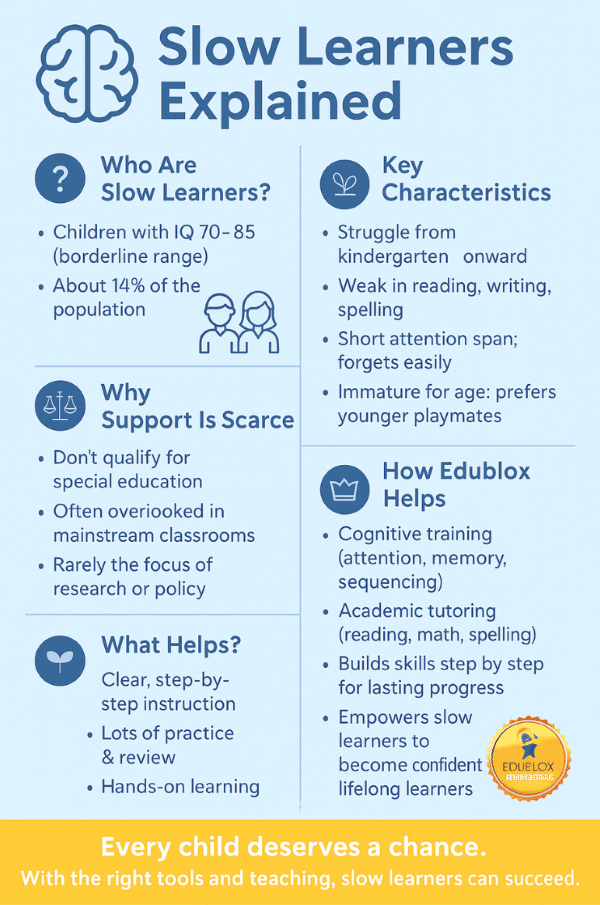
Children in this category usually have IQ scores between 70 and 85 — that is, below the average range but above the level of intellectual disability. This places them in the 12–18% of the population, with many studies citing a midpoint of about 14%. In other words, this is a very large group of learners, bigger than the combined number of children with learning disabilities, intellectual disabilities, and autism.
Unlike students with a specific learning disorder (SLD), who may struggle in one skill area (such as reading or math) while performing normally in others, slow learners tend to experience difficulties across all subjects. Their progress is steady but significantly slower, and they often need more time, repetition, and support to master concepts.
Importantly, being a “slow learner” does not mean a child is lazy or unmotivated. These students usually try hard and want to succeed. Still, their learning pace and capacity require instruction that is more explicit, concrete, and scaffolded than what is provided in the typical classroom.
Characteristics of slow learners
Although every child is unique, many slow learners share a common set of traits that show up across development, academics, and social-emotional life. Recognizing these patterns can help parents and teachers provide the right support.
Early development signs
- Reached early milestones like walking and talking, but more slowly than peers.
- Often appeared immature for their age, preferring younger playmates.
- Enjoyed playing with others but had difficulty maintaining long-term friendships.
Academic challenges
- Struggled academically from the very start of school, often beginning in kindergarten.
- Fell further behind each year despite effort and attendance.
- Consistently scored low on achievement tests.
- Studied but had difficulty retaining what they learned.
- Typically weak in reading, writing, and spelling, but may perform better with hands-on material.
- Found it hard to follow multi-step directions.
Cognitive and behavioral traits
- Short attention spans, easily distracted in class or at home.
- Conversations may wander, with frequent “off the wall” comments unrelated to the topic.
- As teenagers, wanted to be treated as adults but often thought and acted several years younger.
- Had trouble setting long-range goals and tended to live in the present.
Social and emotional profile
- Friendships were often short-lived and difficult to maintain.
- Experienced low self-esteem, especially after repeated academic setbacks.
- Needed encouragement and positive reinforcement to stay motivated.
Why research on slow learners is scarce
Although slow learners make up a large portion of the school population, surprisingly little research has been devoted to them. There are several reasons for this gap:
- Terminology shift: Modern researchers rarely use the term ‘slow learner’. Instead, they classify these students under borderline intellectual functioning (BIF) or as part of the “low-achieving” population. As a result, relevant studies can be challenging to find because they are hidden under different labels.
- Policy blind spot: In diagnostic manuals like the DSM-5 and ICD-11, borderline intellectual functioning is not recognized as a full disorder. Because it sits in this “gray area,” funding and services for research are limited compared to those for recognized disabilities.
- Educational mismatch: In schools, slow learners are often considered too high-functioning to qualify for special education, but too weak to thrive in the mainstream classroom without help. This means they are often overlooked in both research and intervention programs.
The result is a group of learners who represent a significant percentage of the population but remain largely invisible in educational planning and policy.
Challenged by a lack of services
Because slow learners do not fit neatly into existing categories, they often miss out on the support they need. Special education programs are usually reserved for students with diagnosed disabilities, while mainstream classrooms move too quickly for those who learn at a slower pace.
As a result, many receive only minimal remedial help, if any at all. Over time, the lack of consistent support can lead to widening academic gaps, declining self-confidence, and a higher risk of leaving school without the skills needed for work and independence.
How Edublox can help slow learners
Edublox offers a unique approach designed for students who learn more slowly than their peers. Our method combines three elements:
- Cognitive skills training — strengthening foundational tools like attention, memory, processing speed, and sequencing.
- Academic tutoring — building essential reading, spelling, writing, and math skills step by step.
- Proven learning principles — such as structured practice, repetition, scaffolding, and overlearning to ensure knowledge is retained.
This threefold approach provides slow learners with both the tools and the strategies they need to make lasting progress. Many students who once struggled to keep up in school discover that they can succeed when their underlying learning skills are developed alongside their academics.
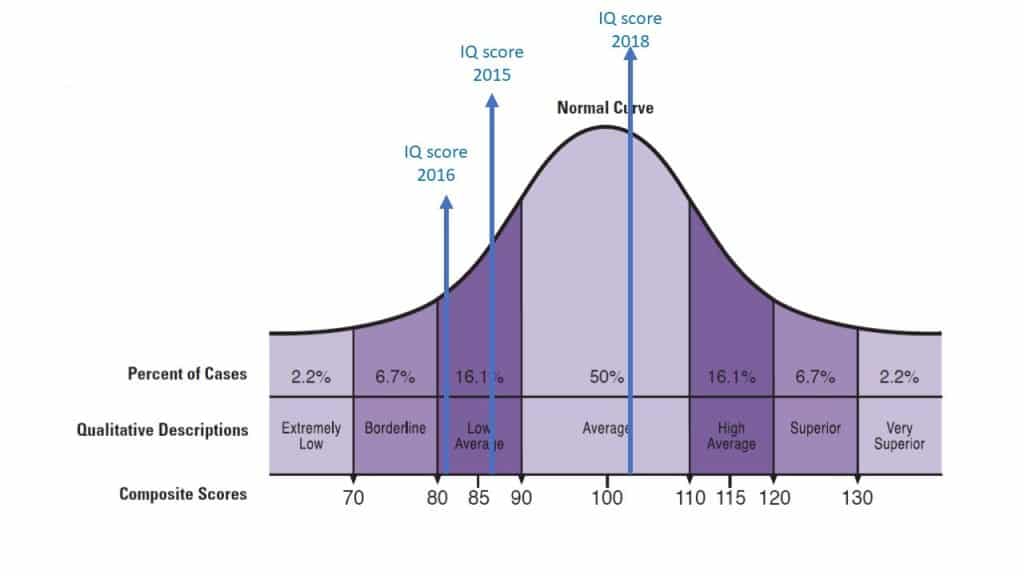
One example comes from a student who completed intensive Edublox training over nine months. Her IQ scores increased by 16 points compared to her first assessment — evidence that intelligence is not fixed, but can grow when the brain is challenged through the right kind of education.
Edublox is not a quick fix, but it empowers slow learners to become confident, lifelong learners who can reach their highest potential.
Every child deserves a chance
The term slow learner may not be perfect, but the children it describes are very real — and they matter. Too often, these students are overlooked simply because they do not qualify for special services, yet cannot keep pace in a mainstream classroom. Left unsupported, their struggles can grow into frustration and failure.
But with the right help, slow learners can thrive. They can master reading, writing, and math, gain confidence, and discover their strengths. What they need is patient teaching, step-by-step skill-building, and encouragement that fuels perseverance.
At Edublox, we believe that no child should be defined by a label or left behind because of a slower learning pace. With the right tools and support, every child can learn, grow, and succeed.
Key takeaways