
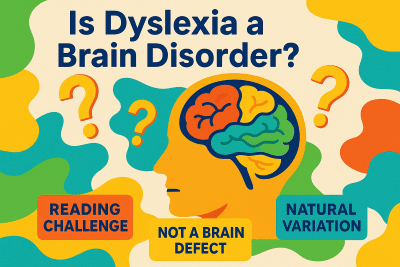
The article “Is Dyslexia a Brain Disorder?” by Athanassios Protopapas and Rauno Parrila critically examines the widespread assumption that dyslexia is a neurodevelopmental disorder.
Challenging the medical model of dyslexia
The authors argue that while dyslexia is often described as a brain abnormality or neurological impairment, there is no clear scientific evidence to support this claim. Instead, they propose that dyslexia represents one end of the normal spectrum of variation in reading ability and should not be classified as a disorder in the traditional medical sense.
At its core, dyslexia is defined as a persistent and unexpected difficulty in acquiring age-appropriate word-reading skills, despite adequate instruction and intelligence. This makes it distinct from reading struggles caused by poor education, cognitive delays, or sensory issues. However, the authors emphasize that defining it as a “disorder” suggests that something has gone wrong in brain development—an assertion not supported by current scientific evidence.
Neuroimaging evidence: Correlation, not causation
The article critiques neuroimaging studies that claim to show brain differences between people with and without dyslexia. While such studies reveal differences in brain activity and structure, these findings are largely correlational and based on group averages. They do not prove that the brains of individuals with dyslexia are dysfunctional or abnormal—only that different levels of reading skill are associated with different patterns of brain activity, which is to be expected in any skill area.
Notably, the authors argue that differences are not the same as deficits. Brains differ for every task—singing, dancing, solving math problems—and reading is no exception. To label dyslexia as a disorder simply because it involves difficulty with a specific cultural skill (reading) is misleading. It creates the impression of a medical problem where none may exist.
A call for a new perspective on reading differences
They also point out the danger of medicalizing a learning difference: it can stigmatize individuals, misguide research efforts, and lead to ineffective interventions. Rather than looking for a neurological “fault,” the focus should be on understanding individual learning needs and supporting literacy development through education and training.
The article concludes that while dyslexia is undoubtedly “biological” in the sense that all cognitive functions are rooted in the brain, there is no evidence of brain damage or dysfunction in most cases of dyslexia. The term “neurodevelopmental disorder” implies a developmental failure or defect, but current data do not support this. Dyslexia simply reflects normal individual differences in brain development, making learning to read more difficult for some.
Ultimately, the authors call for a shift in how we conceptualize dyslexia—from a deficit-based model toward one that embraces diversity in learning and cognition. Dyslexia is not a mysterious brain fault to be fixed but a variation in human learning that deserves understanding and tailored support.