
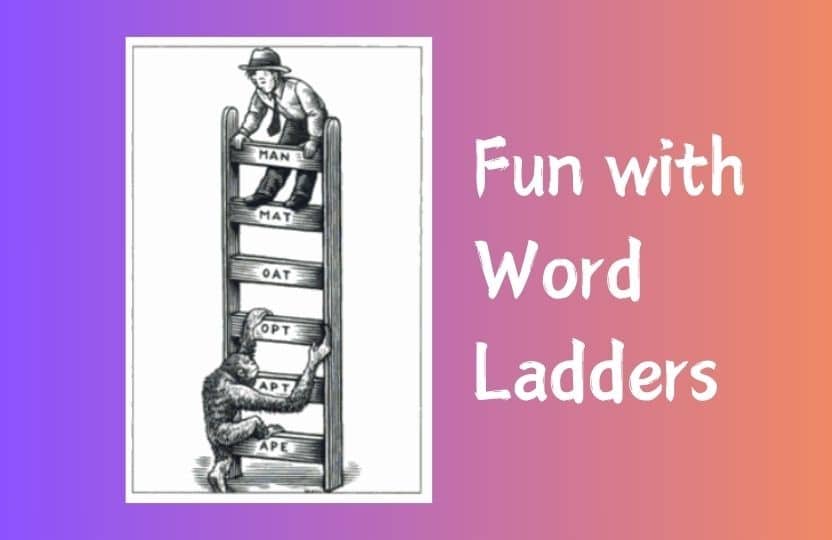
Word ladders are a timeless wordplay activity offering far more than just entertainment—they are a powerful instructional tool for developing critical literacy and thinking skills. Often used in classrooms to improve decoding, phonics, spelling, and vocabulary, word ladders foster higher-order thinking through problem-solving and verbal reasoning.
The challenge involves transforming one word into another by changing one letter at each step to create a valid new word. For example, to change the word “name” to “tank” in four steps, you would follow this sequence: name > same > sane > sank > tank.
name → same → sane → sank → tank.
Each step challenges students to draw on their knowledge of letter-sound relationships, recognize word patterns, and apply logic in real-time.
Invented by Lewis Carroll
The word ladder was invented by none other than Lewis Carroll, the Victorian-era polymath best known for Alice’s Adventures in Wonderland. In addition to his fame as an author, Carroll (whose real name was Charles Lutwidge Dodgson) was also a mathematician, logician, photographer, and Anglican deacon.
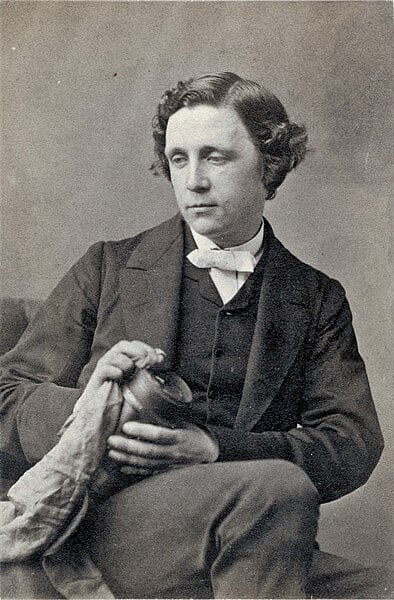
Carroll is believed to have created the game during Christmas in 1877 as a way to entertain and challenge his friends and family. In his diary entry dated March 12, 1878, he referred to the game as “Word-links,” describing it as a two-player game in which players compete to find the shortest or most elegant chain of intermediate words connecting a start word to a target word.
Published as “Doublets”
In 1879, Carroll began publishing these puzzles—now called Doublets—in the popular magazine Vanity Fair. The first puzzle appeared in the March 29, 1879 issue, sparking public interest in the brainteasing game. Later that year, the complete collection of Carroll’s puzzles was compiled and published as a book titled Doublets: A Word-Puzzle by Macmillan and Co.
In this published version, Carroll not only provided puzzles but also shared solutions and commentary, often with a touch of wit and literary flair. The goal was not only to challenge but to amuse, engaging readers both intellectually and playfully.
More than just a game
One of the fascinating aspects of Carroll’s original Doublets was his use of semantic relationships. The goal wasn’t merely to connect random words but to link words that shared some meaningful connection—such as synonyms (love → like), antonyms (hot → cold), or words connected by theme (king → pawn). This added layer of cognitive challenge made the puzzles even more enriching and relevant for language development.
Classroom applications
Today, word ladders are commonly used in education for students of all ages. Here’s how they support key literacy skills:
- Phonics and decoding: Changing one letter at a time reinforces the relationship between letters and sounds, helping students internalize phoneme-grapheme correspondences.
- Spelling patterns: By observing how words change step by step, students become familiar with common spelling patterns, prefixes, and suffixes.
- Vocabulary growth: Each new word encountered becomes an opportunity to build vocabulary through exposure and context.
- Cognitive flexibility: Students must consider multiple paths, encouraging mental flexibility and adaptive thinking.
- Problem-solving and reasoning: There’s an intrinsic logic puzzle to solve, making it a form of language-based critical thinking.
Teachers often scaffold the activity depending on skill level—starting with two- or three-letter words for early readers and progressing to more complex or themed ladders for advanced students.
Variations and challenges
Educators and puzzle-lovers have created many variations of the original game over the years:
- Timed word ladders: Great for adding excitement and fostering fluency.
- Themed ladders: All words relate to a topic (e.g., animals, school, weather).
- Mystery word: Students are given only the start and end words and must deduce the steps without guidance.
- Minimal ladders: The challenge is to use the fewest steps possible—ideal for upper-level learners.
Solve these word ladders
Tips for solving word ladders
- Start with sounds: Try common phonetic shifts first (e.g., changing a consonant sound like /d/ to /t/).
- Think of word families: Move through words that share common endings or patterns (like -at or -ook).
- Use context: If the end word is related by meaning, think of possible synonyms or opposites.
- Don’t be afraid to backtrack: Sometimes, the shortest path isn’t the most obvious one!
- Change dog into pit in 3 steps
- Change cat into dog in 3 steps
- Change run into mat in 3 steps
- Change big into sad in 3 steps
- Change poor into good in 3 steps
- Change sit into rut in 3 steps
- Change hate into love in 3 steps
- Change warm into cold in 4 steps
- Change fold into soul in 4 steps
- Change give into take in 4 steps
- Change pine into rose in 4 steps
- Change tame into wild in 4 steps
- Change book into read in 5 steps
- Change good into best in 5 steps
- Change lost into find in 5 steps
Answers to the word ladders
- dog → dot → pot → pit
- cat → cot → cog → dog
- run → ran → man → mat
- big → bag → sag → sad
- poor → moor → mood → good
- sit → sat → rat → rut
- hate → have → hove → love
- warm → ward → card → cord → cold
- fold → food → fool → foul → soul
- give → live → like → lake → take
- pine → dine → done → dose → rose
- tame → time → tile → wile → wild
- book → rook → room → roam → ream → read
- good → goad → goat → boat → beat → best
- lost → loot → foot → food → fond → find