
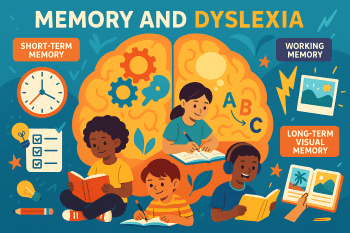
Dyslexia is usually known for causing trouble with reading and spelling. Most people connect it with problems in how the brain processes sounds (phonological processing). But there’s more to the story.
Research shows that many types of memory also play an essential role in dyslexia. These include short-term memory, working memory, visual-sequential memory, iconic memory, and long-term visual memory. Learning to read and spell becomes even harder when these memory systems don’t work well.
Short-term memory: Holding on to information
Short-term memory is where we hold small bits of information for a few seconds. In people with dyslexia, verbal short-term memory is often weak—especially when it comes to remembering things in order. For example, remembering a string of numbers, letters, or syllables can be difficult, even if there aren’t many. This makes it harder to sound out words or keep track of verbal instructions.
Visual short-term memory can also be a problem. Even if someone can see letters or shapes clearly, they might mix up the order when trying to remember them.
Working memory: Juggling information
Working memory is like mental multitasking. It helps us hold information in our minds while doing something with it—like solving a math problem or figuring out how to read a new word. In dyslexia, the phonological loop, which handles spoken and written words, is often weak.
This makes it hard to:
- Break words into syllables
- Blend sounds into words
- Follow long instructions
The visual part of working memory, called the visuo-spatial sketchpad, can also be affected. Some people with dyslexia do well on spatial reasoning tasks (like puzzles). Still, they may struggle with tasks that involve keeping visual information in order, such as copying a pattern or remembering where to look on a page.
Visual sequential memory: Knowing what comes first
Visual sequential memory means remembering the order of what you see. This is very important for reading and spelling, where even one letter out of place changes the word (“form” vs. “from”).
Many people with dyslexia find this kind of memory difficult. It can lead to:
- Mixing up letter order
- Reversing letters (like “b” and “d”)
- Mistaking one word for another
This is not just a problem with the eyes. It shows that the brain has trouble keeping track of the order of visual information, which is essential for building a mental picture of how words should look.
Iconic memory: The blink-and-you-miss-it stage
Iconic memory is a very short type of visual memory. It holds images for just a split second after you see them. It acts like a mental “screenshot” that gives your brain time to begin processing what you saw.
In people with dyslexia, this memory may fade more quickly than usual. That makes it harder to recognize letters or words, especially in fast-paced reading tasks. Experiments show that when a quick flash of an image is followed by something else (a “mask”), dyslexic individuals have more trouble remembering what came first.
This weak iconic memory can cause problems early in the reading process, before comprehension even begins.
Visual long-term memory: Troubles with details
Long-term memory stores information over time. People with dyslexia often have difficulty with the visual long-term memory of details. A study by Weis et al. (2014) found that adults with dyslexia could recognize an image they had seen before but had trouble remembering its specific version.
This means while the overall shape or idea is remembered, the fine details are not. That matters in reading and spelling, where remembering exactly how a word looks is key. Without a strong memory for word shapes and spellings, people have to rely more on sounding things out, which affects their fluency.
A mix of strengths and weaknesses
Not every memory system is weak in dyslexia. Some individuals are strong in spatial thinking or big-picture visual processing. They might do well in areas like building things, using maps, or understanding patterns.
But these strengths don’t make up for weaknesses in remembering order or details, which are essential for literacy. One person might remember how a place looks but still struggle to spell “friend” or know which direction a “b” faces.
This mix of strengths and challenges is part of what makes dyslexia so complex and personal.
Conclusion
Dyslexia affects more than just how the brain processes sound. Short-term, sequential, iconic, and long-term visual memory systems also play a significant role. When several of these systems don’t work well, reading and spelling become more difficult and less automatic.
By looking beyond just sound processing, we can better understand what people with dyslexia are experiencing. It also helps us support them more effectively, not by assuming they’re lazy or careless, but by recognizing how their brains handle information differently.
Edublox offers explicit, systematic reading instruction integrated with cognitive training to help students overcome the symptoms of dyslexia. We work with families worldwide. Book a free consultation to explore how we can support your child’s learning journey.
Authored by Sue du Plessis (B.A. Hons Psychology; B.D.), a dyslexia specialist with 30+ years of experience in learning disabilities.
Edublox is proud to be a member of the International Dyslexia Association (IDA), a leading organization dedicated to evidence-based research and advocacy for individuals with dyslexia and related learning difficulties.