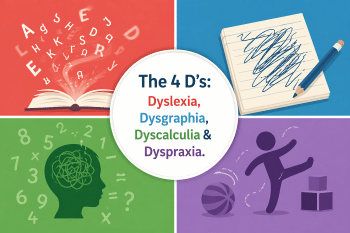
The 4 D’s of learning difficulties are dyslexia, dysgraphia, dyscalculia, and dyspraxia. These common learning challenges affect reading, writing, math, and coordination, and often occur together. Each presents differently, but they share underlying cognitive roots. Effective support must address how children learn, not just labels.
What the 4 D’s are—and why they matter
The term “4 D’s” is often used to group together four types of learning difficulties that affect academic performance and everyday functioning. These include dyslexia (reading), dysgraphia (writing), dyscalculia (math), and dyspraxia (coordination and movement).
These are often referred to as learning disabilities in formal settings. However, in practice, children often experience blurred boundaries between them. A child struggling to read may also struggle to spell. Another who struggles with math may also have difficulty following sequences or remembering steps.
This overlap occurs for a reason. All learning relies on underlying cognitive processes, including memory, attention, processing speed, and sequencing. Weaknesses in these processes can cause difficulties in multiple areas.
This is why simply identifying a label is not enough. Supporting a child effectively requires looking deeper at the root causes behind the learning difficulty. This broader understanding is key to meaningful help.
Dyslexia: When reading does not become automatic
Dyslexia mainly affects reading and spelling, but it often impacts other areas as well.
Children with dyslexia typically struggle to accurately decode words, recognize familiar words, and read fluently. They often read slowly, with effort, and become frustrated.
Difficulties with phonological processing—the ability to work with the sounds of language—usually lie at the heart of dyslexia. Even when children improve at decoding, many continue to struggle with fluency and comprehension.
Working memory plays an important role. If a child cannot hold information long enough to process it, comprehension breaks down—even when they can read the words.
Dysgraphia: When writing becomes a barrier
Dysgraphia affects writing, which requires integrating motor skills, language, memory, and attention.
Children may produce slow or illegible handwriting or struggle to organize ideas when writing.
Writing places heavy demands on working memory. As children try to think, spell, form letters, and organize ideas all at once, the load becomes too great, and performance breaks down.
Dyscalculia: When numbers do not make sense
Dyscalculia involves difficulty understanding numbers and mathematical relationships.
Children may misunderstand number concepts, fumble with counting, forget math facts, or struggle through multi-step calculations. As tasks become more complex, their difficulties grow.
Working memory is central to math. Children often lose track of steps or forget what they are doing midway through a problem, which makes math inconsistent and frustrating.
Dyspraxia: When coordination affects learning
Dyspraxia affects motor planning and coordination. Children may move clumsily, struggle with fine motor tasks, and take longer to master new movements.
In the classroom, this slows children’s writing speed and reduces their accuracy, while also complicating tasks that require coordination and sequencing. Learning is not purely academic—it involves both physical and cognitive processes.
Why these difficulties often occur together
These difficulties frequently occur together because they rely on shared underlying skills such as memory, attention, and processing speed.
Weaknesses in these areas can affect reading, writing, math, and coordination simultaneously. This explains why isolated interventions often have limited success.
Moving beyond labels
Labels help us identify patterns, but they do not reveal the cause. Two children with the same label may experience different underlying difficulties.
To help a child learn, we must look beyond labels and understand the cognitive processes beneath them. Targeted intervention comes from identifying how the child learns and where challenges arise.
Supporting children effectively
We should provide structured, step-by-step support matched to each child’s developmental level. This support should address both academic skills and underlying processes such as memory and attention.
Simply practicing more often fails to help. When children strengthen their underlying processes, they achieve more stable and consistent learning.
Conclusion
The 4 D’s describe different ways learning can be affected. Although each shows its own characteristics, strong connections link them.
Understanding these difficulties means looking beyond surface labels. Addressing the underlying cognitive processes gives children the best chance to make meaningful progress—the central message of the 4 D’s.
Edublox offers an integrated approach that combines online tutoring with cognitive training for students with dyslexia, dyscalculia, and other learning challenges. We work with families worldwide. Book a free consultation to discuss your child’s learning needs.
The 4 D’s: Dyslexia, Dysgraphia, Dyscalculia & Dyspraxia was authored by Sue du Plessis (B.A. Hons Psychology; B.D.), a dyslexia and dyscalculia specialist with 30+ years of experience in learning disabilities.
Edublox is proud to be a member of the International Dyslexia Association (IDA), a leading organization dedicated to evidence-based research and advocacy for individuals with dyslexia and related learning difficulties.