
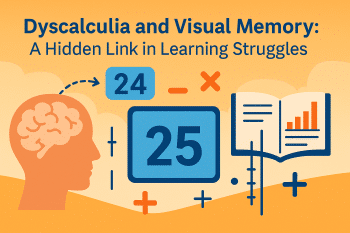
Numbers might be visible on the page, but for some children, they don’t stick—the shapes, meanings, and relationships between them fade as quickly as they appear. Welcome to the complex world of dyscalculia, a learning difficulty that affects a child’s ability to understand numbers and math—and where visual memory often plays a far bigger role than people realize.
What is dyscalculia?
Dyscalculia is sometimes described as “dyslexia for numbers,” but that comparison doesn’t quite do it justice. While both conditions affect learning, dyscalculia is specifically tied to difficulties with number sense, spatial reasoning, and math-related tasks. Children with dyscalculia often struggle with counting, sequencing, recognizing number patterns, remembering math facts, and understanding place value.
But, when the image numbers slip away before a child can process it, the real challenge isn’t math—it’s memory. Visual memory, to be exact.
The role of visual memory in math
Visual memory—the ability to remember what you see—is a critical part of early mathematical development. Before a child ever learns what “3 + 2” equals, they must be able to:
- Recognize and recall digits visually.
- Match symbols with quantities (e.g., “4” means four objects).
- Remember spatial layouts (like where numbers sit on a number line).
- Visually track sequences in equations or multi-step problems.
When visual memory is weak, these foundational skills wobble. A child might confuse similar-looking numbers (like 6 and 9), forget the steps in a written problem, or be unable to remember the layout of a multiplication table—no matter how many times they study it.
Visual memory breakdown: Which types matter?
Not all visual memory is created equal. The following types often overlap in children with dyscalculia:

- Visual working memory: This is the ability to hold and manipulate visual information in the mind for a short time—a kind of mental whiteboard. It’s crucial for multi-step math tasks. For example, when a child reads a math problem like 14 + ___ = 23, they must remember the “14,” hold the image of “23,” and figure out what fits the gap—all in real-time. Weak visual working memory can lead to lost steps, misaligned operations, or forgotten instructions halfway through a task.
. - Visual sequential memory: The ability to recall a sequence of visual information. This is crucial for remembering number patterns (e.g., 3-6-9-12) or math procedures (e.g., long division steps).
. - Visual-spatial memory: The ability to remember the spatial relationship between objects affects how children align digits in written problems, understand geometry, or navigate math manipulatives. A study by Szűcs et al. (2013) provides compelling evidence that visuo-spatial working memory and visuo-spatial short-term memory play a significant role in developmental dyscalculia.
. - Long-term visual memory: Storing visual information for later use. Without it, children struggle to retain visual strategies or diagrams they’ve learned before.
Why the link matters
Research increasingly shows that dyscalculia isn’t just about poor “math sense”—it often involves broader issues in visual processing and memory. Studies suggest that children with math difficulties frequently have deficits in:
- Visual short-term or working memory
- Visuo-spatial memory
- Visual symbol recall
This doesn’t just impact math—it can affect executive function, reading fluency, and even attention. It’s like trying to solve a jigsaw puzzle with half the pieces missing from your mental snapshot.
What to look for
Children who may have dyscalculia linked to visual memory difficulties often:
- Forget what numbers look like or how to write them
- Reverse or misread digits (13 vs. 31)
- Struggle to copy math problems accurately
- Lose track of steps in visual tasks
- Have trouble learning math facts despite repeated exposure
They may also perform well with oral math tasks or mental calculations but fall apart when visuals are involved.
Intervention
Edublox offers help to students with mild to severe dyscalculia. Our math help consists of the following:
- Developing foundational math skills such as visual processing and memory.
- Teaching math skills sequentially.
- Teaching an in-depth understanding of math terminology.
Watch our playlist below and book a free consultation to discuss your child’s math learning needs.
References for Dyscalculia and Visual Memory: A Hidden Link in Learning Struggles:
- Geary, D. C. (2011). Cognitive predictors of achievement growth in mathematics: A five year longitudinal study. Developmental Psychology, 47(6), 1539–1552.
- Holmes, J., & Adams, J. W. (2006). Working memory and children’s mathematical skills: Implications for mathematical development and mathematics curricula. Educational Psychology, 26(3), 339–366.
- Mammarella, I. C., Caviola, S., Giofrè, D., & Szűcs, D. (2018). The underlying structure of visuospatial working memory in children with mathematical learning disability. British Journal of Developmental Psychology, 36(2), 220–235.
- Szűcs, D., Devine, A., Soltesz, F., Nobes, A., & Gabriel, F. C. (2013). Developmental dyscalculia is related to visuo-spatial memory and inhibition impairment. Cortex, 49(10), 2674–2688.
Dyscalculia and Visual Memory: A Hidden Link in Learning Struggles was authored by Sue du Plessis (B.A. Hons Psychology; B.D.), an educational specialist with 30+ years of experience in the learning disabilities field.