
Welcome to the Dyscalculia Hub — a comprehensive guide to understanding dyscalculia in children and adults. Whether you are a parent, teacher, tutor, or student, this hub brings together research-based articles, videos, and practical guidance to help you recognize this learning disorder, understand its causes, explore effective interventions, and support struggling learners with confidence.
What Is Dyscalculia?
Dyscalculia is a specific learning disability that affects a person’s ability to understand numbers, learn math facts, perform calculations, and develop mathematical reasoning skills. Individuals with dyscalculia may struggle with number sense, mental math, sequencing, visual-spatial skills, working memory, and grasping mathematical concepts despite normal intelligence and adequate instruction. Dyscalculia occurs on a continuum from mild to severe and can affect children and adults alike.
Often described as “dyslexia for math,” dyscalculia impacts far more than school performance. It can affect confidence, daily functioning, time management, money skills, and emotional well-being. However, with appropriate intervention and support, many learners with dyscalculia can make meaningful progress and develop greater confidence in math and learning.
Dyscalculia Symptoms and Warning Signs
Dyscalculia symptoms may look different from one learner to another. Some children mainly struggle with basic number understanding, while others experience broader difficulties involving memory, sequencing, visual-spatial processing, or mathematical reasoning.
Common symptoms include:
- Difficulty understanding number value
- Difficulty learning and recalling math facts
- Counting inaccurately or very slowly
- Difficulty understanding place value
- Problems solving word problems
- Difficulty performing mental calculations
- Reliance on finger counting long after peers have stopped
- Confusion with mathematical symbols
- Reversing numbers, such as 18 and 81
- Difficulty with sequencing and following multi-step procedures
- Weak estimation skills
- Difficulty telling time and handling money
- Problems organizing numbers correctly on the page
- Math tasks may feel confusing, overwhelming, and mentally exhausting
- Frustration, anxiety, and low confidence related to math
Symptoms often persist despite normal intelligence, effort, and adequate instruction and may continue into adolescence and adulthood if not properly addressed.
New to Dyscalculia?
Start with this short introductory video.
Essential Dyscalculia Guides
These cornerstone articles provide the best starting point for understanding dyscalculia — what it is, how it affects learning, how it is identified, and which interventions can help struggling learners succeed.
⭐ Dyscalculia Explained: Signs, Causes, Diagnosis, Support Strategies
⭐ Dyscalculia Characteristics, Symptoms, and Signs
⭐ 4 Causes of Dyscalculia
⭐ Dyscalculia Therapy & Intervention: The 2 Missing Pieces
Editor’s Picks
Comprehensive Dyscalculia Resource Library
1. Foundations of Dyscalculia
These articles lay out what dyscalculia is, where it comes from, and how it’s been recognized over time. You’ll find clear explanations of symptoms, causes, and history.
- Defining Dyscalculia: Beyond “Being Bad at Math”
- Dyscalculia Explained: Signs, Causes, Diagnosis, Support Strategies
- Math Learning Disabilities: Symptoms, Causes, Treatment
- The History and Recognition of Dyscalculia
2. Characteristics and Symptoms
What does dyscalculia look like in real life? This section explores its telltale characteristics, including weak number sense, difficulty with subitizing, and the core skill deficits that make math so challenging.
- Dyscalculia Characteristics, Symptoms, and Signs
- The 4 Core Math Skill Deficits in Dyscalculia
- Number Sense: A Key to Mathematical Learning
- Subitizing: A Core Deficit of Dyscalculia
- Everyday Life with Dyscalculia: Beyond the Classroom
- Dyscalculia Screening Checklist (PDF)
3. Causes and Types
Why do different learners show different profiles of math difficulty? These articles explore underlying causes—from memory deficits to brain differences—as well as the different types and subtypes of dyscalculia.
- 4 Causes of Dyscalculia
- Cognitive Skills and Math Ability
- Understanding Math Today, Forgetting It Tomorrow
- Dyscalculia and Visual Memory: A Hidden Link in Learning Struggles
- Dyscalculia Types and Subtypes
4. Treatment and Intervention
The good news: support strategies exist. This section explains how dyscalculia can be treated and outlines practical, evidence-based ways to help, from professional interventions to child-friendly explanations that make this learning disorder less intimidating — plus powerful stories of hope.
- Dyscalculia Therapy & Intervention: The 2 Missing Pieces
- Dyscalculia Therapy vs Traditional Math Tutoring
- Dyscalculia Intervention: A Structured Cognitive-Mathematical Approach
- Dyscalculia Treatment & Intervention: 5 Strategies that Work
- Overcoming Dyscalculia Symptoms: 6 Tried and Tested Steps
- From Struggle to Success: What Two Students Taught Us About Dyscalculia
- How to Explain Dyscalculia to Children
- 13 Dyscalculia Success Stories from Real Families
- Severe Dyscalculia: Signs, Challenges, and a Story of Hope
- Dyscalculia Case Study: Sam’s Remarkable Progress in Math
- Dyscalculia Case Study: From Struggle to Success
5. Overlap with Other Conditions
Dyscalculia rarely travels alone. Here you’ll learn how it overlaps with dyslexia, math anxiety, and conditions like PANDAS — and why recognizing these links matters for effective support.
- The 4 D’s: Dyslexia, Dysgraphia, Dyscalculia & Dyspraxia
- The 5 Main Types of Learning Disabilities
- Dyscalculia and Dyslexia: Overlap and Key Differences
- Math Anxiety in Children with Dyscalculia
- PANDAS, Visual-Spatial Disorder, and Dyscalculia: How They Overlap and How to Help
6. Facts and Research
For those who want the big picture: this section gathers quick facts and scientific insights into dyscalculia, its prevalence, and the neuroscience behind it.
- Dyscalculia Statistics and Prevalence: How Common Is It?
- 20 Facts About Dyscalculia
- The Research and Neuroscience of Dyscalculia
Book a Consultation
If your child struggles with math, numbers, memory, or basic arithmetic despite effort and practice, dyscalculia may be a factor. Early intervention can make a meaningful difference. And if your child has dyscalculia, it is never too late to intervene.
At Edublox Online Tutor, we integrate cognitive training with academic tutoring to help students strengthen the skills required for math success. We support families worldwide.
Book a free consultation to discuss your child’s learning needs and explore how we can help.
Dyscalculia Printables and Visual Guides
1. Webinar
Watch our in-depth webinar on dyscalculia presented by Hannelie Brönner. The webinar explores the signs, characteristics, causes, and intervention strategies associated with dyscalculia and related math learning difficulties. Ideal for parents, teachers, tutors, and anyone seeking a deeper understanding and evidence-based support strategies.
Hannelie Brönner is a secondary math and remedial teacher who worked in the United Kingdom for 17 years as a remedial teacher and SENDCo in mainstream schools before becoming Head of School at Starhurst School, a special secondary school for boys with SEMH needs. She holds an MA Ed (Leadership and Management), specializing in Inclusive Education.
2. Free eBook
This free eBook provides a comprehensive introduction to dyscalculia, including its signs, causes, diagnosis, and intervention options. Written for parents, teachers, tutors, and students, it explains why some learners struggle with math and what can be done to help. Download here: Dyscalculia eBook: Your Guide to Dyscalculia
3. Infographics
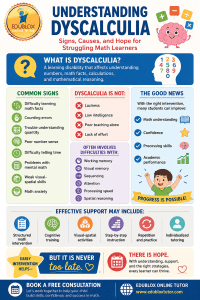
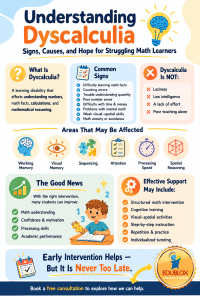
[View Full Infographic PNG] [Download PDF]
Landmark Research
- Brian Butterworth’s The Mathematical Brain (1999) is one of the foundational works linking dyscalculia to deficits in number sense and numerical cognition.
- Stanislas Dehaene’s The Number Sense (1997) is a landmark work in neuroscience explaining how the brain processes numbers and mathematical quantity.
- David C. Geary’s article, “Mathematics and learning disabilities,” published in the Journal of Learning Disabilities (2004), is a landmark paper explaining how deficits in working memory, procedural skills, and math fact retrieval contribute to mathematical learning disabilities and dyscalculia. Read a summary of this article.
- Kucian, K., et al. (2006) published “Impaired neural networks for approximate calculation in dyscalculic children: A functional MRI study” in Behavioral and Brain Functions. This study showed that children with dyscalculia process numerical information differently at the brain level, particularly in regions linked to quantity processing and calculation.
- Ann Dowker’s Individual Differences in Arithmetic: Implications for Psychology, Neuroscience and Education (2005) became influential because it emphasized that dyscalculia does not present the same way in every learner and that intervention should be individualized rather than one-size-fits-all.
- Ladislav Kosc’s “Developmental dyscalculia,” published in the Journal of Learning Disabilities (1974), is one of the earliest formal definitions of developmental dyscalculia and remains historically important.
This page was reviewed by Sue du Plessis (B.A. Hons Psychology; B.D.), a dyscalculia specialist with more than 30 years of experience in learning disabilities.