
Many people still think dyscalculia simply means being “bad at math.” In reality, dyscalculia is far more serious and far more complex than ordinary difficulty with school mathematics.
Children with dyscalculia are often intelligent, hardworking, and capable in many other areas, yet continue struggling with numbers despite extra help, repeated explanations, and hours of practice. Parents frequently describe the same frustrating experience: their child studies hard, receives tutoring, passes a test, and then seems to forget everything a few days later.
This is because dyscalculia is not laziness, lack of effort, or poor teaching.
It is a severe and persistent learning difficulty that makes mathematics very difficult to learn and do. The DSM-5 classifies dyscalculia as a specific learning disorder in mathematics. Learners with dyscalculia often experience characteristic symptoms and frequently struggle to improve through traditional math tutoring and repeated practice alone.
Common symptoms of dyscalculia
Dyscalculia symptoms are many and varied, but several patterns appear repeatedly.
Poor number sense
Many learners with dyscalculia struggle to understand the size of numbers and how numbers relate to one another. Numbers may feel abstract rather than meaningful.
Poor subitizing
Subitizing is the ability to instantly recognize how many objects there are without counting. Most people can subitize small quantities automatically. Children with dyscalculia may struggle to subitize even very small numbers.
Slow and effortful calculations
Learners may continue relying on finger counting long after their peers have stopped. Even simple calculations can require enormous mental effort.
Difficulty memorizing math facts
Basic facts such as 5 + 5 = 10 or 6 × 6 = 36 often fail to become automatic despite repeated practice.
Poor spatial awareness
Some learners struggle to align numbers correctly during calculations, which can create major problems in procedural mathematics.
Math anxiety
Math struggles often create enormous frustration, fear, and anxiety. Over time, repeated failure can lead to avoidance and low confidence.
A practical framework for understanding dyscalculia
After working with dyscalculic students for many years, I began grouping symptoms differently because it created a practical framework for intervention.
Counting
Most students can count forward but struggle to count backward. Many also struggle to count by 2s, 3s, and other sequences, which makes learning multiplication tables especially difficult.
Mental math
Learners often struggle to add and subtract mentally, sometimes even with very small numbers.
Procedural math
Many students can add with carrying, and some can subtract with borrowing, but that is often where the process breaks down. Multiplication, long division, fractions, mixed numbers, decimals, and order of operations may become overwhelming.
Place value
For many learners, place value can be a major challenge, especially when zeros are involved. A learner may write 7,032 as 700032 or 51,002 as 512.
This framework is useful because it does not simply describe symptoms. It also helps guide intervention.
Why traditional tutoring often is not enough
Most people who have traveled this road with a dyscalculic child or student will agree that traditional teaching and tutoring often do not help enough for the student to truly catch up.
Yes, tutoring may help a learner pass a test or exam. But a few days later, the work is often forgotten.
Something is missing.
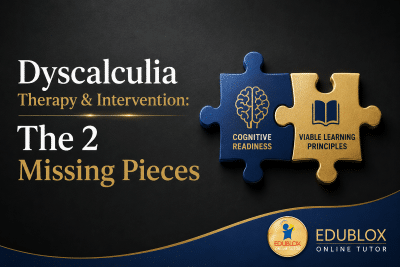
Without ignoring genetic factors — yes, dyscalculia does run in families — and without ignoring brain differences, one contributing factor that can be addressed is weak cognitive skills.
Learning is a stratified process. Certain skills must become strong before more advanced skills can develop successfully. It is like climbing a ladder or building a house. Without a strong foundation, the structure cannot stand.
We understand this principle naturally in sport. A child cannot learn to play ice hockey before learning to ice skate.
The same principle applies to mathematics.
Cognitive skills and mathematical readiness
Cognitive skills form the foundation of academic learning.
One especially important skill is visual-spatial processing — the ability to understand where things are in space and how they relate to one another. In mathematics, visual-spatial processing helps learners:
- align numbers correctly,
- understand place value,
- recognize patterns,
- and follow procedures on a page.
Memory also plays a critical role.
Visual memory, visual-spatial memory, and visual sequential memory all contribute to successful mathematical learning. Working memory and long-term memory are equally important.
Working memory is the ability to hold and manipulate information in the mind simultaneously. In mathematics, learners use working memory to remember numbers, follow steps, and solve problems mentally.
Logical thinking and reasoning are also essential, especially when learners solve word problems or apply mathematical concepts in new situations.
The important thing is this: these skills can be developed and improved. That is what science says.
Readiness does not automatically create achievement
However, science also tells us something extremely important: The transfer of improved cognitive skills to academic performance is not automatic.
While academic performance cannot improve fully without stronger cognitive skills, the transfer does not happen automatically — just as being a good ice skater does not automatically make someone a good ice hockey player. You still have to learn to play hockey. One simply creates readiness for the other.
In the same way, students with dyscalculia still need to catch up academically in math. To do that successfully, you need to follow viable learning principles.
Edublox is based on nine learning principles.
At the heart of it is neuroplasticity — the brain’s ability to adapt and change through learning.
Another principle is step-by-step teaching. Students do not move forward until they are ready. It is like a builder waiting for a row of bricks to dry before building higher.
We also teach students to use three senses: visual, auditory, and touch.
Repetition and drill-and-practice are vital, but they must be done in a certain way to eventually create a snowball effect and automaticity. The violin master and educator Shinichi Suzuki successfully developed this principle in music education. Edublox applies the same idea to learning.
We also embrace flearning — learning from failure — which helps students see mistakes in a positive light and gradually reduces anxiety.
Edublox in practice
The process starts with a consultation, followed by a free assessment. The assessment is not diagnostic, but it helps us make recommendations and personalize each student’s program.
Part of the intervention includes cognitive skills development, which is done at home through a program called Development Tutor. The student needs access to a computer or laptop and, under some parental supervision, completes two to three cognitive lessons per week. Each lesson takes approximately 20–25 minutes.
The other part of the intervention involves direct academic support, which we provide online. Most students attend three 30-minute lessons per week.
We use a finger-coding exercise to teach counting, multiplication tables, and division. We also work on mental math and place value. In addition, we work on procedural mathematics. This may begin with addition and eventually progress to integers, algebra, geometry, transformations, and statistics.
There is hope
Dyscalculia can be challenging, frustrating, and emotionally exhausting for both learners and parents.
But improvement is possible.
With the right support, many students make far more progress than people initially expect. Never give up on finding the right support for your children or students.
Edublox offers an integrated approach that combines cognitive training with academic tutoring for students with dyscalculia and other learning challenges. We support families worldwide. Book a free consultation to discuss your child’s learning needs.
Dyscalculia Therapy & Intervention: The 2 Missing Pieces was authored by Sue du Plessis (B.A. Hons Psychology; B.D.), a dyscalculia specialist with 30+ years of experience in learning disabilities.