
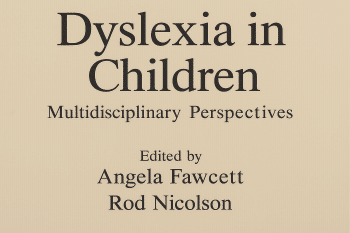
Dyslexia in Children: Multidisciplinary Perspectives (1994) presents a wide-ranging, multidisciplinary examination of dyslexia, moving beyond the traditional view of it as a purely reading-related disorder. Edited by Angela Fawcett and Rod Nicolson, the book compiles research from psychology, neuroscience, education, and linguistics to provide a comprehensive picture of the cognitive and developmental dimensions of dyslexia.
1. Redefining dyslexia: More than a reading disorder
Dyslexia has traditionally been viewed as a specific difficulty with reading and spelling, occurring in individuals who otherwise show normal intelligence and have had sufficient learning opportunities. However, Angela Fawcett’s experience with her own son challenged this limited perspective. Her close observation, combined with in-depth research, revealed that dyslexia extends beyond literacy struggles—it also affects memory, coordination, and everyday organization. This broader pattern of difficulties points to a deeper issue with learning and automating skills, aligning with emerging views that dyslexia is a more widespread and multifaceted learning difference.
2. Phonological deficit hypothesis
A dominant theory in dyslexia research is the Phonological Deficit Hypothesis, introduced and extensively reviewed by John Rack. This theory posits that dyslexic individuals struggle to process phonological information—the sounds of language—which underpins their difficulties with decoding words, rhyming, blending, and segmenting sounds. Rack evaluates the theory across four dimensions:
- Specificity: Phonological deficits are specific to reading-related tasks.
- Causality: Deficits appear to precede and contribute to reading failure.
- Process: The inability to map graphemes to phonemes hampers reading.
- Variation: Differences in phonological skills explain variation among people with dyslexia.
Studies confirm that people with dyslexia underperform on tasks like rhyming, sound categorization, and nonsense-word repetition, and these deficits are present even before formal reading instruction begins. Longitudinal studies support phonological awareness as a reliable predictor of reading outcomes.
3. Reading processes and automatization
John Beech expands on the process of reading development, distinguishing between the logographic (whole word) and sublexical (phoneme-based) reading routes. Dyslexic children tend to rely excessively on logographic strategies, limiting their ability to decode unfamiliar words. Even when exposed to phonics-based instruction, some people with dyslexia resist or struggle to acquire sublexical strategies. Beech’s work suggests that these children may never fully automate the subskills required for fluent reading.
Yap and van der Leij’s empirical studies reinforce this point, showing that dyslexic children, even when matched for reading level, process words more slowly and less fluently than their peers. This delay persists over time, indicating a core difficulty with the automatization of reading-related skills rather than a developmental lag.
4. Visual processing and temporal deficits
Although phonological deficits dominate dyslexia discourse, visual processing also plays a critical role. William Lovegrove and John Stein examine visual timing deficits and binocular instability in dyslexic individuals. Their research suggests people with dyslexia have trouble processing rapidly presented visual stimuli—a skill crucial for smooth reading. Stein posits that impaired magnocellular pathways involved in motion detection and visual attention contribute to unstable eye movements and difficulties with word tracking.
These visual issues may co-occur with phonological problems or, in some cases, represent a distinct subtype of dyslexia. The presence of visual deficits challenges the one-size-fits-all approach to intervention and underlines the need for multifaceted diagnostic tools.
5. Motor skills and balance
Fawcett and Nicolson’s studies explore motor control and balance, revealing that dyslexic children often show clumsiness and poor coordination. When tasked with balancing while doing a simultaneous activity, dyslexic children performed significantly worse than their peers, indicating a deficiency in automatic skill integration. Even after prolonged practice, they show slower gains in motor-based learning (e.g., typing), reinforcing the view that dyslexia affects the acquisition of automaticity across domains.
These motor and coordination challenges align with cerebellar dysfunction theories, which propose that dyslexia arises from a broader impairment in procedural learning—a domain governed partly by the cerebellum.
6. Taxonomy and diagnosis of dyslexia
T.R. Miles addresses the difficulties in diagnosing dyslexia due to its heterogeneous presentation. He critiques the traditional discrepancy model—which diagnoses dyslexia based on a significant gap between IQ and reading ability—as narrow and inconsistent. Instead, he advocates for a positive indicator model based on a constellation of skill deficits, particularly in phonological awareness and processing speed.
He calls for a robust taxonomy categorizing dyslexia into subtypes, thereby improving diagnosis and intervention. His Bangor Dyslexia Test was one of the first tools to use positive identification markers instead of exclusionary criteria.
7. Cross-domain skill deficits
In the concluding chapters, Nicolson and Fawcett synthesize findings from their laboratory that tested dyslexic and control children across multiple domains—phonological skill, motor skill, speed of processing, and balance. Their results show that dyslexic children experience deficits across all these areas, not just reading. Phonological deficits were most common, but balance and processing speed also emerged as significant challenges.
Interestingly, when comparing people with dyslexia to non-dyslexic “slow learners,” they found that the latter performed even worse in phonological tasks but better in balance—highlighting dyslexia’s unique neurocognitive profile. These findings highlight the value of developing a multi-domain diagnostic model beyond simple reading tests.
8. Educational and policy implications
The editors argue that early, targeted intervention is critical. Since phonological awareness and motor skill issues are evident before reading failure, preschool screening could identify at-risk children. Interventions must be individualized, incorporating phonics-based instruction, motor coordination training, and possibly visual-motor integration support.
Moreover, they highlight the need for teacher education, more nuanced policy frameworks, and better-informed assessments. Misunderstanding dyslexia leads to misdiagnosis, under-support, and emotional distress for both children and families.
Conclusion
Dyslexia in Children breaks new ground by treating dyslexia not just as a reading problem but as a broader developmental disorder that affects multiple domains of learning. Through contributions from leading researchers, the book builds a compelling case for rethinking how we define, diagnose, and support dyslexic individuals. It encourages a shift from exclusionary labels to inclusive, evidence-based interventions that address the full complexity of the dyslexic profile. Whether you’re a researcher, educator, or parent, this volume provides the theoretical and practical tools to better understand and respond to the diverse needs of dyslexic children.