
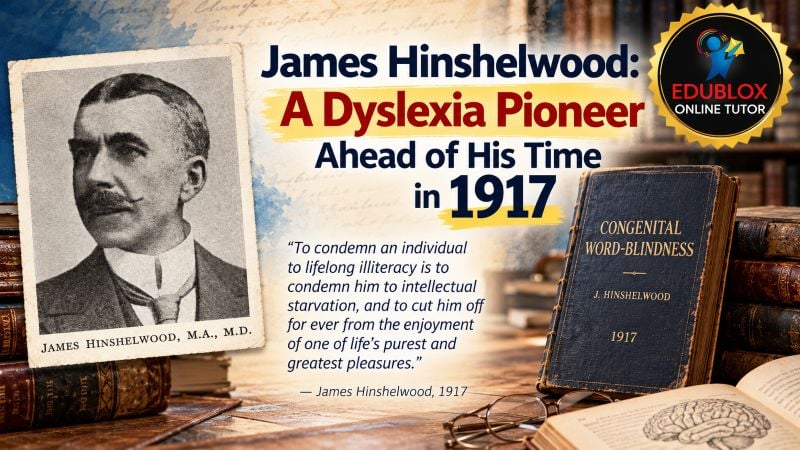
More than a century ago, Scottish ophthalmologist James Hinshelwood was investigating questions about dyslexia that remain relevant today.
He explored the relationship between reading and memory, examined differences in learning abilities, investigated hereditary influences, and developed practical approaches to teaching children with severe reading difficulties. Remarkably, he also discussed the brain’s capacity for change long before neuroplasticity became a familiar concept in education and neuroscience. His 1917 book, Congenital Word-Blindness, reveals a researcher whose thinking was considerably broader than his outdated neurological explanations might suggest.
Understanding reading beyond the brain
Hinshelwood approached reading difficulties through his medical work with people who had lost the ability to read following brain injury. These cases, known today as acquired dyslexia or alexia, provided valuable insights into the complexity of reading. One particularly revealing case involved a highly educated teacher who could still speak, write, and read numbers but could no longer identify written letters and words. Such observations suggested that reading was not a single, indivisible ability and that different aspects of written language could be affected independently.
Hinshelwood extended these observations to children who had never developed normal reading skills, despite adequate intelligence and opportunities to learn. He referred to this condition as congenital word-blindness. Rather than assuming that these children lacked intelligence or motivation, he investigated the particular abilities that appeared to interfere with their progress. His approach was significant because it shifted attention away from blaming the child and toward understanding the processes involved in learning to read.
Although Hinshelwood attempted to explain these difficulties by identifying specific brain regions responsible for visual word memory, his anatomical conclusions were not entirely correct. Nevertheless, the limitations of his neurological theory should not overshadow the value of his clinical observations. Understanding the precise location of a function in the brain and understanding how to teach that function are two different matters. A teacher does not need to understand the neurological mechanisms of piano playing to teach someone to play the piano, and the same principle applies to reading.
Memory at the center of reading development
One of the most striking features of Congenital Word-Blindness is the attention Hinshelwood devoted to memory. He did not treat memory as a single, general ability but distinguished between visual, auditory, and motor memory, discussing how these functions could be affected differently. He also considered the possibility that visual memory for letters and words could be impaired while memory for numbers, musical notation, or familiar objects remained relatively intact.
These distinctions were remarkably perceptive for the time. Hinshelwood understood that successful reading requires the learner to retain information about written symbols and retrieve it efficiently. He placed particular emphasis on visual word memory, which he believed allowed familiar words to be identified rapidly without repeatedly analyzing every letter. Although modern research describes orthographic learning and automatic word recognition in more sophisticated terms, his observations anticipated questions that would become central to later research on reading fluency.
His investigations also demonstrated that children with reading difficulties did not all present the same pattern of weaknesses. Some experienced considerable difficulty learning letters, while others could identify individual letters but struggled to read complete words. These differences mattered because they suggested that instruction should address the particular difficulties experienced by each learner rather than treating all reading problems as identical.
Heredity, intelligence, and individual differences
Hinshelwood devoted considerable attention to the hereditary nature of congenital word-blindness, documenting families in which several members experienced similar reading difficulties. He understood that the condition could occur across generations and that its severity varied between individuals. His observations preceded modern genetic research by many decades, yet they demonstrated an early appreciation of the biological and developmental influences associated with reading disorders.
Equally important was his insistence that severe reading difficulties could occur in otherwise intelligent children. He described learners who performed well in other areas of schoolwork, demonstrated sound reasoning abilities, and appeared capable of learning, yet remained unable to master reading through ordinary classroom instruction. He rejected the assumption that their difficulties resulted from laziness or intellectual limitations and expressed concern about the treatment of children whose problems were misunderstood.
These observations remain relevant because a diagnosis of dyslexia tells us relatively little about an individual’s complete learning profile. Two children may have equally severe reading delays while differing substantially in memory, processing speed, language skills, and other abilities. Hinshelwood did not develop the modern multiple-deficit model associated with Bruce Pennington, but his clinical work illustrates why reading difficulties should not be viewed through a single, narrowly defined explanation.
From letter learning to automatic word recognition
Hinshelwood’s understanding of reading development was closely connected to his teaching recommendations. He described a progression in which children first learned to identify and remember individual letters, then developed the ability to work through words using letter names and auditory memory, and eventually acquired visual word memory that made rapid recognition of familiar words possible.
This progression reveals that he appreciated the distinction between laborious word analysis and fluent reading. A child who must consciously identify and assemble every letter may eventually produce the correct word, but that is not the same as reading it immediately and effortlessly. Automaticity allows the reader to move through text efficiently and devote more attention to understanding its meaning. Hinshelwood understood the practical importance of developing this ability long before reading fluency became a major focus of contemporary research.
His approach also involved more than simply exposing children to written words and hoping that reading would develop naturally. He advocated carefully directed, individualized instruction, with repeated practice designed to strengthen the abilities required for successful reading. Visual and auditory processes both featured in his teaching recommendations, reflecting his understanding that reading involved the coordination of several skills.
He believed children with severe dyslexia could learn to read
Perhaps the most important aspect of Hinshelwood’s work was his conviction that children with severe reading difficulties could make meaningful progress when provided with appropriate instruction. In the chapter titled Prognosis and Treatment, he challenged the pessimistic belief that attempts to teach children with congenital word-blindness were futile. His own clinical experience had convinced him otherwise.
Hinshelwood described children who had learned to read through specialized teaching, including five children discussed in his chapter on heredity whose parents had followed his instructional advice. He emphasized individual attention, patience, persistence, and methods adapted to the learner’s particular difficulties. He was also concerned that children from disadvantaged families might be denied the opportunities available to those whose parents could afford private instruction, arguing that they deserved access to appropriate educational support.
Over approximately fifteen years, Hinshelwood reported encountering 31 cases of congenital word-blindness. His published accounts were clinical case studies rather than controlled intervention trials, and they did not establish the effectiveness of his methods according to modern research standards. Nevertheless, they demonstrate something historically important: Hinshelwood was not merely interested in identifying and classifying reading disabilities. He actively sought ways to help people overcome them and documented the improvements he observed.
Brain plasticity in 1917
One of the most remarkable passages in Congenital Word-Blindness appears on page 97, where Hinshelwood emphasizes the importance of early intervention and refers to:
“those precious early years when the brain is most plastic”
The significance of this statement becomes clearer when considered in context. Hinshelwood was concerned that children with reading difficulties were losing valuable years because their problems went undetected or were addressed inadequately. He believed that early childhood offered particularly favorable opportunities for developing the abilities necessary for reading and argued that appropriate instruction should begin as soon as the difficulty became apparent.
The concept of brain plasticity was therefore not absent from early discussions of dyslexia. Hinshelwood was already drawing attention to the brain’s capacity for change in 1917, even though the neurological mechanisms underlying learning and adaptation were not understood as they are today. His observation was not a modern experimental demonstration of neuroplasticity, but it reflected an important principle: the developing brain is responsive to experience, and educational opportunities should not be wasted.
This historical detail is particularly interesting because neuroplasticity is sometimes presented in contemporary educational discussions as though the underlying idea were a relatively recent discovery. Hinshelwood’s book reminds us that an idea may have a much longer intellectual history than its modern terminology and scientific explanations suggest.
A legacy worth reexamining
Hinshelwood’s work deserves to be evaluated on more than the accuracy of his neurological theories. His understanding of brain anatomy was limited by the scientific knowledge and investigative methods available in the early twentieth century, and some of his conclusions were subsequently superseded. Yet his observations concerning memory, heredity, individual differences, word recognition, and the development of reading skills remain historically significant.
What makes his contribution particularly noteworthy is the relationship between his scientific investigations and his practical teaching. He did not regard an explanation of reading difficulties as an end in itself. Understanding why a child could not read was important because it could help determine how that child should be taught. His willingness to investigate different abilities, adapt instruction, and challenge pessimistic assumptions about learning placed educational progress at the center of his work.
There is also a broader lesson for the history of dyslexia research. Scientific progress does not always follow a straightforward path in which each new theory completely replaces what came before. Valuable observations can be overlooked when an earlier researcher’s central explanation is rejected, and ideas that appear modern may have been discussed decades earlier in different terminology.
Hinshelwood’s work illustrates the importance of distinguishing between a theory’s weaknesses and the enduring value of the evidence, observations, and educational insights associated with it. His anatomical explanations were imperfect, but his recognition of the complexity of reading and his determination to help children develop literacy skills were remarkably forward-looking.
More than a century later, Hinshelwood’s most important message remains relevant: a child’s inability to read should be the beginning of an investigation into how that child can be taught, not the end of the effort.
Reference:
Hinshelwood, J. (1917). Congenital Word-Blindness. London: H. K. Lewis.