

Some children seem to do everything at the right speed. They listen, think, read, write, answer questions, complete assignments, and move from one task to the next with relative ease. Other children do not.
These are the children who are always the last to finish a worksheet, the last to pack their bags, and the last to answer a question in class. They may know the answer, understand the lesson, and have the necessary skills, yet still struggle to keep up. Often they are described as lazy, distracted, unmotivated, or slow.
In many cases, the real problem is not a lack of ability but a weakness in a cognitive skill known as processing speed.
Take the case of John, a 10-year-old boy with ADHD and extremely slow processing speed, who takes three times longer than his 11-year-old sister to complete almost any daily task. From the moment John wakes up, he struggles to keep up. It takes him ten minutes to find his way to the bathroom, even longer to choose what to wear, and so much time to decide what to eat for breakfast that he sometimes leaves for school without eating at all.
Children with processing speed deficits often become frustrated by school because everything seems to take longer and require more effort than it does for their peers. It is therefore important that parents and teachers recognize the signs and understand how processing speed affects learning.
Table of contents:
- What is processing speed?
- How to recognize processing speed deficits
- Why does processing speed matter?
- How can processing speed be improved?
- Key takeaways
What is processing speed?
Processing speed is the rate at which a person can take in information, make sense of it, and respond. In simple terms, it is how quickly the brain can get things done.
Processing speed affects many everyday activities. A child uses processing speed when listening to instructions, answering questions, reading a passage, solving a math problem, copying information from the board, writing an essay, or participating in a conversation.
Processing speed is not the same as intelligence. A child with slow processing speed may be bright, knowledgeable, and capable of learning complex concepts. However, because information is processed more slowly, tasks often take longer to complete and require more effort.
Processing speed involves several underlying processes, including:
• Visual processing — how quickly the eyes perceive information and relay it to the brain.
• Auditory processing — how quickly spoken information is understood and acted upon.
• Motor speed — how efficiently the brain coordinates physical responses, such as completing written work.
Because processing speed influences so many aspects of learning, weaknesses in this cognitive skill can affect reading, spelling, mathematics, writing, note-taking, test-taking, and even social interactions.
How to recognize processing speed deficits
Children with slow processing speed are often described as bright but slow. They may understand the lesson, know the answer, and have the necessary skills, yet still struggle to keep up with the classroom pace.
Some common signs of slow processing speed include:
• Taking much longer than peers to complete homework, tests, or classroom assignments.
• Frequently being the last learner to finish written work.
• Struggling to copy information from the board before it is erased.
• Difficulty keeping up with classroom discussions or lectures.
• Taking longer than expected to answer questions, even when they know the answer.
• Reading accurately but slowly, making it difficult to complete reading assignments on time.
• Forgetting part of a multi-step instruction because the information was not processed quickly enough.
• Needing extra time to switch from one activity to another.
• Becoming overwhelmed when too much information is presented at once.
• Appearing distracted, unmotivated, or inattentive when the real problem is that the pace of instruction exceeds the child’s processing speed.
• Difficulty completing tests or examinations within the allotted time.
• Struggling with note-taking because listening, processing, and writing must occur simultaneously.
• Finding social situations challenging because conversations move too quickly to process and respond comfortably.
Because these learners often work harder than their peers yet achieve less, they may become frustrated, anxious, or discouraged. Over time, some begin to avoid academic tasks altogether, not because they lack ability, but because keeping up requires so much effort.
Why does processing speed matter?
Processing speed is one of the foundational cognitive skills that support learning. When processing speed is strong, information can be taken in, understood, stored, retrieved, and acted upon efficiently. When processing speed is weak, even simple tasks can require significantly more time and effort.
Processing speed affects virtually every aspect of school life. Learners rely on processing speed when reading a passage, following instructions, answering questions, solving math problems, writing assignments, taking notes, completing tests, and participating in classroom discussions. A learner who processes information slowly may know the answer but be unable to retrieve it quickly enough, understand the lesson but struggle to keep pace, or possess the necessary skills but fail to complete work within the allotted time.
Slow processing speed does not mean a child is less intelligent. In fact, many learners with processing speed deficits are bright and capable. The problem is that their brains take longer to process information and respond. As a result, they often work harder than their peers yet achieve less, creating a frustrating gap between potential and performance.
Processing speed also interacts with other cognitive skills. A learner may have good memory, reasoning, or attention, but if information is processed too slowly, those strengths cannot be used efficiently. For this reason, processing speed is often described as a cognitive bottleneck that affects overall learning performance.
Research has linked slow processing speed to a variety of learning and attention difficulties, including dyslexia, dysgraphia, dyscalculia, ADHD, and auditory processing disorder. Weak processing speed has also been associated with difficulties in executive functioning, academic performance, social interactions, and emotional well-being.
The effects extend beyond the classroom. Children with slow processing speed may struggle to keep up with conversations, respond appropriately in social situations, or cope with the pace of everyday life. Over time, repeated experiences of falling behind can lead to frustration, anxiety, low self-esteem, and school avoidance.
Because processing speed affects so many aspects of learning and daily functioning, it plays a critical role in a child’s academic success, confidence, and quality of life.
How can processing speed be improved?
For many years, cognitive skills such as processing speed were thought to be largely fixed. Today, advances in neuroscience have shown that the brain can change throughout life, a phenomenon known as neuroplasticity.
Neuroplasticity refers to the brain’s ability to reorganize itself by forming new neural connections. The stronger and more efficient these connections become, the faster information can be processed. As a result, processing speed can be improved through targeted cognitive training.
Edublox is built on the knowledge that weak underlying cognitive skills contribute to many learning difficulties. Processing speed is one of these foundational cognitive skills. Through structured, multisensory cognitive training, Edublox aims to strengthen the brain’s ability to process information quickly and efficiently.
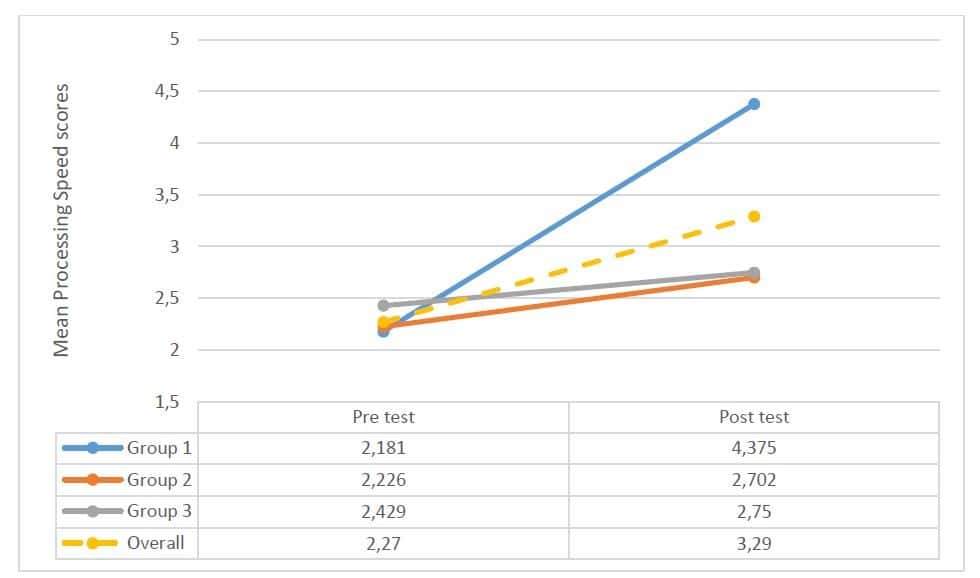
Research supports this approach. A collaborative study involving Edublox, the University of Pretoria, and a primary school in Pretoria investigated the impact of cognitive training on processing speed. Sixty-four Grade 2 students were randomly assigned to one of three groups. One group completed 28 hours of Edublox’s Development Tutor over three weeks, a second group played computer games, and a third group continued with normal school activities.
While all three groups showed some improvement, the Edublox group improved significantly more than the other two groups. Statistical analysis confirmed that exposure to the Edublox program led to significant gains in processing speed.
These findings support earlier research conducted by educational specialist Dr. Lee DeLorge in Ohio. Her study involved 67 students aged 5 to 18 with ADHD, dyslexia, dyscalculia, and non-specific learning disabilities. Ninety-four percent of the participants showed significant improvements in processing speed following Edublox training.
In the interview below, educational specialist Dr. Lee DeLorge explains the importance of cognitive skills and how Edublox helps strengthen them.
Improving processing speed does not simply help learners work faster. It can make reading more fluent, note-taking easier, mental calculations quicker, classroom participation more comfortable, and learning less effortful. In short, strengthening processing speed can help learners make better use of the abilities they already possess.
Key takeaways
- Processing speed is the rate at which the brain takes in, processes, and responds to information.
- Slow processing speed can affect reading, writing, mathematics, attention, and learning.
- A child with slow processing speed may be intelligent and capable but struggle to keep pace with classroom demands.
- Processing speed is a cognitive skill that can be strengthened through targeted intervention.
- Improving processing speed can lead to better academic performance, increased confidence, and more efficient learning.
Edublox provides support for students with dyslexia, dyscalculia, and other learning difficulties. We help students worldwide overcome academic challenges and reach their full potential. Book a free consultation to discuss your child’s learning needs and discover how we can help.
Bibliography:
- Braaten, E., & Willoughby, B. (2014). Bright Kids Who Can’t Keep Up. Help Your Child Overcome Slow Processing Speed and Succeed in a Fast-Paced World. Guilford Press: New York.
- Burgess, K. (2016). Understanding and addressing processing speed deficits in the classroom. LDOnline.org
- Lee, Cynthia Wei-Sheng, PhD; Liao, Chun-Hui, MD; Lin, Cheng-Li, MSc; Liang, Ji-An, MD; Sung, Fung-Chang, PhD; & Kao, Chia-Hung, MD (2015). Depression and risk of venous thromboembolism: A population-based retrospective cohort study. Psychosomatic Medicine.
- Shanahan, M. A., Pennington, B. F., Yerys, B. E., Scott, A., Boada, R., Willcutt, E. G., Olson, R. K., & DeFries, J. C. (2006). Processing speed deficits in attention deficit/hyperactivity disorder and reading disability. Journal of Abnormal Child Psychology, 34, 584-601.
- Stoodley, C. J., & Stein, J. F. (2006). A processing speed deficit in dyslexic adults? Evidence from a peg-moving task. Neuroscience Letters, 399, 264-267.