Table of contents:
- Introduction
- 1. Spaced review
- 2. Frequent low-stakes quizzing
- 3. Dual coding (words + visuals)
- 4. Connect new to known
- 5. Chunk and organize content
- 6. Use storytelling
- 7. Encourage elaboration
- 8. Teach and reteach via multiple modalities
- 9. Metacognitive strategies
- 10. Boost memory through emotion and novelty
- Conclusion: Helping learning stick
Introduction
In today’s classrooms, one of the biggest challenges teachers face is not simply teaching new material, but helping students remember it over time. Too often, knowledge learned on Monday is forgotten by Friday, leaving students frustrated and teachers pressed to reteach the same content again and again.
The solution lies in understanding how memory works. While short-term memory allows students to hold on to information temporarily, it is long-term memory that determines whether knowledge becomes permanent and usable. Retention is the process of keeping that knowledge accessible — the ability to call it up weeks, months, or even years later when it’s needed for deeper learning and problem-solving.
The good news is that decades of cognitive science research give us practical, classroom-tested strategies to strengthen both retention and long-term memory. These strategies don’t require special programs or extra resources — just intentional teaching practices that align with how the brain learns best.
1. Spaced review
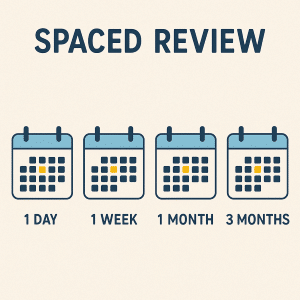
When students encounter new information, it begins to fade quickly from memory if left alone. Reviewing at carefully spaced intervals interrupts forgetting and strengthens the memory trace each time. The spacing gives the brain time to consolidate learning, while recall strengthens connections.
Think of it like weight training: lifting once won’t build muscle, but lifting at intervals with rest in between makes muscles stronger. The same principle applies to memory.
📚 Why it works
- Each recall event strengthens long-term retention.
- Spacing gives the hippocampus time to consolidate memories into the neocortex.
- It combats the forgetting curve described by Hermann Ebbinghaus, meaning less relearning time is needed later.
🎯 Classroom applications
- Daily recap – At the start of each lesson, include 2–3 quick questions from the previous day’s material.
- Weekly review – Dedicate 10 minutes on Fridays to review key concepts from earlier in the week.
- Cumulative quizzes – Build small quizzes that include material from last week, last month, and even earlier in the term.
- Warm-up activities – Post a “Do Now” problem on the board that pulls from older content.
- Spiral curriculum – Reintroduce core ideas throughout the year instead of teaching them once and moving on.
🧪 Examples in practice
- Math: After teaching fractions, review them briefly during decimal lessons, then again during percentages.
- History: Ask students to connect today’s lesson on World War II to events in World War I, which was studied weeks earlier.
- Science: While learning about ecosystems, revisit key vocabulary (like “photosynthesis”) taught at the start of the term.
⚖️ Key point
Little and often beats a lot at once. Revisit the same content at expanding intervals (e.g., Day 1 → Day 3 → Day 7 → Day 21) using quick retrieval (not rereading). Spacing + retrieval is what drives long-term consolidation.
2. Frequent low-stakes quizzing
Frequent, low-pressure quizzes are one of the most potent ways to improve long-term memory. Unlike high-stakes exams, these mini-assessments aren’t meant to judge students but to strengthen recall pathways in the brain. Every time students retrieve knowledge, the memory trace becomes more durable.
📚 Why it works
- Retrieval practice strengthens long-term storage much more than rereading or highlighting.
- Frequent exposure reduces anxiety because testing becomes a regular part of learning.
- Immediate feedback helps correct errors before misconceptions harden into long-term memory.
- Distributed learning (spreading quizzes out) works hand in hand with spaced review.
🎯 Classroom applications
- Exit tickets – A one-question quiz at the end of class (e.g., “What’s the key idea from today’s lesson?”).
- Do now questions – A short review question at the start of the lesson to recall past learning.
- Quick polls or Kahoot! – Gamify recall with digital tools, making quizzes engaging.
- Peer quizzing – Students create and exchange questions; explaining answers reinforces memory.
- Mini whiteboards – Have students write responses and hold them up for instant feedback.
🧪 Examples in practice
- Biology: Every lesson begins with three multiple-choice questions covering material from the last class, last week, and last month.
- Language arts: Use a 5-minute quiz every Friday to recall vocabulary learned throughout the term.
- Math: Daily “one-problem reviews” at the start of class — old material mixed with new.
⚖️ Key point
The “low-stakes” part is essential. Students should feel safe to make mistakes. The purpose is practice, not pressure.
3. Dual coding (words + visuals)
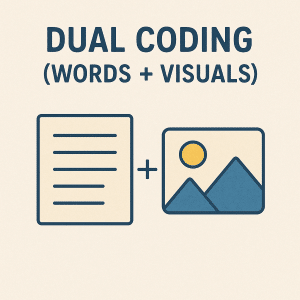
Dual coding theory, proposed by Allan Paivio, suggests that we learn and remember better when information is presented in two formats: verbal (words, text, speech) and non-verbal (images, diagrams, symbols). Each format creates its own memory pathway, and when both are active, recall is stronger because the brain has two ways to retrieve the same information.
📚 Why it works
- Multiple pathways: Words and visuals are processed in different parts of the brain. Using both increases redundancy.
- Stronger connections: Images make abstract or complex ideas concrete.
- Reduced overload: Visuals can simplify information that would be overwhelming if explained only with text.
🎯 Classroom applications
- Diagrams with explanations – For science, show a labeled diagram of the digestive system alongside step-by-step written notes.
- Timelines with narratives – In history, combine a timeline graphic with short text summaries of key events.
- Vocabulary + images – For language learning, show the word “apple” with a picture of an apple.
- Math word problems – Use bar models or number lines to visually represent problems.
- Anchor charts – Post visual-text combinations around the classroom for continual reinforcement.
🧪 Examples in practice
- Geography: Instead of only listing “evaporation, condensation, precipitation,” show the water cycle diagram next to the terms. Students will recall the process more easily when they can “see” it in their mind.
- Literature: Pair a summary of a novel’s plot arc with a story map diagram.
⚖️ Key point
Dual coding doesn’t mean adding random pictures. The visuals must directly reinforce the words. A photo of a lion helps learn about lions — but not for understanding the steps of photosynthesis.
4. Connect new to known
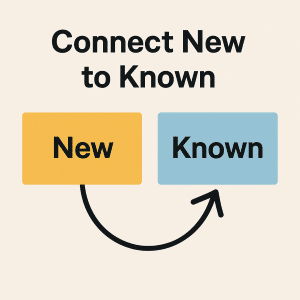
Students don’t learn in a vacuum. Their brains are like networks — every new idea “sticks” more effectively if it can hook into an existing framework of knowledge. When teachers explicitly connect new material to things students already understand, it gives the brain multiple cues for storage and retrieval.
This is called schema building in cognitive science. Schemas are mental structures that organize and interpret information. Expanding an existing schema is much easier than trying to store information without context.
📚 Why it works
- Anchors new content to prior knowledge, making it meaningful rather than abstract.
- Strengthens retrieval paths by giving the brain more than one way to access the memory.
- Boosts the transfer of learning, enabling students to apply old knowledge to new problems.
🎯 Classroom applications
- Analogies and metaphors – Compare a new concept to something familiar (e.g., atoms as “solar systems”).
- KWL charts (Know, Want to Know, Learned) – Before a lesson, ask what students already know and connect it to the new material.
- Review before build – Start each lesson by recalling last week’s content and linking it to today’s topic.
- Use everyday examples – In math, connect fractions to pizza slices or in science, link ecosystems to the schoolyard.
- Concept mapping – Students visually link old and new concepts in a diagram.
🧪 Examples in practice
- History: When teaching the Great Depression, connect it to students’ modern-day experiences of economic hardship (like inflation or job loss in families).
- Science: Teaching electricity? Compare it to water flowing through pipes — something concrete students already understand.
- Language: When learning new vocabulary, show how it relates to words they already know (synonyms, roots, prefixes).
⚖️ Key point
The more connections a teacher helps students make, the stronger and more accessible the memory becomes. New information without connections risks being forgotten — but tied to the known, it has “mental hooks” to hang on to.
5. Chunk and organize content
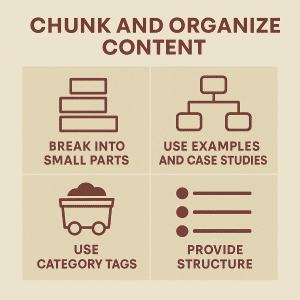
The brain struggles to remember long, unstructured streams of information. But when content is chunked into smaller, meaningful units and organized logically, it becomes far easier to learn and recall.
Think of a phone number: 082 456 7321 is easier to remember than 0824567321 because it’s grouped into chunks. The same principle applies to all learning.
📚 Why it works
- Reduces cognitive load by simplifying information into bite-sized units.
- Helps the brain find patterns — humans are natural pattern-seekers.
- Supports long-term retention because organized material fits into schemas (mental categories).
🎯 Classroom applications
- Grouping vocabulary – Instead of teaching 20 unrelated words, organize them into categories like “food,” “animals,” and “feelings.”
- Breaking texts into paragraphs – Teach students to summarize long passages into main-idea chunks.
- Math concepts – Group related skills (e.g., multiplication + division) before introducing unrelated ones.
- Graphic organizers – Use charts, mind maps, or outlines to show structure.
- “Rule of three” – Present information in threes (e.g., three causes of a war, three steps in a process).
🧪 Examples in practice
- History: Instead of overwhelming students with dozens of causes of World War I, chunk them into three categories: long-term causes (alliances, militarism), short-term causes (assassination of Archduke Franz Ferdinand), and immediate triggers (mobilizations).
- Science: Break the periodic table into categories (metals, non-metals, noble gases) rather than teaching elements as a long list.
- Reading comprehension: Teach students to chunk a text by underlining the main idea of each paragraph, creating a logical outline.
⚖️ Key point
Chunking is about clarity and structure. If information feels overwhelming, it probably hasn’t been chunked well. When content is grouped, categorized, and ordered, students not only understand it better but also remember it longer.
6. Use storytelling
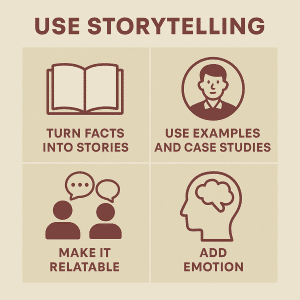
Stories are one of the oldest and most effective ways humans have passed down knowledge. Unlike raw facts, stories engage emotion, imagery, and sequence — all of which make information more memorable. When teachers frame lessons in story form, they give students context and meaning, which helps anchor content in long-term memory.
📚 Why it works
- Emotion boosts retention: Emotional arousal activates the amygdala, which helps encode memories more strongly.
- Sequence gives structure: Stories follow a beginning–middle–end pattern, making information easier to organize in memory.
- Imagery aids recall: Vivid characters, places, and events create mental pictures that stick.
- Relatability connects to prior knowledge: Students remember more when they can place themselves in the narrative.
🎯 Classroom applications
- Turn facts into narratives – Teach scientific discoveries as the story of the scientists who made them. (E.g., Darwin’s voyage on the Beagle.)
- Case studies – In business or history, present real-world examples in story form to illustrate abstract principles.
- Role-play – Students “become” historical figures or novel characters, acting out events.
- Story problems in math – Wrap equations in real-life scenarios (e.g., “Sarah baked 12 muffins and shared them…”).
- Personal stories – Teachers share relevant experiences that connect with lesson content, making learning authentic.
🧪 Examples in practice
- History: Instead of listing causes of the Great Fire of London, tell the story of Thomas Farriner’s bakery where it started, how the fire spread, and how people reacted. Students will recall causes more easily when tied to this narrative.
- Science: Instead of memorizing Newton’s laws, tell the story of the falling apple and Newton’s curiosity about gravity.
- Language arts: Teach literary devices by analyzing how an author builds suspense in a short story rather than only defining terms.
⚖️ Key point
A story transforms dry content into lived experience. The brain is wired to remember experiences — and when a lesson feels like an experience, the knowledge sticks.
7. Encourage elaboration
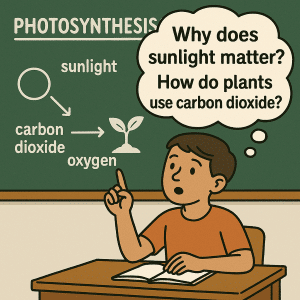
Elaboration means getting students to go beyond surface learning by asking them to explain, connect, and expand on what they are learning. Instead of memorizing facts in isolation, they add detail, create relationships, and answer more profound questions (“Why? How? What if?”). This process strengthens neural connections and increases the likelihood that the information will stick in long-term memory.
📚 Why it works
- Forces deeper processing: Students who elaborate are not just repeating facts; they are reorganizing information in their own words.
- Creates multiple retrieval paths: Explaining a concept in several ways means more “hooks” for later recall.
- Integrates knowledge: New ideas get tied into existing schemas, making them more durable and easier to use in problem-solving.
🎯 Classroom applications
- Ask open-ended questions – Instead of “What is photosynthesis?” ask “Why does sunlight matter in photosynthesis?”
- Elaborative interrogation – Have students explain why a fact is actual (e.g., “Why do leaves change color in autumn?”).
- Think-pair-share – Students explain a concept to a partner before sharing with the class.
- “What if” scenarios – Pose hypothetical situations: “What if the Earth didn’t tilt on its axis—how would seasons change?”
- Student-generated questions – Learners create their own “why/how” questions about the lesson.
- Concept mapping – Have students expand on one central idea with connected sub-ideas.
🧪 Examples in practice
- Science: When teaching electricity, don’t stop at “current flows through a circuit.” Ask: “Why does current stop if the circuit is open?” and “How is this like water flowing in a pipe?”
- History: Instead of memorizing that WWI began in 1914, ask: “Why did alliances make the war spread so quickly?”
- Language arts: While reading a poem, encourage: “How does this image make you feel?” or “Why might the poet have chosen this word?”
⚖️ Key point
Elaboration shifts learning from rote recall to meaning-making. When students explain, expand, and question, they not only remember more but also understand it more deeply — which is the foundation of long-term learning.
8. Teach and reteach via multiple modalities
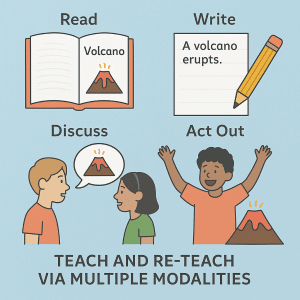
Different sensory channels (visual, auditory, kinesthetic, verbal) help students encode information in multiple ways. When teachers present and revisit material through various modalities, they give students more “entry points” to learning, increasing the chance that the knowledge transfers into long-term memory.
It’s not about labeling kids as “visual” or “auditory” learners (that’s a myth). Instead, it’s about strengthening memory by creating multiple traces in the brain.
📚 Why it works
- Encoding variety: The more ways a concept is experienced, the stronger the memory.
- Reinforcement: Reteaching the same concept differently prevents forgetting.
- Engagement: Switching modalities keeps students active and attentive.
🎯 Classroom applications
- Read → write → wiscuss → act out – For example, in a science lesson on volcanoes:
- Students read about volcanoes in a text.
- Write a short explanation (“A volcano erupts when pressure builds up inside the Earth”).
- Discuss in pairs what causes eruptions.
- Act it out with a model or body movements.
- Math concepts – Teach fractions by:
- Showing a diagram (visual).
- Having students explain aloud (verbal).
- Using fraction tiles or cutting a pizza (kinesthetic).
- Writing problems in a notebook (written).
- Language arts – Learning new vocabulary by:
- Reading the word in context.
- Hearing it in a story.
- Drawing a picture to represent it.
- Using it in a skit.
- History – For the Civil Rights Movement:
- Watch a documentary clip (visual/auditory).
- Read primary source documents.
- Write a diary entry from the perspective of someone living through it.
- Participate in a debate or role-play.
🧪 Examples in practice
A teacher introduces the water cycle:
- Students first watch an animation of evaporation, condensation, and precipitation.
- Then, they label a diagram.
- Next, they discuss in small groups how the cycle affects the weather.
- Finally, they act out the cycle (students as sun, clouds, raindrops).
The cycle is now encoded visually, verbally, socially, and physically — making recall much stronger.
⚖️ Key point
The secret of this strategy is variety with repetition. Students revisit the same idea more than once, but in a different format each time. This prevents boredom while strengthening long-term retention.
9. Metacognitive strategies
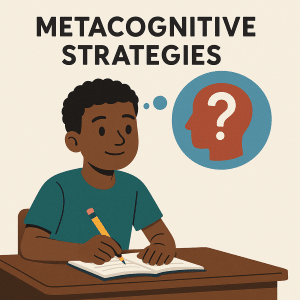
Metacognition means “thinking about thinking.” It’s the ability to monitor, regulate, and direct one’s own learning. When students are aware of how they learn, they become more independent, strategic, and effective.
In simple terms, metacognition is teaching students to plan, monitor, and evaluate their learning.
📚 Why it works
- Improves self-regulation: Students catch themselves when they don’t understand something.
- Strengthens long-term retention: By actively checking what works, they avoid shallow study habits (like rereading without testing).
- Builds independence: They don’t just rely on the teacher; they learn how to learn.
🎯 Classroom applications
- Think-alouds – Teachers model their thinking process while solving a problem (“I don’t understand this part, so I’ll reread the sentence”).
- Learning journals – Students reflect on what strategies helped them learn best that week.
- Checklists – Simple prompts: Did I understand? Did I check my work? Can I explain this in my own words?
- Self-testing – Encourage students to quiz themselves instead of just reviewing notes.
- Error analysis – After a quiz, students analyze mistakes and write how they’ll avoid them next time.
- Goal-setting – At the start of a unit, students set learning goals and revisit them at the end.
🧪 Examples in practice
- Math: Before solving a word problem, a student plans (What strategy will I use?). While solving, they monitor (Am I on the right track?). After solving, they evaluate (Did I get the correct answer? If not, why?).
- Reading: While reading a passage, students stop to ask themselves: Did I understand this? Should I reread? How does this connect to what I already know?
- Writing: Students use a revision checklist: Did I state my thesis clearly? Do my paragraphs support it?
⚖️ Key point
Metacognition is like giving students a mental compass. Instead of wandering through learning, they know where they are, where they’re going, and how to get back on track when lost.
10. Boost memory through emotion and novelty
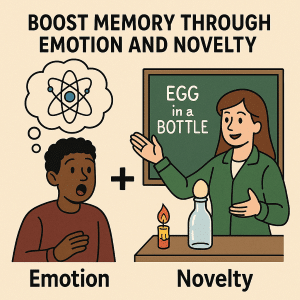
Our brains are wired to remember what matters. If something sparks strong feelings (joy, surprise, fear, curiosity) or is unusual compared to everyday experiences, the brain flags it as “important” and encodes it more strongly.
That’s why students often forget a worksheet but can vividly recall a funny story, an experiment that went wrong, or a surprising fact years later. Emotion + novelty = sticky memory.
📚 Why it works
- Emotion activates the amygdala, which boosts memory consolidation in the hippocampus.
- Novelty grabs attention — when the brain encounters something unexpected, it heightens alertness and focus.
- Together, they create durable, distinct memories that stand out from routine experiences.
🎯 Classroom applications
- Surprising demonstrations – Like the egg-in-a-bottle, Mentos in soda, or a historical reenactment.
- Storytelling with feeling – Tell history through dramatic personal stories instead of dry timelines.
- Humor and fun – A joke, cartoon, or silly skit tied to the lesson makes it unforgettable.
- Role-play and simulations – Let students “live through” a concept (e.g., acting as molecules in a gas).
- Controversial or big questions – Spark emotion with debates like, “Was dropping the atomic bomb justified?”
- Celebrate learning wins – Recognize effort and progress with enthusiasm to attach positive emotion to schoolwork.
🧪 Examples in practice
- Science: Instead of only teaching air pressure in theory, a teacher performs the “crushed can” experiment, where a soda can implodes after being heated and cooled. Students gasp — and remember air pressure forever.
- History: Teaching about the Berlin Wall, the teacher dramatically tapes a line across the classroom and separates students, then tells stories of divided families. Emotion + novelty ensures they’ll never forget it.
- Math: Introducing probability with a coin toss is fine, but using a magic trick that relies on probability creates surprise and curiosity.
⚖️ Key point
When students feel something or see something out of the ordinary, the brain says: “This matters — keep it!” A little emotional spark or novelty turns an ordinary lesson into a lasting memory.
Conclusion: Helping learning stick
Helping students move information into long-term memory is not about adding more work to an already full plate — it’s about teaching in ways that make learning last. By incorporating strategies such as spaced review, retrieval practice, elaboration, and storytelling, teachers can transform lessons from fleeting experiences into durable knowledge that students carry forward.
When students retain what they learn, classroom time is used more effectively. Instead of reteaching the same material over and over, teachers can build on firm foundations and guide learners toward higher-order thinking and deeper understanding.
Most importantly, strengthening retention and long-term memory equips students with confidence and independence. They begin to see learning not as a cycle of forgetting, but as a steady process of growth. That shift — from temporary recall to lasting knowledge — is what truly empowers students for the future.
At Edublox, we believe that every child can succeed — and with the right support, they do. Our programs combine cognitive training with live online tutoring, empowering students with dyslexia and other learning challenges to thrive. Book a free consultation to discuss your child’s learning needs and explore how we can help them reach their full potential.
10 Teaching Strategies to Boost Retention and Long-Term Memory was authored by Sue du Plessis (B.A. Hons Psychology; B.D.), an educational specialist with 30+ years of experience in learning disabilities.