
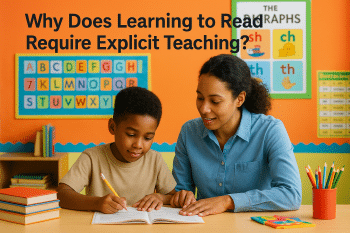
In her book, Teaching Children with Dyslexia: A Practical Guide, Philomena Ott argues that learning to read is not a natural process like learning to speak; it requires systematic, explicit teaching, especially for children with dyslexia. She challenges the notion that immersion in print-rich environments is sufficient, highlighting the complexity of the reading process and the necessity for deliberate instruction.
The mechanics of reading: Why phonics matters
Ott explains that reading involves decoding—translating written symbols into spoken language—and comprehension. For decoding to happen, children must develop phonological awareness, understand the alphabetic principle, and learn phonics systematically. She emphasizes that for many children, particularly those with dyslexia, these skills do not develop incidentally and must be taught directly and explicitly.
She critiques teaching methods that assume children will discover phoneme-grapheme correspondences intuitively. Instead, she advocates for structured phonics instruction where letter-sound correspondences are taught in a logical, cumulative sequence. This structured approach helps children recognize patterns, build orthographic knowledge, and achieve automaticity in reading.
Understanding dyslexic learners
Ott draws on cognitive psychology to explain that dyslexic learners often have deficits in phonological processing, working memory, and processing speed. These difficulties hinder the development of decoding skills unless teachers provide explicit, multisensory instruction. Multisensory teaching integrates visual, auditory, and kinesthetic modalities, reinforcing learning through multiple pathways.
Building fluency and comprehension
She also discusses the need for overlearning—repetition and frequent practice to embed reading skills into long-term memory. For dyslexic learners, consistent reinforcement and structured practice are critical to ensure fluency and retention.
Additionally, Ott emphasizes that reading instruction should include comprehension strategies from the outset. Teaching vocabulary, prediction, summarization, and questioning techniques alongside decoding helps children engage with and understand texts more meaningfully.
Ott makes a case for teacher training. She warns that without adequate knowledge of how reading develops and how dyslexia interferes with this process, educators may unintentionally leave behind students who need structured support the most.
In conclusion, Ott underscores the importance of intentional, evidence-based teaching practices for all learners, especially those with dyslexia. Explicit, structured, and systematic instruction in reading is essential to unlock literacy and foster academic success.