
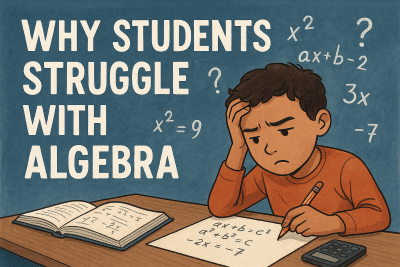
Mathematics has long been regarded as one of the most challenging school subjects. When students reach algebra, many suddenly feel as though they have stepped into unfamiliar territory. Numbers are no longer the only players on the stage — letters, symbols, and rules join the mix. For students who have shaky foundations, this shift can feel like trying to build a house on sand.
The challenge of the “unknown”
One of the greatest hurdles in algebra is the introduction of variables. Letters such as x and y stand in for numbers that are not yet known. This demand for abstract thinking can leave students bewildered. Up to this point, math has been tangible — they could count on their fingers or use concrete tools like counters and beads. Suddenly, they are asked to manipulate symbols that they cannot physically see. Without preparation, it is no wonder some students feel lost.
The importance of a strong foundation
Algebra rests on earlier mathematical knowledge. Students who are not confident in the basics — addition, subtraction, multiplication, division, fractions, decimals, and the order of operations — will stumble when the problems become more complex. These “simple” skills are actually the scaffolding that supports all higher math. Without them, algebra can trigger frustration and even math anxiety, because the tools students need aren’t in place.
Too many rules, too little understanding
Algebra also comes with a long list of rules and procedures. Some students try to cope by memorizing steps without grasping why they work. This approach usually backfires. Under exam pressure, students may ask themselves, What exactly is an inequality? When do I use the distributive property? Why do two negatives make a positive? The result is confusion, errors, and dwindling confidence.
Multi-step problems and memory load
Unlike basic arithmetic, most algebraic problems require several steps to solve. Each step must be carried out in sequence, and a single mistake early on can compromise the entire solution. Students who struggle with sequential memory — the ability to keep steps in order — find this especially taxing. Even those with good memory can feel overwhelmed by the length and complexity of specific problems, which can make algebra seem like a minefield.
The weight of math anxiety
Mistakes are inevitable in math, but in algebra, even a single slip can derail an entire problem. For students who are already nervous, this can heighten math anxiety. They may blank out during tests, avoid practicing, or convince themselves they “just can’t do math.” Over time, fear and self-blame can do more damage than the subject itself.
Progress is possible
Struggling with algebra is not a sign of failure — it is a signal that extra support is needed. Every student has the capacity to learn algebra if provided with the proper foundation, encouragement, and effective strategies. With practice, patience, and tools that make abstract concepts more concrete, students can strengthen their confidence and their skills. Mistakes should be seen as stepping stones, not dead ends.
Algebra may feel intimidating at first, but it is also an opportunity —a chance for students to sharpen their reasoning, resilience, and problem-solving skills. With the proper guidance, what once felt impossible can become manageable — even rewarding.
Edublox offers cognitive training and live online tutoring to students with dyslexia, dysgraphia, dyscalculia, and other learning disabilities. We support families in the United States, Canada, Australia, and beyond. Book a free consultation to discuss your child’s learning needs.
References:
- Artin, M. (2018). Algebra. Pearson.
- Necka, E. A., Sokolowski, H. M., & Lyons, I. M. (2015). The role of self-math overlap in understanding math anxiety and the relation between math anxiety and performance. Frontiers in Psychology, 6.
- Newton, K. J., Star, J. R., & Lynch, K. (2010). Understanding the Development of Flexibility in Struggling Algebra Students. Mathematical Thinking and Learning, 12(4), 282–305.